A groundbreaking clinical trial has reshaped the landscape of interventional pulmonology by demonstrating a remarkable improvement in diagnostic accuracy when employing cryobiopsy compared to traditional forceps in transbronchial lung biopsies. This advancement holds significant implications for patients afflicted with pulmonary nodules, masses, recent lung transplants, and diffuse parenchymal lung disease, promising not only enhanced diagnostic yield but also increased procedural safety.
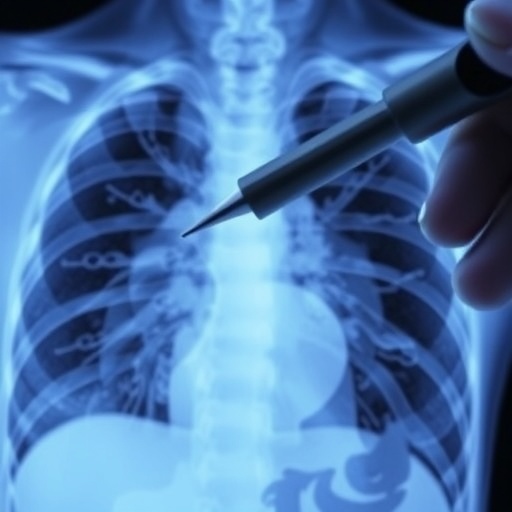
Transbronchial lung biopsy is a minimally invasive diagnostic procedure whereby a bronchoscope—a slender, flexible tube equipped with a light source—is navigated through the patient’s nasal or oral passages deep into the lungs. Through the channel of this scope, physicians introduce various instruments to procure tissue samples for histological examination, a critical step in diagnosing and managing a wide array of pulmonary conditions. Historically, biopsy forceps have been the principal tool for tissue extraction, mechanically gripping and excising tissue. However, forceps tend to compress and crush delicate lung tissue samples, potentially compromising the integrity of the specimens and the accuracy of subsequent pathological analyses.
The emergence of cryoprobe technology signals a paradigm shift in this domain. Cryoprobes operate on the principle of rapid localized freezing, inducing tissue adhesion at the probe tip, allowing for extraction of larger and vastly better-preserved tissue samples without the mechanical trauma inflicted by forceps. The FROSTBITE-2 randomized clinical trial rigorously evaluated this technology, comparing a 1.1-millimeter diameter cryoprobe against the conventional 2.0-millimeter biopsy forceps across 500 patients undergoing transbronchial biopsy for various lung conditions.
Results from this landmark study were illuminating. Overall diagnostic yield was significantly higher with cryobiopsy, reaching an impressive 88.6%, compared to 78.8% with forceps—a near 10 percentage point advantage. The discrepancy was even more pronounced within the subset of patients with pulmonary nodules or masses, where cryoprobe use elevated diagnostic yield to 83.2% versus 70.1% for forceps. Such findings underscore the critical importance of obtaining structurally intact and adequately sized tissue samples, which are more likely to reveal definitive pathological features.
Safety, a paramount concern in bronchoscopic procedures, also favored the cryoprobe. Incidences of pneumothorax—a potentially severe complication involving lung collapse—were markedly reduced in the cryobiopsy cohort, with zero events requiring chest tube intervention, while the forceps group experienced four such cases (1.6%). Moreover, neither significant bleeding nor respiratory failure was reported in either group, highlighting the favorable safety profile of both biopsy methods, but particularly of the cryoprobe.
Fabien Maldonado, MD, MSc, professor of Medicine and Thoracic Surgery and Director of Interventional Pulmonology at the Vanderbilt Lung Institute, articulated the implications succinctly: “Securing a large, undamaged tissue specimen is crucial for accurate diagnosis, which forms the foundation for effective treatment planning in lung disease.” His commentary reflects the clinical imperative driving this research—to refine procedural tools to benefit patient outcomes without escalating risks.
One of the notable advances of the FROSTBITE-2 trial was the use of a smaller diameter cryoprobe (1.1 millimeters) as opposed to previously studied larger probes (1.9 millimeters). While larger cryoprobes had been linked to greater tissue yields, they also carried increased risks of bleeding and pneumothorax. The smaller probe, by virtue of its design, allows tissue extraction through the working channel of the bronchoscope without necessitating withdrawal of the scope itself. This innovation not only enhances patient safety by reducing procedural time and potential complications but also maintains the quality of biopsy specimens.
The reliability of the cryoprobe instruments was corroborated despite a recent FDA Class I recall affecting certain lots due to reports of probe ruptures during activation. Importantly, no such device failures were encountered during the FROSTBITE-2 trial, underscoring stringent quality control and operator vigilance during the study.
This multicenter trial was conducted under the aegis of the Interventional Pulmonary Outcomes Group, a leading international consortium committed to advancing pulmonary care through collaborative clinical research. Dr. Maldonado, who also holds the Pierre Massion Directorship in Lung Cancer Research at Vanderbilt Health, serves as vice chair of this influential group, championing innovation in diagnostic methodologies.
Participating institutions, including nine high-volume U.S. centers such as Vanderbilt University Medical Center, were chosen based on their robust pulmonology programs and expertise, each performing over 100 transbronchial biopsies annually and managing comprehensive care for lung cancer, lung transplant, and interstitial lung disease populations. Patients aged 18 years or older, scheduled for transbronchial biopsy due to pulmonary nodules, lung transplant evaluation, or diffuse parenchymal lung disease, were randomized evenly to undergo biopsy using either the cryoprobe or forceps.
The promising outcomes of FROSTBITE-2 have galvanized efforts to further explore cryobiopsy’s clinical utility. Robert Lentz, MD, Associate Professor of Medicine and Thoracic Surgery at Vanderbilt, emphasized ongoing research with the FROSTBITE-3 trial, which seeks to determine the advantage of cryoprobe-guided biopsies in lymph node sampling and its efficacy in facilitating molecular testing critical for personalized lung cancer therapy.
Financial support for FROSTBITE-2 was provided by Erbe, an international medical technology company specializing in surgical systems. Notably, the funding source maintained no involvement in the study’s design, conduct, data analysis, or publication decisions, ensuring objectivity and scientific rigor.
The advent of the 1.1-millimeter cryoprobe heralds a new era in bronchoscopy, bolstering diagnostic accuracy while simultaneously enhancing patient safety. As lung diseases continue to demand precise and timely diagnosis, tools like the cryoprobe pave the way toward more effective, less invasive, and safer interventions—transforming patient care paradigms and illuminating new paths in pulmonary medicine.
Subject of Research: Diagnostic Approaches in Transbronchial Lung Biopsy Using Cryoprobe Versus Forceps
Article Title: Cryobiopsy vs Forceps for Bronchoscopic Lung Biopsy
News Publication Date: May 18, 2026
Web References:
Article in JAMA
FROSTBITE-2 Clinical Trial
FDA Cryoprobe Recall Notice
Interventional Pulmonary Outcomes Group
References:
The full text of the article is available in JAMA under DOI: 10.1001/jama.2026.7908
Image Credits: Vanderbilt Health
Keywords: Lung cancer, Lung tumors, Transbronchial biopsy, Cryobiopsy, Forceps biopsy, Pulmonary nodules, Interventional pulmonology, Diagnostic yield
Tags: cryobiopsy vs forceps biopsycryoprobe lung biopsy advantagescryoprobe technology in pulmonologydiagnostic accuracy in pulmonologydiffuse parenchymal lung disease diagnosishistological examination lung samplesinterventional pulmonology advancementslung transplant biopsy methodsminimally invasive lung tissue samplingprocedural safety in lung biopsiespulmonary nodule diagnosis improvementstransbronchial lung biopsy techniques