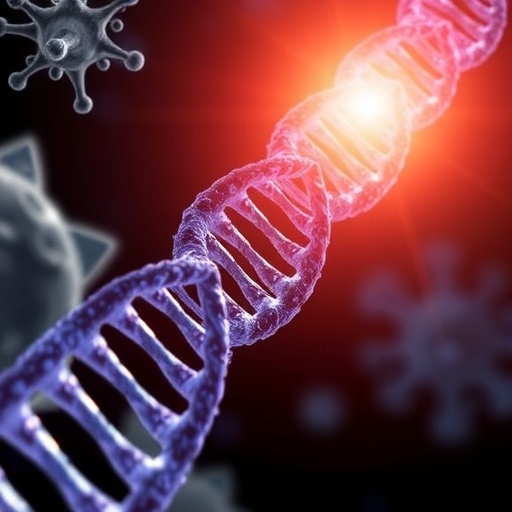
In a groundbreaking study led by the University of Surrey, researchers have unraveled the intricate molecular choreography that underpins DNA’s extraordinary ability to protect itself from the potentially devastating effects of ultraviolet (UV) radiation. This work sheds light on the ultrafast chemical reactions that safeguard the fundamental genetic material, revealing a complex and dynamic network of photoprotective pathways far more sophisticated than previously understood.
DNA is incessantly exposed to UV light from the sun, a form of electromagnetic radiation capable of inducing chemical alterations that can lead to mutations, and thereby raise the risk of cancerous growths. Despite this relentless assault, DNA exhibits remarkable photostability—the capacity to rapidly dissipate absorbed UV energy and revert to a stable, damage-free state before any mutagenic processes can take hold. The molecular mechanisms orchestrating this impressive resilience, however, have remained largely elusive until now.
The collaborative research effort, which combined expertise from the University of Surrey alongside Aix Marseille University, the French National Centre for Scientific Research (CNRS), and Université Claude Bernard Lyon 1, employed advanced quantum chemical simulations to probe these phenomena. By modeling DNA’s behaviour at the atomic scale and in real time, the team succeeded in visualizing the precise sequence of events that occur after DNA absorbs UV photons, particularly focusing on guanine-cytosine base pairs. These base pairs are critical components of DNA’s double helix structure and thus serve as a vital window into understanding the molecular underpinnings of DNA’s inherent photoprotection.
Harnessing state-of-the-art computational techniques, the researchers discovered that following UV excitation, DNA channels the excess energy through a sophisticated series of molecular pathways that involve the concerted transfer of electrons and protons. These transfers occur almost instantaneously—on the timescale of femtoseconds, or quadrillionths of a second—neutralizing the potentially harmful excited states and safely restoring DNA to its ground state. This rapid energy dissipation prevents the formation of photolesions that could otherwise compromise genomic integrity.
Importantly, the study reveals that DNA does not rely on a singular escape route for energy deactivation. Instead, it accesses a rich and competing network of ultrafast relaxation mechanisms. These pathways are characterized by a dynamic interplay between electron movement and proton transfer, which, while closely correlated, are not rigidly coupled. Such flexibility appears to underlie the robustness of DNA’s photoprotection, enabling multiple parallel avenues for energy release that collectively enhance resilience to UV-induced damage.
Dr. Marco Sacchi, Associate Professor of Physical and Computational Chemistry at the University of Surrey and the lead senior author of this research, emphasized the evolutionary significance of these findings. He remarked that DNA’s enduring resilience under constant UV exposure is a tribute to nature’s sophisticated biochemical infrastructure that has evolved over billions of years. The visualization of these ultrafast molecular processes provides unprecedented insight into how DNA preemptively counters photodamage, effectively nipping mutagenic events in the bud.
The lead author, Juliana Gonçalves de Abrantes, a postgraduate researcher at the University of Surrey, highlighted the remarkable diversity and complexity of these relaxation pathways. She explained that the strong yet flexible coupling between electron and proton dynamics results in a multitude of decay channels, thereby providing redundancy and enhancing the reliability of DNA’s protective mechanisms. This multiplicity ensures that even if one pathway is compromised, others can step in to dissipate the energy harmlessly.
These insights carry profound implications beyond basic molecular biology. By better understanding how DNA shields itself from radiation-induced harm, scientists could improve current models of mutation, ageing, and carcinogenesis, potentially informing the development of novel therapeutic interventions. Moreover, these revelations bear weight in the biotechnology field, where UV stability of nucleic acids is a factor in various applications, and could also influence the search for life’s origins and adaptation strategies in astrobiology.
The methodology utilized in the study—high-level quantum chemistry simulations combined with atomic-scale real-time monitoring—sets a new standard for probing biomolecular photophysics. It allows scientists to capture fleeting intermediate states that are otherwise experimentally inaccessible, rendering an intricate atomic ballet visible and measurable. Such techniques promise to deepen our understanding of other photoprotective systems and could spur innovation in designing artificial materials with enhanced UV resilience.
Historically, the photostability of DNA was attributed either to single, dominant relaxation pathways or to relatively simple deactivation mechanisms. This study challenges those earlier notions by unveiling a far richer landscape of molecular processes that work in concert. It attests to the notion that biological systems often employ redundancy and complexity as evolutionary safeguards against environmental chaos.
In conclusion, this pioneering research decisively illustrates that the molecular survival of DNA under solar radiation is governed by a multifaceted network of ultrafast relaxation events that involve a nuanced synergy between electron shifts and proton dynamics. This elegant and elaborate natural design secures the integrity of genetic information, maintaining cellular health and viability in a UV-rich environment—a testament to the resilience and adaptability of life at the molecular frontier.
Subject of Research: Molecular mechanisms of DNA photostability focusing on charge and proton transfer in cytosine–guanine base pairs
Article Title: The Hidden Routes of DNA Photostability: Charge and Proton Transfer in Excited Cytosine–Guanine Tetramers
News Publication Date: 7-May-2026
Web References:
https://pubs.acs.org/doi/10.1021/acs.jpclett.6c00376
http://dx.doi.org/10.5281/zenodo.18456089
Keywords
DNA photostability, ultraviolet radiation, molecular dynamics, charge transfer, proton transfer, quantum chemistry simulations, guanine-cytosine base pairs, photoprotection mechanisms, femtosecond reactions, mutation prevention, DNA resilience, biophysics
Tags: DNA damage and cancer riskDNA mutation prevention pathwaysDNA photoprotection mechanismsDNA photostability molecular basisgenetic material UV resilienceinterdisciplinary DNA research collaborationmolecular choreography of DNA repairphotoprotective pathways in DNAquantum chemical simulations of DNAreal-time atomic scale DNA behaviorultrafast chemical reactions in DNAultraviolet radiation DNA damage