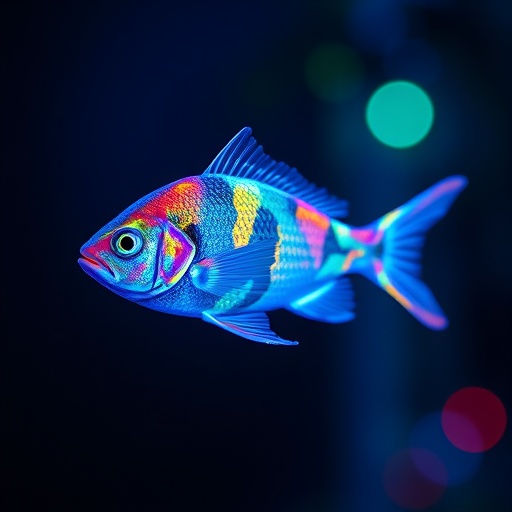
Deep beneath the ocean’s surface, where sunlight cannot penetrate, a remarkable natural phenomenon thrives in the form of bioluminescence—light produced by living organisms. Among these extraordinary creatures is the slender fangjaw (Sigmops gracilis), a deep-sea fish equipped with specialized photophores, light-emitting organs that enable it to generate its own illumination. For decades, scientists have marveled at the bioluminescent displays underwater, but new research sheds light on the complex optical mechanisms behind this natural glow, uncovering layers of crystalline guanine platelets that do far more than merely reflect light. These structures scatter and recycle the emitted bioluminescence to maximize its efficiency, a discovery with profound implications for biomimetic technology.
Bioluminescence, which is present in approximately 75% of marine organisms, serves vital ecological functions ranging from communication and mating to predation and defense. The light is produced within photophores, specialized organs uniquely adapted to generate and regulate light emission. However, while the photophores serve as the biological light source, the surrounding structural elements—particularly arrays of crystalline guanine platelets—play a crucial role in manipulating the light’s behavior. These guanine crystals form layered arrangements on the surface of photophores, acting as sophisticated optical materials that enhance the visibility and directionality of the emitted light.
In a groundbreaking study published in the journal Biointerphases, a researcher from Hiroshima University, Masakazu Iwasaka, has explored the subtle and intricate ways guanine platelets contribute to bioluminescent efficacy in the slender fangjaw. Rather than simply reflecting the light, as previously supposed, the guanine layers scatter and redirect it in highly complex patterns. This scattering is facilitated by the unique shape and organization of the guanine platelets, which are needle-shaped and locally clustered. The interaction between the light and these anisotropic crystalline structures leads to a highly directional and efficient light emission, optimizing how the fish uses its bioillumination to interact with its environment.
Iwasaka’s research is rooted in a combination of field observations and laboratory analyses. Intriguingly, it was during expeditions on a deep-sea research vessel that Iwasaka realized laboratory studies alone could not capture the full extent of these phenomena. This realization opened a novel research direction focused on biomimetics—the design and production of materials and systems inspired by biological entities. In this case, the deep-sea fish’s light-emitting organ offered inspiration for creating artificial illumination systems that recycle light rather than waste it.
Central to the study is the concept of anisotropic reflection, a property exhibited by guanine platelets wherein light reflection varies depending on the angle of incidence. This means the direction from which light arrives significantly affects how it is scattered or reflected. In slender fangjaw photophores, anisotropic reflection is pronounced, enabling the fish to control light emission with a precision that was previously unrecognized. Iwasaka’s meticulous experimental work demonstrated that guanine crystals’ orientation and morphology directly influence this optical behavior.
Earlier studies led by Iwasaka on guanine plates in goldfish elucidated how these crystals functioned as tiny mirrors, reflecting light in a specific anisotropic manner due to their slightly tilted configuration. However, in the slender fangjaw, the crystals exhibit a different mechanism. They act more like prisms than mirrors, refracting and redirecting light rather than simply reflecting it. The crystals’ high aspect ratio and their layered formations create properties akin to photonic crystals, which are materials engineered to affect the motion of photons in innovative ways. This biological photonic crystal arrangement efficiently enhances the slender fangjaw’s bioluminescence by recycling leaked light.
To delve deeper into these optical properties, Iwasaka employed electromagnets to precisely manipulate the orientation of the guanine crystals in experimental setups. By exposing the crystals to external light sources at various angles and measuring the scattered light patterns, the study uncovered how the crystals’ orientation governs optical output. This approach not only demonstrated the complex functionality of these platelets but also suggested potential applications beyond marine biology, particularly in biomedical device design where efficient light control in aqueous environments is critical.
The efficiency of light utilization observed in bioluminescent organisms like the slender fangjaw may inspire new materials and technologies in fields such as medical imaging, phototherapy, and implantable devices. By mimicking the structural organization and optical behavior of guanine platelets, engineers could develop devices capable of maximizing internal light recycling, reducing energy waste, and improving performance in challenging environments like the human body.
The significance of this research lies not only in understanding a fascinating biological feature but also in demonstrating that nature’s solutions to problems of light manipulation can revolutionize human technology. The study enriches the growing field of biomimetics by providing a model of natural photonic structures that optimize illumination through light scattering and anisotropic reflection, signaling the potential for breakthroughs in optical materials science.
Despite the challenges inherent in obtaining deep-sea specimens and conducting in situ studies, the insights gleaned are invaluable. Iwasaka emphasizes that continuing to investigate guanine platelet formation and function across various fish species will likely uncover a wealth of knowledge, setting the stage for future innovation inspired by evolutionary designs.
This research illustrates the power of interdisciplinary approaches, combining physics, biology, materials science, and engineering to decode and apply the secrets of natural light emission. As the study on slender fangjaw guanine platelets reveals, the interface between living organisms and physical phenomena offers untapped reservoirs of inspiration for the next generation of optical technologies.
In an era where ecological and technological challenges demand sustainable and innovative solutions, examining the optical prowess of bioluminescent deep-sea fish transforms from a niche marine biology investigation into a beacon for technological advancement. This research underscores the importance of continuing scientific exploration at all layers of the natural world, from the deepest oceans to engineered environments on the human scale.
Subject of Research: Biomimetic light manipulation inspired by guanine platelet structures in deep-sea bioluminescent fish
Article Title: Biomimetic illumination enhancement inspired by guanine platelets in the photophore surface of the deep-sea bristlemouth Sigmops gracilis
News Publication Date: May 26, 2026
Web References: https://doi.org/10.1116/6.0005382
Image Credits: Masakazu Iwasaka
Keywords: Bioluminescence, Guanine Platelets, Deep-sea Fish, Biomimetics, Photophores, Light Scattering, Anisotropic Reflection, Photonic Crystals, Optical Materials, Biomedical Devices
Tags: bioluminescence in marine organismsbioluminescent fish light scattering mechanismsbiomimetic applications of bioluminescencedeep ocean light emission biologyecological roles of marine bioluminescenceguanine platelets optical propertieslight recycling in bioluminescent animalsmicrocrystals in deep-sea bioluminescenceoptical structures in deep-sea creaturesphotophores in deep-sea fishprism-like light manipulation in fish