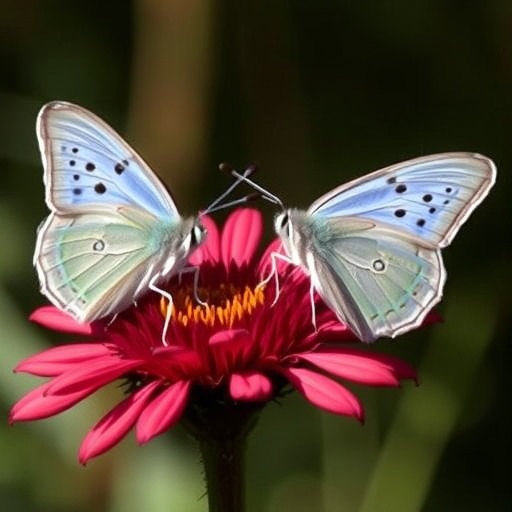
A recent study from Osaka Metropolitan University has shed new light on the intricate relationship between invasive plant species and the reproductive ecology of a near-threatened butterfly, the Fischer’s Blue (Tongeia fischeri). This butterfly, native to Japan, demonstrates fascinating ecological adaptability by utilizing both indigenous and alien plants as larval hosts. However, this adaptability might carry unforeseen consequences at the level of adult phenotype and behavior, particularly through subtle yet crucial modifications in wing coloration, which plays a pivotal role in mating dynamics.
Butterfly wing coloration is more than mere aesthetic—it serves as a vital visual signal central to sexual selection. In many Lepidoptera species, wing colors and patterns influence mate recognition and mate choice. The underlying pigments and structural features responsible for coloration can be shaped during the larval stage, often contingent on the chemical and nutritional composition of the host plant. While this connection has been hypothesized broadly, prior to this investigation, no empirical evidence existed for T. fischeri regarding how non-native host plants might impact adult wing appearance and, by extension, mating behavior.
Professor Norio Hirai’s team embarked on a meticulous experimental study to interrogate this potential host effect. Larvae of Fischer’s Blue were reared on two distinct plants: the native Orostachys japonica—known colloquially as Japanese Dunce Cap—and the invasive Sedum sarmentosum. Both plants serve as larval food sources in natural settings, but Sedum sarmentosum’s proliferating presence raises ecological concerns. Researchers compared key life-history traits including oviposition preference, growth rate, and pupal weight, all fundamental parameters indicating larval host suitability.
Interestingly, the results revealed no statistically significant differences in these conventional life-history metrics between larvae reared on native versus invasive hosts. Growth performance and female oviposition preference remained largely unaffected by the plant species consumed during the larval stage. This suggests that Sedum sarmentosum can sustain larval development comparably well, indicating that the invasive plant’s nutritional profile does not directly impair survival or fecundity capabilities.
However, when the investigation shifted focus to adult wing phenotype, more nuanced and meaningful differences emerged. Utilizing high-resolution imaging, the team captured both visible light and ultraviolet photographs of adults’ ventral wing surfaces. Remarkably, butterflies reared on the native O. japonica exhibited a distinctively yellowish hue with lower ultraviolet reflectance, contrasting with the grayer and higher UV-reflective wings of those reared on the invasive host. Spectral reflectance measurements confirmed these colorimetric disparities, implicating larval nutrition or secondary metabolites as modulators of adult wing coloration.
Such optical changes carry significant ecological implications. Fischer’s Blue males in the wild were observed during mate choice experiments, where a clear preference manifested for conspecifics that emerged from larvae fed on native plants. Males initiated considerably more mating contacts with yellowish, low-UV-reflecting individuals, which signals that wing coloration acts as a cue influencing sexual selection. This behavioral bias may ultimately affect gene flow and population dynamics by favoring butterflies emergent from native host plants over those from invasive hosts.
This study thus underscores a subtle but critical indirect effect of invasive species on native pollinators and herbivores. While invasive plants like Sedum sarmentosum can sustain larval growth adequately, their biochemical impact on adult phenotypic traits, notably wing coloration, can cascade into altered reproductive behavior and potential fitness consequences. The phenomenon exemplifies a cryptic threat to biodiversity, wherein mutualistic or neutral plant-insect interactions are destabilized by changes to visual signaling, which is vital for mate recognition and reproductive success.
Karen Hisai, the first author, emphasized the broader ecological concern: as invasive plants continue to spread globally, similar influences on other insect species may be pervasive albeit underrecognized. This research highlights the importance of integrating chemical ecology, vision science, and behavioral ecology to fully understand how anthropogenic environmental change affects wildlife populations, particularly those already under threat.
Professor Hirai remarked that these findings offer a model to illuminate the intricate and often indirect ways invasive species depress native biodiversity. Conservation strategies should incorporate the ecological complexity of visual communication systems impacted by habitat alterations in order to preserve endangered species effectively.
The study also prompts further inquiry into the molecular and physiological mechanisms by which host plant species influence pigmentation pathways during metamorphosis. Future work may explore how larval diet-induced changes in pigment biosynthesis or wing scale nanostructure modulate spectral properties visible in both human and insect visual ranges.
In conclusion, the research advances scientific understanding of the ecological consequences stemming from invasive flora beyond mere resource competition. By revealing how larval host plants shape adult butterfly wing coloration and associated mating preferences, this work provides a cautionary tale about the hidden ramifications of environmental change on species survival and evolution.
Published in the journal Basic and Applied Ecology, this pioneering work by Osaka Metropolitan University researchers not only enriches lepidopteran biology but also elevates the discourse on invasive species management and insect conservation in the face of accelerating global environmental change.
Subject of Research: Animals
Article Title: Effects of alien host plant on wing coloration and mating behavior of an endangered butterfly
News Publication Date: 21-Feb-2026
Web References: https://www.omu.ac.jp/en/
References: Basic and Applied Ecology, DOI: 10.1016/j.baae.2026.02.003
Image Credits: Osaka Metropolitan University
Keywords: invasive species, butterfly wing coloration, Fischer’s Blue, Tongeia fischeri, host plant effects, reproductive behavior, ultraviolet reflectance, Lepidoptera ecology, conservation biology, chemical ecology, mating preference, environmental change
Tags: butterfly conservation and habitat changesbutterfly larval host plant adaptationbutterfly mating behavior and wing colorecological consequences of invasive plantsFischer’s Blue butterfly wing colorationimpact of non-native host plants on butterfliesinvasive plant species effects on Lepidopteralarval diet influence on adult butterfly phenotypeplant-insect interactions in butterfly developmentreproductive ecology of near-threatened butterfliessexual selection in butterfliesTongeia fischeri ecological study