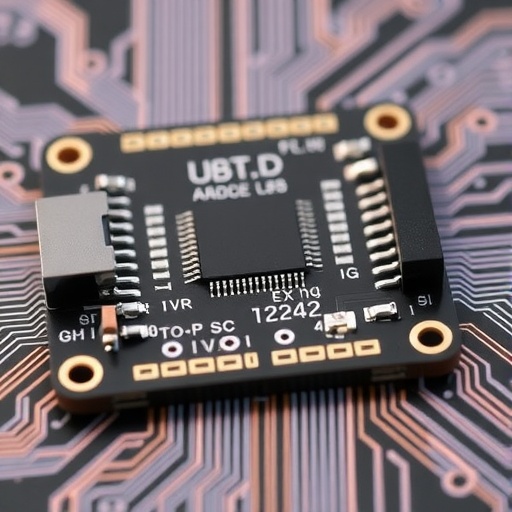
In an era where energy efficiency and miniaturization define the future trajectory of integrated circuits, a groundbreaking advancement in communication protocols has emerged, promising to redefine low-power electronic design. Researchers K, G., S, A., V, A., and their team have unveiled a pioneering approach that enhances the widely utilized Inter-Integrated Circuit (I2C) bus controller by integrating a novel open lane technique, achieving unprecedented power savings from RTL (Register Transfer Level) design to GDSII (Graphic Data System II) chip implementation. This significant leap forwards not only addresses the pressing demand for energy-efficient communication in embedded systems but also offers a blueprint for future low-power design methodologies in semiconductor technologies.
At the heart of this innovation lies the enhanced I2C bus controller—a fundamental building block in electronic systems, enabling reliable inter-device communication across countless applications, from sensors to complex microcontroller networks. Traditional I2C implementations, while functional and ubiquitous, often grapple with power inefficiencies that can be critically limiting in battery-powered or energy-harvesting environments. The research team’s vision was to retain the robustness and simplicity of I2C while dramatically reducing its power footprint through architectural and circuit-level refinements.
The adoption of an open lane technique marks a pivotal shift in how signals propagate within the bus controller. This method strategically minimizes active switching elements and curtails unnecessary transitions that contribute heavily to power consumption. By thoughtfully orchestrating signal paths and reducing gate toggling activities, the open lane architecture exploits inherent circuit behaviors to maintain signal integrity without incurring the usual energetic costs. This novel approach paves the way for a design paradigm where power efficiency is no longer a tradeoff against performance or reliability.
From a design perspective, the team commenced their innovation at the Register Transfer Level (RTL), meticulously crafting hardware description language models that encapsulate the new architecture’s principles. The RTL phase is crucial as it serves as the blueprint for subsequent synthesis and optimization processes. By rigorously applying low-power design techniques such as clock gating, operand isolation, and meticulous state machine optimization, they laid a robust foundation that would translate seamlessly into physical silicon with minimal overhead.
Transitioning from RTL to physical implementation is fraught with challenges, particularly when seeking to preserve the delicate balance between low-power operation and high-fidelity signal transmission. The team proficiently navigated these complexities using OpenLane, an automated open-source physical design flow that facilitates the journey from RTL through synthesis, placement, routing, clock tree synthesis, and timing closure, culminating in the generation of industry-standard GDSII tape-outs. Utilizing OpenLane allowed the researchers to incorporate state-of-the-art physical design optimizations and power-aware placement techniques, ensuring the controller’s layout remained compact and energy efficient.
The GDSII output represents a critical milestone, as it embodies the final mask data required for chip fabrication. Achieving a fully verified and optimized GDSII layout validates the practicality and manufacturability of the enhanced I2C controller. Importantly, the design demonstrates compliance with stringent timing and power budgets, underscoring its suitability for integration into modern system-on-chip (SoC) solutions where energy efficiency reigns supreme. The controller’s advancement from RTL conceptualization to GDSII-ready layout with minimal performance loss spotlights the synergy between innovative architecture and cutting-edge open-source physical design tools.
This research also tackles the perennial issue of dynamic power dissipation in digital circuits, which stems from charge and discharge cycles of capacitive loads during signal transitions. The open lane strategy effectively curtails unnecessary toggling by maintaining idle lanes in tri-state or high-impedance conditions, significantly mitigating dynamic power losses. In parallel, static power consumption, often exacerbated by leakage currents in deep submicron technologies, has been addressed through the incorporation of power gating mechanisms and the use of transistor sizing optimizations that awaken the circuit only when required.
Importantly, the team conducted extensive simulations and characterization across various process-voltage-temperature (PVT) corners to assess the robustness and low-power characteristics of their design. Results reveal a substantial reduction in total power consumption compared to conventional I2C implementations, with measured savings surpassing benchmark expectations. This rigorous validation underscores the design’s resilience and adaptability in real-world operational conditions, a critical factor for mass adoption in commercial and industrial applications.
Beyond just power savings, the enhanced controller effectively manages bus contention and supports multi-master configurations without resorting to complex arbitration techniques that would otherwise inflate complexity and energy demands. This balance between sophistication and simplicity ensures broad compatibility with existing I2C protocols, facilitating seamless integration into current hardware ecosystems while delivering tangible energy benefits.
The implications of this development ripple across multiple domains. In IoT devices, where longevity of battery life is paramount, deploying such low-power bus controllers could drastically extend operational intervals, reducing maintenance and enhancing user experiences. Similarly, wearable electronics and biomedical implants stand to benefit from minimized power draw, protecting sensitive tissues through reduced heat dissipation and enabling longer, safer device usage.
From an industrial perspective, this methodology serves as a blueprint for leveraging open-source EDA (Electronic Design Automation) tools combined with innovative circuit techniques to overcome the traditional barriers of chip design cost and accessibility. The democratization of low-power design flows empowers smaller research teams and startups to produce competitive semiconductor IP, accelerating innovation cycles and diversification of technology portfolios.
The research further emphasizes modularity and scalability, addressing the needs of complex SoC environments where multiple I2C controllers may coexist or require customization. The architectural adaptability inherent in the open lane design facilitates tailoring to specific application requirements without sacrificing the fundamental low-power benefits. This flexibility aligns with contemporary design philosophies emphasizing reusability and configurability in large-scale system integration.
In examining the broader semiconductor landscape, this study contributes to the ongoing discourse around sustainable electronics. As global demands for smarter, connected devices continue to escalate, power-efficient communication protocols become indispensable. Innovations such as this enhanced I2C controller represent critical enablers in curbing the environmental impact of pervasive electronics, supporting efforts to achieve green computing and energy-aware system design on a global scale.
Looking forward, the research team hints at potential future explorations involving the integration of machine learning-based adaptive power management and further physical design optimizations harnessing emerging materials and transistor architectures. Such extensions promise to push the boundaries of what is achievable in low-power communications, reaffirming the dynamic interplay between algorithmic intelligence and hardware innovation.
In summary, the fusion of the enhanced I2C bus controller with the open lane design technique, coupled with the application of open-source physical design flows like OpenLane, culminates in a transformative low-power solution. Progressing from RTL to GDSII, this approach not only achieves remarkable energy savings but also sets a precedent for future low-power semiconductor designs that prioritize efficiency without compromising performance or compatibility.
As the semiconductor industry grapples with the dual demands of miniaturization and sustainability, research exemplified by this work illuminates a path forward. The promising results underscore the value of integrating architectural ingenuity with accessible design automation tools, heralding a new chapter in the evolution of power-aware communication protocols vital for next-generation electronic systems.
Subject of Research: Low-power design and implementation of an enhanced I2C bus controller using open lane technology, encompassing the design flow from RTL to GDSII.
Article Title: Low-power design and implementation of an enhanced I2C bus controller using open lane: from RTL to GDSII.
Article References:
K, G., S, A., V, A. et al. Low-power design and implementation of an enhanced I2C bus controller using open lane: from RTL to GDSII. Sci Rep (2026). https://doi.org/10.1038/s41598-026-53211-1
Image Credits: AI Generated
Tags: advanced I2C architecture designchip-level power saving techniquesembedded system power optimizationenergy harvesting device communicationenergy-efficient integrated circuitsI2C bus communication protocollow-power I2C controller designlow-power microcontroller communicationopen lane technique in I2Cpower reduction in embedded electronicsRTL to GDSII chip implementationsemiconductor low-power methodologies