


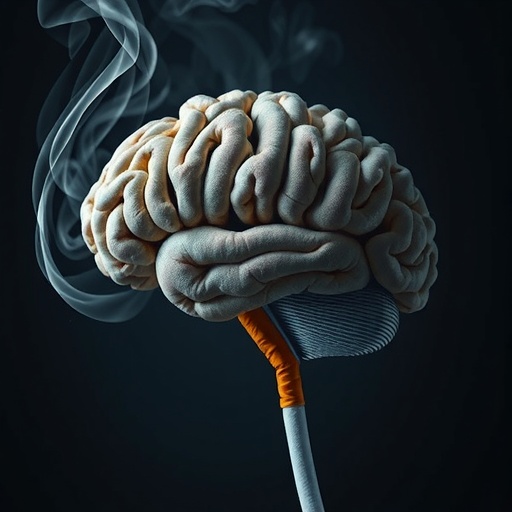
In the relentless battle against tobacco addiction, researchers have long grappled with the brain’s intricate role in nicotine dependence and resistance. For many, quitting smoking transcends simple willpower, becoming a profound neurological struggle between the brain’s craving circuits and its capacity for self-control. Groundbreaking research led by Xingbao Li, M.D., at the Medical University of South Carolina’s Hollings Cancer Center introduces a promising new frontier: the precise modulation of brain activity using repetitive transcranial magnetic stimulation (rTMS) to reshape these competing neural pathways.
This innovative technique, rTMS, delivers targeted magnetic pulses noninvasively to circuits deep within the brain, effectively altering neuronal activity. While traditional cessation methods, including pharmacological aids and behavioral therapies, have achieved limited long-term success, this approach considers the biological substrate of addiction—a dynamic imbalance between craving-driven and control-related brain systems. The study, recently published in the Journal of Psychiatric Research, explored how stimulating discrete regions associated with decision-making and reward processing can influence smoking behavior.
The core hypothesis rests on two key brain regions. First is the dorsolateral prefrontal cortex (DLPFC), a prefrontal area heavily involved in executive functions such as impulse control, decision-making, and moderating inappropriate behaviors. The other focal point is the medial orbitofrontal cortex (mOFC), central to processing rewards and craving sensations. By leveraging rTMS to either reinforce the DLPFC or suppress the mOFC, researchers aimed to understand which neural manipulation more effectively diminishes cigarette consumption.
In a rigorously designed clinical trial, adult smokers actively seeking to quit were randomized into three groups: one received high-frequency rTMS targeting the DLPFC with the goal of augmenting self-regulatory control; a second group underwent rTMS aimed at downregulating activity in the mOFC to directly tamp down craving signals; and a control group was given a sham treatment to serve as a placebo baseline. Sessions were administered over a three-week period, with each participant receiving 15 rTMS treatments. Functional brain imaging ensured stimulation precision, embodying a true precision medicine paradigm personalized to individual neuroanatomy.
The results were compelling. Participants who underwent DLPFC-focused stimulation demonstrated a profound reduction in cigarette consumption, quitting on average more than 11 cigarettes daily – a statistically and clinically significant outcome when compared to both sham and mOFC-targeted groups. Moreover, these subjects reported lower craving intensity and exhibited decreased carbon monoxide biomarkers, objectively verifying their reduced intake. Perhaps most excitingly, these benefits persisted at least one month post-intervention, suggesting durable neuroplastic changes within executive control circuitry that outlasted the active treatment phase.
Neuroimaging elucidated the underlying mechanisms of this success. Enhanced activity in the prefrontal cortex was accompanied by suppressed engagement of reward-related brain areas including the orbitofrontal cortex, highlighting a top-down modulatory effect where re-energizing control networks yields a secondary dampening of craving signals. Notably, the extent of these neural shifts directly correlated with the degree of reduction in smoking behavior, reinforcing the causal implication of brain circuit modulation in achieving cessation.
Conversely, efforts to reduce cigarette use via direct inhibition of the mOFC, aimed at suppressing craving, did not yield comparable behavioral or biological improvements. This finding underscores a vital insight: addiction is not solely a function of excessive craving activation but also a failure in the brain’s capacity to exert inhibitory control. Enhancing self-regulatory mechanisms surpasses attempts to blunt craving in reversing smoking habits.
The implications of this research are far-reaching, particularly for populations where traditional cessation interventions have failed. Many smokers experience intolerable side effects with pharmacotherapies or relapse despite repeated quit attempts. For cancer patients and others facing acute health risks exacerbated by smoking, novel tools that intervene at the neural circuit level hold transformational potential. The Hollings Cancer Center’s existing Tobacco Treatment Program, which integrates counseling and medication, could be complemented by rTMS to target addiction’s neurological roots more precisely and effectively.
This study signals a new era where personalized neuromodulation becomes an integral part of addiction medicine. Harnessing the brain’s plasticity, it redefines cessation as an achievable neurological realignment rather than mere behavioral modification. Although constrained by a modest sample size, these findings justify larger-scale clinical trials now underway to confirm therapeutic efficacy and optimal treatment regimens tailored to individual neural profiles.
Ultimately, the strategy emerging from this research champions restoring balance within the brain’s competing systems. Rather than suppressing cravings directly, empowering the brain’s natural control systems to override the lure of nicotine establishes a more sustainable path to quitting. It is a shift from defensive to proactive intervention—the brain is taught to say no.
In an age when smoking remains a leading preventable cause of death worldwide, these advancements breathe fresh hope into the cessation landscape. Repetitive transcranial magnetic stimulation targeting the dorsolateral prefrontal cortex may soon join the arsenal of evidence-based strategies that help millions break free from the grip of nicotine dependence, offering a science-driven, neurocentric approach that aligns with the modern understanding of addiction as a brain disease.
Subject of Research: People
Article Title: DLPFC rTMS is more effective than sham or orbitofrontal stimulation for smoking cessation and alters frontal brain activity: A double-blind, sham-controlled randomized clinical trial
News Publication Date: 4-Mar-2026
Web References: http://dx.doi.org/10.1016/j.jpsychires.2026.02.053
Image Credits: Medical University of South Carolina
Keywords: Brain stimulation, Transcranial magnetic stimulation, Brain, Dorsolateral prefrontal cortex
Tags: brain craving circuits for nicotinedorsolateral prefrontal cortex role in addictionexecutive function in addiction controlinnovative treatments for smoking addictionmedial orbitofrontal cortex and reward processingneural pathways in nicotine dependenceneurobiological basis of tobacco cravingneuromodulation in tobacco addictionnoninvasive brain stimulation techniquesovercoming nicotine addiction through brain modulationrepetitive transcranial magnetic stimulation for smoking cessationrTMS effects on decision-making brain regions

