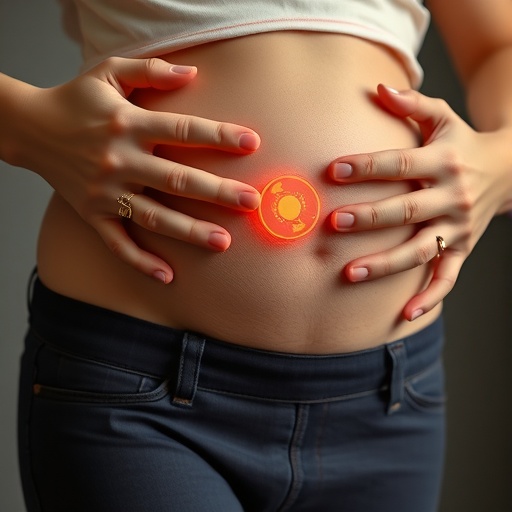
In a groundbreaking leap for reproductive endocrinology, researchers have unveiled a novel approach that could redefine how fertility issues are diagnosed and treated in both men and women. Traditional hormone tests often capture static snapshots, missing the intricate rhythms governing hormone fluctuations essential for reproductive health. Now, utilizing an innovative wearable skin sensor patch combined with artificial intelligence (AI), scientists can monitor the dynamic ebb and flow of reproductive hormones in real time, heralding a potential revolution in the early detection of infertility.
Infertility remains a perplexing challenge, affecting an estimated 15 to 30 percent of couples worldwide with no discernible cause after standard clinical evaluations. For men, infertility or hypogonadism (characterized by clinically low testosterone levels) is commonly assessed through a single serum testosterone measurement taken in the morning. Women, conversely, undergo tests focused on menstrual cycle regularity and reproductive hormone levels such as luteinizing hormone (LH), follicle-stimulating hormone (FSH), estradiol, and progesterone. However, the conventional approach overlooks the fact that these hormones exhibit pronounced circadian and ultradian rhythms—patterns of secretion that vary systematically over minutes, hours, and days.
In a pivotal study conducted by Dr. Tinatin Kutchukhidze and colleagues at Oxford University and New Anglia University, 102 men aged 22 to 38 with clinically normal morning testosterone levels were monitored continuously for four days using this new AI-enhanced wearable sensor. These men, from both the UK and Georgia, included individuals with symptoms of hypogonadism or infertility alongside healthy controls. The device collected testosterone data every 15 minutes, enabling an unprecedented real-time acuity into androgen dynamics. The findings were revelatory: despite normal testosterone levels on traditional tests, men exhibiting symptoms demonstrated marked disruptions in their testosterone rhythmicity, characterized by diminished diurnal amplitude and irregular peaks. These rhythm abnormalities strongly correlated with reduced sperm counts and clinical manifestations of androgen deficiency.
Dr. Kutchukhidze emphasized, “Our technology enables the first continuous, non-invasive tracking of testosterone rhythms in men over several days. This disrupts long-standing assumptions that a normal morning serum testosterone is adequate to exclude androgen deficiency. Instead, our work reveals that the timing and synchronization of hormone fluctuations, not just their quantity, is critical in male reproductive health.” The AI system’s integrated algorithms quantify key parameters of hormone dynamics, such as amplitude, phase delays, and variability, providing clinical insights beyond static hormone levels.
Parallel research explored female reproductive endocrinology by deploying an AI-derived metric termed Endocrine Rhythm Integrity (ERI). Studying 312 women aged 18 to 22 with self-reported regular menstrual cycles—including both fertile participants and those with unexplained infertility—researchers collected extensive hormonal profiles across the luteal phase, alongside physiological data such as basal body temperature, heart rate, and sleep patterns via wearables. ERI synthesizes these data streams to assess the coherence, phase synchrony, and feedback stability of hypothalamic-pituitary-ovarian (HPO) axis hormone dynamics across the menstrual cycle.
Even though traditional markers such as cycle length and mid-luteal progesterone levels appeared normal, ERI scores were substantially lower in women experiencing unexplained infertility. This novel metric demonstrated superior predictive power for infertility, outperforming classical indicators like cycle length and single-time hormone measurements. Intriguingly, ERI also correlated inversely with histories of implantation failure, suggesting that subtle disruptions in hormonal timing and synchronization may underlie failed pregnancies previously attributed to idiopathic causes.
The implications of ERI are profound. Dr. Kutchukhidze explained, “Rather than treating hormone levels as isolated data points, ERI reframes menstrual health as a property of rhythmic endocrine organization. This paradigm shift could enable clinicians to detect subclinical reproductive dysfunction earlier and with greater accuracy than ever before.” Such a rhythm-based diagnostic approach could enhance personalized fertility interventions by focusing on restoring optimal timing and interplay among reproductive hormones.
Together, these pioneering studies suggest that reproductive endocrine disorders may fundamentally be disorders of hormonal dynamics—disruptions in timing, synchrony, and biological rhythms—rather than mere deficits in hormone concentrations. This conceptual evolution challenges the prevailing clinical framework that relies heavily on static measurements and opens new vistas for rhythm-informed diagnostics and therapies.
Looking forward, Dr. Kutchukhidze and her team aim to validate these AI-driven tools in larger and more ethnically diverse populations, investigating their utility across a spectrum of reproductive conditions. By incorporating rhythm-based metrics into fertility care, the goal is to develop predictive, personalized treatment strategies that intervene before infertility manifests clinically, potentially improving conception success rates.
Beyond fertility, this technology holds promise for other realms of endocrine health. The continuous, real-time hormone monitoring platform could transform transgender medicine, an area that currently depends on intermittent blood tests that inadequately capture hormone fluctuations. The AI-assisted wearable device could enable precise, adaptive management of hormone therapy in transgender individuals, aligning treatments more closely with physiological dynamics and improving outcomes.
Moreover, the integration of wearable chronodiagnostics into clinical practice could extend to broader applications in endocrinology, including timing-optimized hormone therapies for various conditions. As Dr. Kutchukhidze articulated, “Our long-term vision is to establish wearable hormonal rhythm monitoring as a new standard across reproductive medicine, personalized endocrinology, and transgender healthcare—ushering in a patient-centered era of rhythm-based diagnosis and therapeutic decision-making.”
These advances represent a convergence of biomedical engineering, artificial intelligence, and endocrinology, exemplifying how multidisciplinary innovations can unravel complex physiological phenomena. By moving beyond traditional snapshots of hormone levels toward continuous, rhythm-resolved data streams, clinicians may offer more nuanced, effective care for reproductive disorders, ultimately enhancing fertility and health outcomes globally.
The promise and potential of this emerging field were highlighted recently at the 28th European Congress of Endocrinology held in Prague, where the research by Dr. Kutchukhidze and collaborators received significant attention. The event underscored the urgent need for novel diagnostic tools to address the persistent enigma of unexplained infertility, affecting millions worldwide.
As reproductive health intersects increasingly with technology and data science, the clinical landscape stands on the cusp of transformation. This AI-driven, wearable sensor approach marks a critical step toward precision reproductive medicine, where the rhythm of hormones—not merely their quantity—guides evaluation, diagnosis, and treatment.
Subject of Research:
Continuous monitoring of reproductive hormone rhythms for improved detection of subclinical infertility in men and women using AI-driven wearable technology.
Article Title:
Unraveling Hidden Hormonal Rhythms: AI-Driven Wearable Sensors Transform Fertility Diagnostics.
News Publication Date:
May 9-12, 2026 (European Congress of Endocrinology 2026).
Web References:
European Society of Endocrinology – https://www.ese-hormones.org
Image Credits:
European Society of Endocrinology
Keywords
Infertility, Hormones, Testosterone, Progesterone, Estrogen, Human reproduction, Artificial intelligence, Endocrine rhythm integrity, Wearable devices, Male hypogonadism, Menstrual cycle health, Personalized medicine, Transgender healthcare, Chronodiagnostics
Tags: AI in reproductive endocrinologyAI-powered wearable hormone monitoringcircadian rhythms in reproductive healthdynamic hormone rhythm analysisfemale menstrual hormone cycle monitoringhormone fluctuations in infertility diagnosisinnovative fertility diagnostic toolsmale hypogonadism hormone assessmentreal-time reproductive hormone trackingultradian hormone secretion patternsunexplained infertility detection technologywearable skin sensor for fertility