In the face of increasingly frequent and intense extreme weather events, the resilience of power infrastructure has become a paramount concern. Washington State University researchers have made a breakthrough with a novel computational model designed to predict the failure and collapse of transmission towers under severe wind conditions. This advancement promises a pivotal shift in how utilities assess and mitigate risks to their power networks, particularly in regions prone to hurricanes and tornadoes.
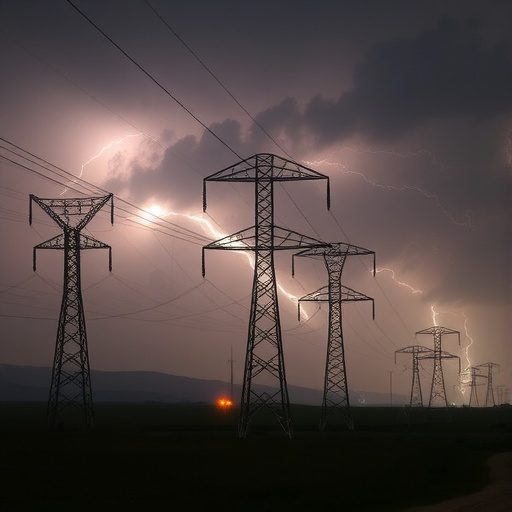
Transmission towers, the steel lattice structures that carry high-voltage electrical lines across vast distances, are critical yet vulnerable elements of the power grid. Their placement often coincides with exposed, windy terrains, rendering them susceptible to the destructive forces of extreme wind events. When these towers succumb to such natural hazards, the resultant power outages can span large communities, underscoring the imperative for effective predictive tools.
Traditional methods of vulnerability assessment have largely centered on historical data analysis or scrutinizing individual transmission towers in isolation. While these approaches provide insight, they falter when scaling up to complex, widespread power networks. Analyzing each tower separately across a multi-county region is impractical and fails to anticipate future events with the necessary precision.
The research team, led by Ji Yun Lee, associate professor in WSU’s Department of Civil and Environmental Engineering, has advanced a physics-based simulation framework that leverages surrogate modeling to estimate transmission tower fragility at a systemic level. This sophisticated approach permits rapid evaluation of towers with varying designs, heights, and dimensions within interconnected power networks, maintaining both computational efficiency and predictive accuracy.
Surrogate modeling, at the heart of this framework, serves as an approximation technique that drastically reduces the computational load required for extensive simulations. By replicating the physical behavior of structures under stress, surrogates enable swift yet reliable predictions of failure probabilities. This methodology, validated in analogous structural engineering contexts such as earthquake response modeling for bridges and buildings, offers a promising tool for wind damage assessment.
A key innovation in this model lies in its multi-faceted consideration of environmental variables during extreme wind events. The framework integrates factors including wind velocity, directional forces, and concurrent rainfall intensity—each of which can interplay to affect structural integrity. By encapsulating this complexity, the model approaches real-world scenarios with a nuanced fidelity that enhances prediction reliability.
Accuracy assessments reveal that the model predicts the structural response of transmission towers with an impressive average accuracy of 96%. This level of precision not only empowers power companies to identify high-risk towers preemptively but also facilitates strategic decisions regarding where to allocate resources for structural reinforcements or retrofits, thereby reducing outage risks effectively.
The 2021 hurricane in Louisiana serves as a stark illustration of the stakes involved. With wind speeds exceeding 150 miles per hour, hundreds of miles of transmission lines were destroyed, leaving nearly a million residents without power. Such widespread disruptions emphasize the critical need for system-level vulnerability assessments that transcend individual components and address the network holistically.
PhD candidate Abdel-Aziz Sanad, the study’s first author, underscores the importance of viewing transmission towers as part of an interconnected web rather than as standalone entities. This perspective is crucial for pinpointing fragility nodes within the complex lattice of power infrastructures, enabling targeted interventions that enhance overall grid resilience.
The research received support from the U.S. Department of Energy, highlighting the strategic relevance and potential policy impact of these developments. As climate change drives an increase in intense wind events worldwide, tools like this surrogate-based fragility modeling framework become invaluable assets for utility companies and grid operators seeking to safeguard continuous power delivery.
Looking ahead, the team envisions integrating this model into operational platforms used by utility companies, offering real-time assessments and decision-making support. Such integration can revolutionize maintenance schedules, risk management strategies, and emergency preparedness plans, fortifying power grids against the unpredictable fury of nature.
Ultimately, this innovative approach marks a significant stride toward more resilient and reliable energy infrastructure. It exemplifies how advances in computational modeling and engineering science can translate into practical solutions that mitigate the societal impacts of natural disasters, protecting both communities and critical lifelines.
Subject of Research: Transmission tower structural vulnerability and failure prediction under extreme wind conditions.
Article Title: Surrogate-based fragility modeling framework for system-level wind damage assessment of transmission towers.
News Publication Date: March 27, 2026.
Web References: Engineering Structures Journal Article
Keywords: Transmission towers, extreme wind, surrogate modeling, structural vulnerability, wind damage assessment, power grid resilience, computational simulation, structural engineering, power outage mitigation, physics-based modeling, network-level analysis, retrofitting strategies.
Tags: advanced infrastructure risk mitigationcomputational models for utility risk assessmentextreme wind power outage predictionhigh-voltage transmission line vulnerabilitymulti-county power outage risk managementpower grid resilience to hurricanespredictive tools for power network stabilitysteel lattice tower collapse analysistornado impact on electrical infrastructuretransmission tower failure modelingWashington State University wind damage researchweather-induced electrical grid failures