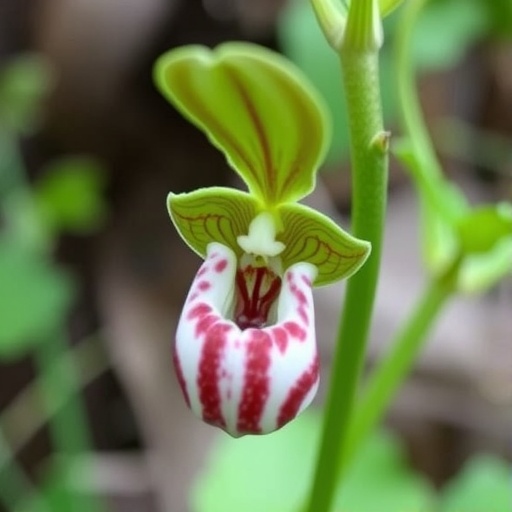
In the realm of plant conservation, the endangered orchid species Paphiopedilum purpuratum stands as both a symbol of botanical beauty and a pressing ecological challenge. Despite successful efforts to enhance its reproduction outside its natural habitat, this species faces severe physiological and microbial hurdles that threaten its long-term survival. A groundbreaking study led by Dr. Qifei Yi at the South China Botanical Garden, Chinese Academy of Sciences, unveils the intricate mechanisms that enable P. purpuratum to adapt to ex situ conservation. This comprehensive research combines physiological measurements, stable isotope techniques, and cutting-edge fungal community sequencing, providing unprecedented insights into the delicate balance between reproduction and stress tolerance mediated through a finely tuned root microbiome.
At the core of this research lies a fascinating physiological trade-off. While ex situ conservation practices have managed to boost the seed-set rate of P. purpuratum by an impressive 52%, this reproductive success is not without cost. The plant exhibits a marked decline in photosynthetic capacity and an increase in oxidative stress markers, highlighting a classic resource allocation dilemma. Essentially, the plant appears to divert crucial resources away from photosynthesis to support enhanced seed production—a survival strategy that may compromise its overall health if left unmanaged.
Delving deeper into the root microbiome, the study explores the dual roles of mycorrhizal and non-mycorrhizal fungi in mediating this adaptation. Mycorrhizal fungi form a surprisingly stable consortium, maintaining compositional consistency despite shifts in environmental conditions. This fungal core restructures into complex multi-cluster networks, bolstering ecosystem resilience and potentially supporting the host’s nutrient acquisition and stress mitigation processes. In stark contrast, non-mycorrhizal fungi engage in vigorous species turnover, dynamically reconfiguring the peripheral microbial landscape to favor beneficial taxa known for their pathogen-suppressing capabilities.
The intricate orchestration of these microbial communities reflects a sophisticated “core-periphery” framework, where the mycorrhizal core offers stability and continuity, while the non-mycorrhizal periphery provides adaptive flexibility. This dual-fungal strategy appears pivotal to the orchid’s capacity to withstand the physiological pressures of ex situ environments, balancing enhanced reproductive output with the necessity for stress resilience. Such a model challenges traditional conservation paradigms by emphasizing microbiome management as a vital component of plant adaptation.
Equally notable is the role of host nitrogen metabolism identified as a dominant driver of fungal community assembly. Stable isotope analyses reveal that nitrogen fluxes interact closely with microbial dynamics, influencing which fungal taxa dominate and how effectively nutrient exchanges occur between plant and fungi. This coupling between host metabolic processes and symbiotic partners underscores the complexity of plant adaptation, illustrating that successful conservation must address biochemical networks alongside ecological ones.
This research revolutionizes ex situ conservation frameworks. Instead of focusing narrowly on the mere survival of endangered plants, it advocates for integrated management approaches that regulate host physiological trade-offs and intentionally shape microbial symbionts. By understanding how P. purpuratum reallocates resources and restructures its root microbiome, conservationists can develop precision interventions—such as targeted mycorrhizal inoculations and microenvironmental controls—that foster stable, resilient populations in artificial settings.
Furthermore, the study’s findings have profound implications beyond orchids, hinting at broader principles applicable to other endangered flora reliant on complex fungal associations. The “stable mycorrhizal core plus dynamic non-mycorrhizal periphery” blueprint may serve as a universal model guiding conservation practices in diverse ecosystems, especially where microbial symbioses critically influence plant fitness under environmental stress.
The physiological insights gleaned from this study also cast new light on the balancing act plants perform between photosynthesis and reproduction. While elevated seed production boosts the chances of species persistence, compromised photosynthetic function could undermine long-term vitality if physiological demands become unsustainable. This nuance stresses the importance of monitoring not only reproductive metrics but also underlying physiological health when assessing conservation success.
In terms of methodological innovation, this investigation stands out by combining high-throughput fungal sequencing with stable isotope tracing and robust physiological assays. Such integrative approaches enable a holistic understanding of plant-fungal interactions, moving beyond simple taxonomic surveys towards functional ecology that deciphers microbial network rewiring and metabolic feedback loops shaping host adaptation.
Ultimately, the research spearheaded by Yong Tan, Junxi Liang, Wentao Wang, Jianing Tian, and Qifei Yi reshapes how we conceptualize and implement ex situ conservation for Paphiopedilum purpuratum. By uncovering the dynamic root microbiome strategies underpinning adaptation and growth, the study charts a path toward more adaptive and sustainable conservation strategies—ensuring that these exquisite orchids thrive not only in botanical gardens but eventually return to flourishing wild populations.
This pioneering work published in the journal Biological Diversity marks a milestone for conservation biology, plant physiology, and microbial ecology. It reflects the urgent need to embrace multi-disciplinary, systems-level perspectives to address biodiversity loss intricately connected to plant-microbe symbioses and physiological intricacies. In a future increasingly defined by ecological uncertainty, such innovative research will be indispensable to safeguarding botanical heritage and ecosystem resilience worldwide.
Subject of Research:
Plant physiological adaptation and root-associated fungal community dynamics in endangered orchid species ex situ conservation.
Article Title:
Resource Allocation Trade-Offs and Rewired Mycorrhizal Networks Underlie the Adaptation of Paphiopedilum purpuratum to Ex Situ Conservation.
News Publication Date:
April 24, 2026.
Web References:
Biological Diversity Journal
DOI: 10.1002/bod2.70022
References:
Tan, Yong, Junxi Liang, Wentao Wang, Jianing Tian, and Qifei Yi. 2026. “Resource Allocation Trade-Offs and Rewired Mycorrhizal Networks Underlie the Adaptation of Paphiopedilum purpuratum to Ex Situ Conservation,” Biological Diversity: 3(1), 47–60.
Image Credits:
Yong Tan, Junxi Liang, Wentao Wang, Jianing Tian, Qifei Yi.
Keywords:
carbon-nitrogen metabolism, ex situ conservation, fungal community, mycorrhizal fungi, Paphiopedilum purpuratum, photosynthetic adaptation, physiological response.
Tags: endangered orchid species survival strategiesex situ plant adaptation mechanismsfungal community sequencing in orchidsmycorrhizal network rewiringorchid root microbiome studiesoxidative stress in endangered plantsPaphiopedilum purpuratum conservationplant physiological stress responsesreproductive success vs photosynthesis trade-offresource allocation trade-offs in orchidsSouth China Botanical Garden orchid researchstable isotope analysis in plant research