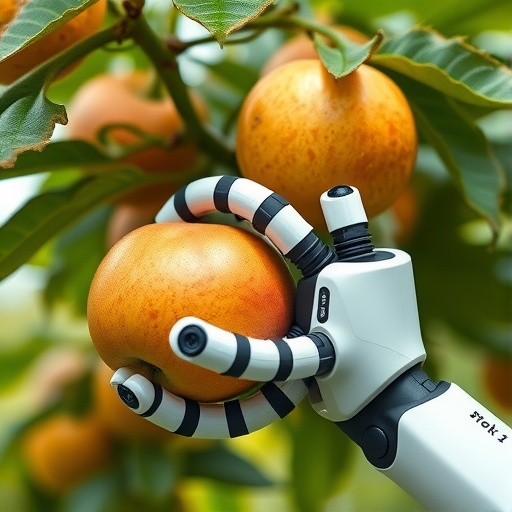
Cornell University engineers have taken a significant leap toward the future of agricultural automation with the development of a soft robotic gripper capable of discerning the ripeness of strawberries simply through touch. This innovative system integrates stretchable fiber-optic sensors embedded within pliable fingers, enabling the robot not only to assess the ripeness of fruit by measuring tactile properties but also to delicately twist the strawberries off their vines without causing any damage. The breakthrough, achieved under the guidance of mechanical engineering professor Rob Shepherd, paves the way for more sustainable, efficient, and gentle harvesting techniques that could reshape how delicately cultivated fruits are managed globally.
At the core of this robotic innovation lies the use of fiber-optic strain gauges, sensors that exhibit mechanical compliance harmonious with the soft materials of the gripper itself. Unlike rigid sensors that might compromise a soft robotic system’s flexibility and responsiveness, these stretchy fiber-optic sensors seamlessly integrate into the robot’s structure. They provide precise measurements of mechanical deformation, capturing subtle changes in curvature along the gripper’s fingers and monitoring the pressure applied at the fingertips. This dual sensing modality enables the robot to form a fine discrimination of the fruit’s firmness and shape, crucial parameters indicating ripeness and readiness for harvest.
This technology’s practical validation used the strawberry as a model fruit due to the clear visual cues of ripeness usually associated with its color maturation. However, focusing on tactile sensing enabled the research team to train the robotic gripper to make ripeness evaluations independent of visual data, reinforcing the device’s utility in conditions where sight alone is insufficient. Lead researcher Anand Mishra, a former postdoctoral scholar, successfully calibrated the gripper’s touch sensors to correlate the firmness readings to ripeness stages, validating this tactile approach against the visual benchmarks of color changes on the strawberries’ surface.
While classical robotic harvesting systems generally rely on pulling or plucking—with an inherent risk of bruising or damaging delicate fruits—this soft gripper adopts a different approach. The robot incorporates a planetary gear mechanism within its wrist joint, facilitating a gentle rotation movement that twists the fruit off its stem. This method mimics the natural picking technique used by human harvesters, mitigating mechanical stresses on the fruit and preserving its marketability and shelf-life. The design exemplifies biomimetic principles, where engineering solutions are inspired by biological processes, blending mechanical sophistication with the subtlety required for agricultural finesse.
The fiber-optic sensing technology confers more than tactility: it allows the robot to adapt its grip dynamically. Since the sensors share identical mechanical properties with the soft gripper material, they move and stretch in concert with the robot’s fingers, effectively creating a system where the ‘skin’ itself senses touch. This intimate integration ensures that feedback is real-time and inherently linked to the gripper’s deformation, allowing precise regulation of grasp force and finger conformation to the unique shape of each fruit. Such refined control is essential for handling perishables without causing bruising or mechanical damage.
Despite the sensor complexity and mechanical elegance, the researchers recognized that visual cues remain indispensable in certain scenarios, especially when fruits are hidden beneath foliage or obscured by other vegetation. To accommodate these situations, the robotic gripper is also equipped with a camera embedded within its palm area, enhancing the robot’s ability to detect occluded fruit and guide the grasping maneuver effectively. This combination of tactile sensing and computer vision empowers a versatile agricultural tool capable of operating reliably in diverse orchard conditions.
The implications of this robotic gripper extend well beyond strawberry harvesting. The system promises significant utility in handling fruits for which visual ripeness indicators are unreliable or hard to discern, such as avocados, pineapples, and pawpaws. For these fruits, subtle changes in texture and firmness are primary ripeness metrics, perfectly suited to the robot’s sensory modalities. This opens the door to mechanized harvesting in crop categories currently dominated by labor-intensive manual picking, thereby addressing labor shortages and reducing operational costs.
More broadly, Professor Shepherd envisions a transformation in agricultural practices fostered by robotic systems like this one. Traditional row-crop farming optimizes for the limitations of large, singular machines, often requiring monocultures and simplified plant arrangements to maximize mechanical efficiency. However, the advent of numerous smaller, intelligent robots promises the feasibility of mixed cropping and diversified agroecosystems. Diverse interspersed species could provide synergies such as pest resistance, natural barriers to infestation, and enhanced drought resilience through canopy effects. Robots with delicate touch capability enable harvesting in such complex environments without compromising crop integrity.
The research exemplifies the Organic Robotics Lab’s commitment to bridging soft robotics and sustainable agriculture, illustrating how advanced materials science, optics, and mechanical design converge to tackle a practical challenge. The stretchable fiber-optic sensors are a pivotal innovation, representing a paradigm shift in how robots can ‘feel’ their environment without rigid instrumentation. This tactile intelligence is crucial for delicate operations, unlocking new possibilities in precision agriculture where the quality and integrity of harvested produce are paramount.
This soft robotic harvesting system also offers promise in enhancing ecological food production. By enabling gentle harvesting methods, it supports the cultivation of fruit species typically difficult to mass-produce due to their fragility. This may lead to increased crop diversity in markets, promoting biodiversity and consumer choice. The reduction in damage during picking also implies less food waste, aligning with growing calls for sustainability and resource efficiency in global food systems.
Given current global challenges in labor availability and the rising demand for sustainable farming solutions, this development could rapidly gain traction. The minimal bruising achieved through the combination of soft materials, fiber-optic sensing, and controlled twisting extraction represents a crucial advance in fruit handling technology. As robots become smarter and softer, the agriculture industry might experience a paradigm shift where human-robot collaboration or fully autonomous harvesting becomes feasible for a broader range of fruit crops.
Future research and development efforts will likely focus on scaling the system for commercial orchard deployment, integrating more advanced machine learning algorithms to improve ripeness assessment accuracy, and extending tactile sensing arrays to handle different crop varieties. The convergence of tactile sensing and visual processing, embedded in soft robotics frameworks, heralds a new era in agricultural robotics—one where machines can interact with nature with unprecedented delicacy and intelligence.
In conclusion, the Cornell University soft robotic gripper represents a milestone in agricultural technology, showcasing how embedding flexible, fiber-optic sensors into soft machines enables precise, damage-free fruit harvesting based on touch perception. This work demonstrates not only a remarkable technical achievement in sensor integration and robotic manipulation but also promises profound impacts on sustainable agricultural practices, food quality preservation, and the expansion of crop diversity. It embodies the transformative potential of soft robotics in reconciling the mechanical precision of automation with the gentle nuances of natural product handling.
Subject of Research: Soft robotic gripper technology for tactile assessment and gentle harvesting of ripe fruit.
Article Title: (Not provided in the content)
News Publication Date: (Not specified within the content)
Web References: Cornell Chronicle story
References: Shepherd, R.F., Mishra, A., et al., “Soft robotic gripper with stretchable fiber-optic strain sensors for tactile fruit ripeness detection,” Nature Communications, DOI: 10.1038/s41467-026-70588-9
Image Credits: (Not specified within the content)
Keywords: Soft robotics, fiber-optic sensors, tactile sensing, agricultural robotics, fruit ripeness detection, sustainable farming, robotic harvesting, biomechanical sensors, strawberry picking, planetary gear mechanism, ecological agriculture.
Tags: agricultural automation technologyfruit ripeness detectiongentle fruit harvestingmechanical compliance sensorsnon-damaging harvest techniquespliable robotic fingerspressure-sensitive robotic grippersrobotic strawberry harvestingsoft robotic gripperstretchable fiber-optic sensorssustainable fruit picking methodstactile sensing in robotics