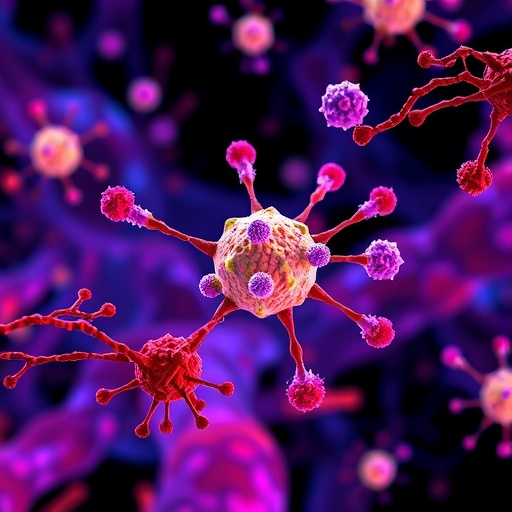
In the ever-evolving realm of cancer immunotherapy, a groundbreaking paradigm is emerging from the shadowy intricacies of the tumor microenvironment (TME). Recent advances illuminate the chemokine–chemokine receptor axis as a pivotal molecular traffic controller orchestrating immune cell dynamics, heralding a transformative approach to reprogram solid tumors. Chemokines, traditionally understood as chemotactic cytokines guiding immune cells, mediate a complex network of signaling pathways that delicately balance tumor promotion and suppression. This duality underscores their potential as a master switch in therapeutic interventions that recalibrate tumor immunity toward durable, efficacious responses.
At its core, the chemokine system establishes nuanced concentration gradients within the TME, effectively directing T lymphocytes, natural killer cells, macrophages, and dendritic cells past formidable physiological barriers to infiltrate tumorous regions. However, their role transcends mere navigation; chemokines influence immune cell activation states, proliferation rates, and functional phenotypes through precise receptor-mediated signaling cascades. This biochemical crosstalk decisively modulates the immunological landscape, effectively toggling between immune surveillance and tumor-induced immunosuppression, thereby dictating cancer progression trajectories.
Elucidating the multifaceted impact of chemokine signals on tumor cells reveals a regulatory web that extends beyond immunity. Chemokine-receptor engagement affects malignant cell proliferation, apoptosis resistance, and phenotypic plasticity including epithelial-to-mesenchymal transition (EMT). These processes drive invasion and metastasis, challenging therapeutic efficacy. Therefore, dissecting the spatiotemporal heterogeneity and regulatory circuitry of chemokine expression within distinct tumor contexts is pivotal to crafting therapeutics capable of reshaping the notoriously immunosuppressive TME.
In a comprehensive review published in the Chinese Medical Journal on March 11, 2026, Chinese researchers have meticulously charted the chemokine expression profiles across a spectrum of malignancies, correlating these patterns with immune cell infiltration dynamics and clinical prognosis. Their synthesis underscores several innovative therapeutic methodologies harnessing the chemokine axis to potentiate antitumor immunity. Crucially, these strategies exploit the nuanced interplay between chemokine ligands and their receptors, navigating the intricacies of tumor biology to optimize immune engagement.
Foremost among these approaches is the pharmacological inhibition of immunosuppressive chemokines such as CCL2 and CXCL12. Employing small molecules or monoclonal antibodies to disrupt these signaling pathways alleviates the immunosuppressive milieu within tumors. This blockade reinvigorates the cytotoxic potential of immune effector cells and dials down factors contributing to immune evasion. By selectively targeting components of the chemokine network, this strategy promises to unshackle antitumor immunity, restoring the natural capacity of the immune system to detect and eradicate malignant cells.
Complementing inhibitory tactics are advanced delivery platforms designed to amplify immunostimulatory chemokine presence directly within tumor sites. Oncolytic viruses and antibody-drug conjugates are at the forefront of this tactic, delivering chemokines like CXCL9, CXCL10, or CCL5 with high spatial precision. This intratumoral supplementation remodels “cold” tumors—those deficient in immune cell infiltration—into “hot” tumors rich in effector lymphocytes capable of mounting a robust immune response. These delivery vehicles leverage tumor-selective tropism, thus minimizing off-target effects and maximizing therapeutic payload efficiency.
Beyond delivery, the genetic engineering of cellular therapies represents a cutting-edge frontier in chemokine axis exploitation. CAR-T and TCR-T cell therapies benefit markedly from modifications that induce overexpression of chemokine receptors, including CXCR2 and CXCR3. By enhancing sensitivity to chemokine gradients within the TME, these engineered immune cells exhibit improved homing, infiltration, and retention, overcoming one of the principal barriers to effective cell-based immunotherapies. This genetic augmentation offers a personalized approach, tailoring immune cells to the unique chemokine landscape of each patient’s tumor.
Moreover, integrating chemokine modulation with established immunotherapeutic modalities unveils synergistic possibilities to surmount therapeutic resistance. The coupling of chemokine-targeted treatments with tumor vaccines amplifies antigen-specific immune activation, boosting vaccine efficacy. Similarly, combining with immune checkpoint inhibitors, such as PD-1 or PD-L1 antagonists, addresses the challenge of insufficient immune infiltration—often a key resistance mechanism—thereby broadening the responsiveness across diverse patient populations. Adoptive cell therapy integration further enhances immune cell survival and activity, fostering the emergence of tertiary lymphoid structures that sustain long-term antitumor immunity.
The review also explores the emerging paradigm of epigenetic regulation as a modulatory lever over chemokine expression. Histone modifications and DNA methylation patterns within tumor cells and the surrounding stroma influence chemokine gene transcription, offering an additional therapeutic axis. Targeting these epigenetic mechanisms may fine-tune chemokine output, normalizing immune infiltration patterns, and mitigating adverse effects associated with systemic chemokine administration. This approach promises the development of more refined and precise interventions aligned with tumor-specific epigenomic landscapes.
Despite these promising avenues, the complexity and redundancy intrinsic to the chemokine system present substantive challenges. Tumor heterogeneity—both inter-patient and intra-tumoral—complicates the prediction of therapeutic outcomes and necessitates robust biomarker-driven stratification methods. Furthermore, the potential for systemic toxicities arising from widespread modulation of chemokine pathways mandates the design of strategies with exquisite specificity and controllability. Addressing these obstacles will require multidisciplinary efforts merging molecular biology, immunology, bioengineering, and clinical oncology.
Looking ahead, future research directives emphasize the need for deep mechanistic insights into chemokine receptor crosstalk, signaling dynamics, and context-dependent effects within the TME. Advanced tools like single-cell transcriptomics and spatial proteomics will facilitate the mapping of chemokine networks with unprecedented resolution. Translation into clinic demands well-designed clinical trials that rigorously evaluate the safety and efficacy of chemokine-targeting agents, alone and in combination, across diverse malignancies. The ultimate objective is to harness chemokine biology to reeducate the TME, tipping the balance decisively in favor of immune-mediated tumor clearance.
In summary, exploiting the chemokine–chemokine receptor axis represents a frontier in immunotherapeutic innovation, offering transformative potential for solid tumor treatment. By manipulating these cellular traffic signals, researchers aspire to reprogram the tumor ecosystem from a sanctuary for cancer cells into a battleground governed by effective immune surveillance. As this research trajectory gains momentum, chemokine-centered strategies are poised to become integral components of precision oncology, delivering renewed hope for durable and comprehensive cancer remission.
Subject of Research: Cells
Article Title: Exploiting the chemokine–chemokine receptor axis: Emerging immunotherapeutic paradigms for solid tumor microenvironment reprogramming
News Publication Date: 11-Mar-2026
Web References: Not provided
References: DOI: 10.1097/CM9.0000000000004009
Image Credits: The Authors: Yang Zhao, Xueqian Wang, Tong Lei, Guiying Wang, Hezhe Lu, Yong Zhao
Keywords: Chemokines, tumor microenvironment, cancer immunotherapy, chemokine receptors, immune cell infiltration, CAR-T cells, immune checkpoint inhibitors, tumor vaccines, epigenetic regulation, oncolytic viruses, antibody-drug conjugates, tumor heterogeneity
Tags: chemokine receptor axis cancerchemokine signaling pathways in oncologychemokine-mediated tumor progressionchemokines in immunotherapydendritic cells in tumor immunityepithelial-to-mesenchymal transition cancerimmune cell infiltration tumorsmacrophage roles in cancernatural killer cell tumor interactionT lymphocyte tumor traffickingtumor immune suppression mechanismstumor microenvironment chemokine signaling