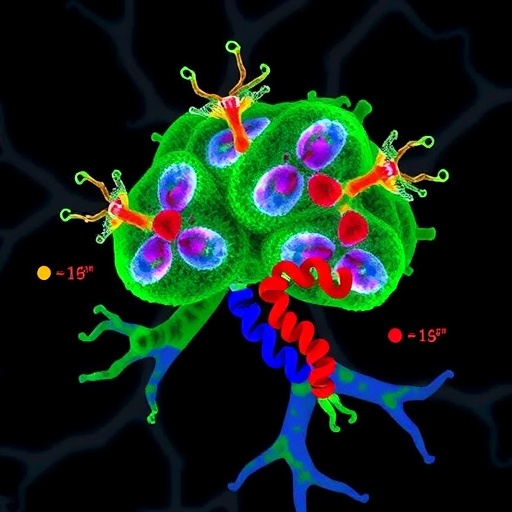
In the intricate landscape of cellular biology, the meticulous transport of proteins to defined subcellular compartments is fundamental for maintaining cellular polarity and function, especially within the highly specialized morphology of neurons. The axon initial segment (AIS), a pivotal site responsible for initiating action potentials, demands precise delivery of molecular constituents to sustain neuronal polarity and signal fidelity. A recent groundbreaking study led by Professor Nobutaka Hirokawa and colleagues at Juntendo University unveils a novel mechanistic insight into how kinesin-2 motor proteins achieve cargo specificity, revealing the assembly of distinct kinesin-2 complexes as a key determinant in selective protein transport to the AIS.
Intracellular trafficking orchestrated by molecular motor proteins underpins neuronal functionality, where the transportation of signaling molecules, organelles, and structural proteins must adhere strictly to spatial constraints dictated by neuronal polarity. Kinesin superfamily proteins (KIFs) operate along microtubule tracks, converting ATP hydrolysis into mechanical force for cargo conveyance. Among these, kinesin-2, primarily comprising KIF3A, KIF3B, and kinesin-associated protein 3 (KAP3), plays an indispensable role in vesicular and protein trafficking. Prior to this study, the understanding of whether kinesin-2’s subunit heterogeneity influences cargo specificity remained unresolved.
Professor Hirokawa’s team employed a multi-disciplinary approach integrating advanced neuronal cell biology, biochemical reconstitution assays, and high-resolution structural interrogation to dissect the molecular composition of kinesin-2 assemblies. Utilizing cultured neuronal models and murine brain tissues, the researchers meticulously analyzed the distribution and interaction profiles of kinesin-2 complexes. Genetic manipulation techniques, including targeted knockdown and knockout models, were pivotal in establishing the functional link between kinesin-2 components and their transport substrates.
A revelation emerged that kinesin-2 exists not as a monolithic entity but as heterogeneous assemblies with distinct subunit compositions. Beyond the canonical KIF3A/B/KAP3 complex conventionally regarded as the kinesin-2 form, the researchers identified a specialized assembly predominated by KIF3B homodimers paired with KAP3. This KIF3B/B/KAP3 assembly displayed a remarkable affinity for TRIM46, a critical axon-organizing protein integral to maintaining AIS architecture and neuronal polarity, spotlighting a previously uncharacterized division of labor within kinesin-2 motor functions.
Functional assays demonstrated that depletion of KIF3B significantly impaired the localization and accumulation of TRIM46 at the AIS, without altering the overall TRIM46 expression levels. This dissociation between protein synthesis and spatial localization underscores the primacy of transport fidelity in neuronal compartmentalization. The impaired TRIM46 distribution consequentially perturbs AIS formation and, by extension, neuronal polarity and excitability, highlighting the physiological significance of kinesin-2 motor diversity.
Structural analysis shed light on the mechanistic underpinnings of cargo specificity, suggesting that variations in the tail domains of kinesin-2 complexes modulate their affinity for distinct cargo molecules. The tail region, responsible for cargo binding, appears to configure molecular interfaces dictating selective engagement with proteins like TRIM46. This domain plasticity within kinesin-2 assemblies confers nuanced control over intracellular trafficking routes, advancing our comprehension of molecular motor specificity.
These findings carry profound implications beyond basic cellular biology, especially in the context of neurological and neurodevelopmental diseases where defective intracellular transport is a recognized pathological hallmark. Aberrant motor protein function can lead to mislocalization of axonal proteins such as TRIM46, potentially contributing to disease phenotypes characterized by impaired neuronal polarity and signaling. By delineating the molecular basis of selective protein transport, this study paves the way for targeted therapeutic interventions aimed at restoring intracellular trafficking precision.
Professor Hirokawa emphasizes the broader impact of this research, stating that uncovering how kinesin-2 motors differentiate cargoes provides a crucial framework for understanding neuronal architecture organization. This paradigm shift in perceiving motor assembly diversity as a determinant of transport specificity augments our theoretical models and prompts reconsideration of intracellular logistics in neuronal and non-neuronal cells alike.
Moreover, the principles elucidated here may have expansive translational potential, inspiring bioengineering efforts in nanotechnology to replicate selective transport mechanisms observed in biological systems. Engineered molecular motors or synthetic transport platforms mimicking kinesin-2’s assembly-dependent cargo specificity could revolutionize targeted delivery strategies in diagnostics, therapeutics, and synthetic biology.
This innovative research, soon to be published in the Journal of Cell Biology, exemplifies the intersection of molecular neuroscience and cell biology, reinforcing the necessity of intricate protein machinery diversification for cellular function. It notably accentuates the sophisticated orchestration within molecular motor systems governing the intracellular environment, spotlighting the intricate choreography required for effective neuronal function.
In summary, kinesin-2’s motor protein heterogeneity emerges as a central determinant of selective cargo transport within neurons, particularly in directing TRIM46 to the AIS. This selective transport is critical for neuronal polarity, underscoring a fundamental principle that intracellular transport specificity arises from motor assembly diversity. These insights not only deepen our molecular understanding of neuronal cell biology but also offer promising avenues for addressing transport-related neurodegenerative conditions.
As this exciting narrative unfolds, it invites a broader investigation into how other motor proteins might utilize analogous strategies to regulate cargo specificity, potentially unveiling uncharted mechanisms governing cellular organization. Future studies probing the structural dynamics and regulatory factors modulating motor assembly composition will undoubtedly further illuminate the complex intracellular logistics necessary for cellular homeostasis and function.
This landmark study thus redefines intracellular transport paradigms and spotlights the critical role of molecular motor assembly diversity in shaping the spatial architecture of neurons—an indispensable advance for both fundamental neuroscience and biomedical innovation.
Subject of Research: Cells
Article Title: The KIF3B/B/KAP3 tail domain specifically facilitates TRIM46 transport to the axon initial segment
News Publication Date: May 4, 2026
Web References: https://doi.org/10.1083/jcb.202503138
References: Xuguang Jiang, Sotaro Ichinose, Tadayuki Ogawa, Kento Yonezawa, Nobutaka Shimizu, and Nobutaka Hirokawa; Journal of Cell Biology, Volume 225, Issue 5, May 2026
Image Credits: Professor Nobutaka Hirokawa, Graduate School of Medicine, Juntendo University, Tokyo, Japan
Keywords: Neuroscience, Cell biology, Molecular biology, Proteins, Intracellular transport, Genetics, Biochemistry, Neurological disorders
Tags: ATP hydrolysis in motor protein functionaxon initial segment protein transportintracellular trafficking in neuronsKIF3A KIF3B KAP3 motor complexkinesin superfamily proteins in neuronskinesin-2 cargo specificitymolecular motor protein mechanismsneuronal cell biology and motor protein assemblyneuronal motor protein compositionneuronal polarity and motor proteinsselective protein delivery in neuronsvesicular transport by kinesin-2