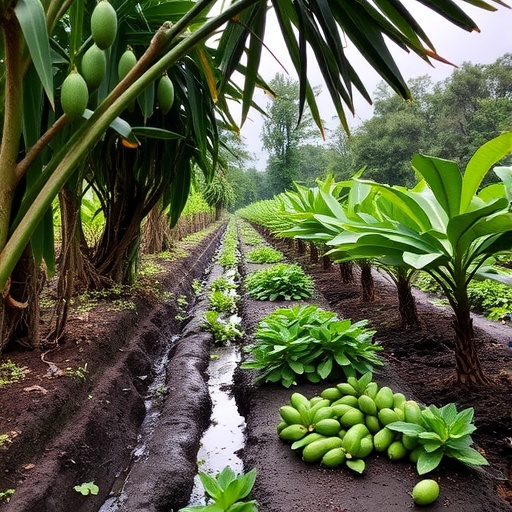
In recent years, the avocado industry has burgeoned into a multibillion-dollar global market, earning the fruit the nickname “green gold.” Central Mexico, famed for its ideal avocado-growing conditions, forms the heart of this thriving agricultural sector. However, new research published in npj Sustainable Agriculture reveals a worrying trend: a significant decline in soil moisture across the avocado-producing regions, collectively referred to as the Avocado “Green Gold Belt.” This phenomenon poses a serious threat to sustaining avocado cultivation, with broader implications for water resource management and agricultural resilience.
Soil moisture is a critical factor for healthy plant growth and agricultural productivity. It governs the availability of water to plant roots, influencing everything from nutrient uptake to crop yield. In the context of avocado cultivation, which relies heavily on well-maintained moisture levels, a decline in soil moisture can lead to diminished fruit quality, lower yields, and increased vulnerability to pests and diseases. The study highlights that this decline is not uniform but varies spatially and temporally, intensifying during dry seasons and in areas already facing water scarcity.
The researchers, led by Barreras et al., undertook a comprehensive assessment of soil moisture levels across central Mexico’s avocado belt, employing a combination of remote sensing technology, field measurements, and climate data analysis. Their approach allowed for high-resolution mapping of soil moisture trends over recent decades, revealing patterns that underscore the critical state of water retention in these soils. The use of satellite data alongside on-the-ground measurements provides unprecedented insight into how environmental variables and human activities interact to influence soil conditions.
One of the standout findings of the study was the marked reduction of soil moisture content over the past two decades, correlating closely with increased local temperatures and variability in precipitation. This trend is attributed both to climate change effects and intensified agricultural practices. Central Mexico has witnessed shifts in rainfall patterns, with more prolonged dry spells and sporadic heavy rainfall events that fail to replenish soil moisture adequately. Concurrently, avocado cultivation’s expansion and intensification have led to increased water extraction, further straining the region’s hydrological balance.
This dual pressure—climatic stress and anthropogenic demand—creates a precarious scenario for farmers. The avocado tree is particularly susceptible to water stress because of its relatively shallow root system and high water requirements. As soil moisture declines, avocado producers face the challenge of maintaining viable crops without exacerbating water resource depletion. This calls for urgent attention toward water-efficient irrigation methods, soil management practices, and possibly revisiting crop selection strategies within vulnerable areas.
Moreover, the study emphasizes the socioeconomic ramifications of dwindling soil moisture. Avocado farming in central Mexico not only supports local livelihoods but also plays a pivotal role in the national economy and global supply chains. Any disruption caused by water scarcity could cascade into reduced income for farmers, higher prices for consumers, and destabilization of export markets. The environmental stress thus directly translates into human and economic vulnerability, reinforcing the need for integrated sustainability approaches.
In addition to identifying declining trends, the research sheds light on possible mitigation pathways. Enhancing soil health through organic amendments, mulching, and conservation tillage can improve water retention capacity. Adaptive irrigation strategies, such as drip irrigation combined with soil moisture monitoring systems, can optimize water use efficiency. The authors advocate for policy interventions that safeguard water catchments and promote agroforestry systems, which maintain ecological balance and improve resilience against climate extremes.
The study also explores the role of technological innovation in managing the crisis. Precision agriculture techniques, enabled by remote sensing and IoT (Internet of Things) devices, can provide real-time data on soil and crop conditions, empowering farmers to make informed water management decisions. Digital platforms could facilitate knowledge sharing and promote best practices that balance productivity with sustainability, ensuring that the “Green Gold Belt” remains viable for future generations.
Importantly, the research brings attention to regional disparities within the avocado belt. Some zones exhibit more acute moisture decline due to local topography, soil types, and water extraction patterns. Tailored approaches that consider microclimatic and socio-economic contexts are essential. One-size-fits-all policies may fail to address localized vulnerabilities, making place-based interventions a critical factor for success.
The authors call on stakeholders—including governmental agencies, agricultural researchers, farmers, and industry partners—to collaborate in addressing this multifaceted challenge. Integrating soil moisture monitoring into routine agricultural management, fostering community engagement, and supporting financial mechanisms for sustainable practices are among the recommendations put forward. These collective efforts can help mitigate risks, preserve ecosystem services, and enhance food security.
Looking ahead, continuous monitoring of soil moisture trends is imperative as climate change projections suggest further temperature rises and changing precipitation regimes. Long-term datasets will enable the validation of models, refinement of mitigation strategies, and adaptive governance. The urgency to act is underscored by the irreversible consequences that prolonged soil moisture deficits could have on land degradation and desertification processes.
The study by Barreras et al. thus represents a crucial contribution to the field of sustainable agriculture, offering a scientific foundation to address water resource challenges in a globally significant avocado production region. It highlights the intricate balance between environmental stewardship and agricultural development in the face of climate variability, advocating for resilient and adaptive frameworks in agroecosystem management.
By shining a light on soil moisture decline in Mexico’s avocado belt, this research provokes a reevaluation of agricultural priorities and practices. It serves as a reminder that the green riches of avocado—a fruit beloved worldwide—are inherently tied to the health of the soil and water beneath our feet. Protecting these resources is not just an agricultural imperative but a planetary necessity.
In conclusion, safeguarding the integrity of soil moisture in central Mexico’s avocado regions demands multidisciplinary approaches combining cutting-edge science, pragmatic policy, and community action. The future of the “Green Gold Belt” hinges on our collective ability to harmonize agricultural productivity with ecological resilience, ensuring that this emblematic sector continues to flourish amid mounting environmental pressures.
Subject of Research: Soil moisture decline in avocado-growing regions of central Mexico and its implications for sustainable agriculture.
Article Title: Soil moisture decline across the Avocado “Green Gold Belt” in central Mexico.
Article References:
Barreras, A., Gutiérrez, S., Vázquez-Lule, A. et al. Soil moisture decline across the Avocado “Green Gold Belt” in central Mexico. npj Sustain. Agric. 4, 24 (2026). https://doi.org/10.1038/s44264-026-00138-9
Image Credits: AI Generated
DOI: https://doi.org/10.1038/s44264-026-00138-9
Tags: agricultural resilience to droughtavocado belt water resource managementavocado cultivation challenges in Mexicoclimate change effects on avocado productionimpact of soil moisture on avocado yieldmultibillion-dollar avocado industry risksnutrient uptake in avocado plantspest vulnerability in low moisture soilsremote sensing for soil moisture monitoringsoil moisture decline in avocado farmingsustainable avocado farming practiceswater scarcity in central Mexico agriculture