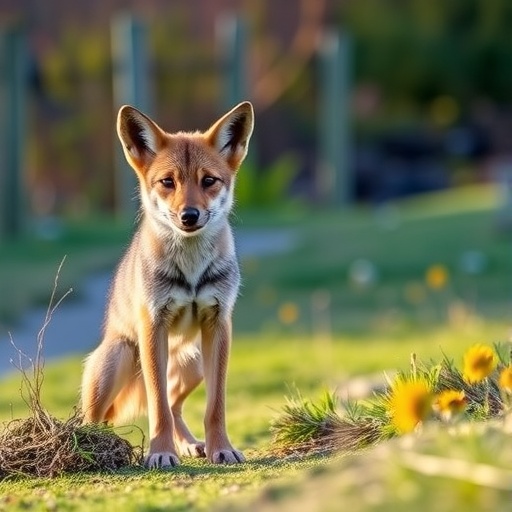
Urban coyotes have proven themselves to be remarkably adept survivors, quietly establishing dens and raising pups within bustling metropolitan landscapes without drawing much human attention. Recent research spearheaded by the University of Georgia unveils how these canids demonstrate an intricate balance between harnessing natural environments and subtly incorporating human-made structures into their denning habits, revealing a nuanced portrait of adaptability seldom appreciated by city dwellers.
Equipped with cutting-edge GPS tracking technology, researchers monitored 48 coyotes navigating the urban sprawl of Atlanta. Their tracking efforts uncovered 20 distinct den sites scattered across the city. Intriguingly, more than half of these dens utilized natural shelters such as burrows or fallen logs, underscoring coyotes’ preference for environments offering covert protection from human detection. This pattern illuminates their strategic avoidance of areas marked by heavy human activity, supporting an emergent understanding of urban wildlife behavior that privileges invisibility over confrontation.
The adaptability of urban coyotes is further highlighted by their innovative use of anthropogenic materials within den sites. Researchers documented dens featuring man-made debris — from abandoned boats to concrete rubble and even large tractor tires — ingeniously repurposed into protective hideaways. Such behavior not only exemplifies the species’ resourcefulness but also reflects an evolutionary flexibility crucial for thriving amidst rapid urbanization, where natural shelter can be scarce or fragmented.
Despite their proximity to human populations, urban coyotes typically exhibit a profound reticence to engage with people. According to lead author Summer Fink, a doctoral candidate at the Warnell School of Forestry and Natural Resources, coyotes demonstrate a marked tendency to avoid direct interaction and instead opt for locations that minimize the risk of human encounter. This strategy allows them to raise young covertly, maintaining a delicate equilibrium that reduces conflict and facilitates coexistence within dynamic urban ecosystems.
These findings challenge prevailing public perceptions that often paint coyotes as aggressive nuisances or threats. Michel Kohl, co-author and associate professor at the Warnell School, emphasizes that the coyote’s remarkable stealth in urban settings frequently goes unnoticed by residents. This invisibility suggests that fears surrounding coyotes may be disproportionate to the actual risks they pose, shifting the narrative toward understanding these animals as integral yet discreet components of city biomes.
The research also reveals subtle choices coyotes make involving human-occupied spaces. Some dens were located adjacent to vacant properties and abandoned buildings, locations evidently perceived by coyotes as low-risk zones free of human interference. This discernment highlights their capability to assess environmental threats and select denning sites based on shelter integrity and concealment rather than mere proximity to civilization, suggesting a sophisticated spatial awareness in urban habitat selection.
Widely prevalent across North America, coyotes now inhabit every major city in 49 states, excluding Hawaii. Their success as urban dwellers stems from their intelligence and adaptive behaviors, though researchers caution that ongoing urban expansion could limit suitable denning habitats and impose new pressures on these populations. Understanding their requirements for secure dens with adequate cover is pivotal for managing coyote populations and minimizing human-wildlife conflict amid future city growth.
Beyond dispelling myths, the study reframes coyotes’ ecological roles within urban territories. As apex predators, they regulate populations of rodents and smaller mammals, curbing outbreaks that could otherwise disrupt urban ecological balance. Moreover, coyotes contribute to seed dispersal through their diet of native plants, enriching urban biodiversity. Their scavenging habits additionally play a crucial role in environmental sanitation, consuming carrion and mitigating disease vectors.
The timing of coyote parturition in Georgia appears synchronized with early spring, spanning mid-March to mid-April. Litter sizes vary between two and nine offspring, although juvenile mortality is high, with many pups failing to reach adulthood. This reproductive timing likely aligns with seasonal resource availability and environmental conditions favorable for pup survival, a trait reflecting coyotes’ adaptation to both natural and anthropogenic pressures.
From a public safety perspective, the risk coyotes pose to humans and pets remains minimal, provided appropriate precautions are maintained. Researchers advise that dogs should remain leashed to prevent antagonistic encounters, and the public should avoid approaching coyote dens or investigating large holes that might conceal pups. Coyotes typically respond to perceived threats by employing distraction behaviors aimed at drawing potential threats away from their vulnerable young, rather than engaging aggressively.
Encounters with coyotes near den sites may involve parents becoming conspicuously visible or vocalizing to divert attention. Such behaviors should not be misconstrued as aggression but rather understood as evolutionary strategies for offspring protection. Awareness and education about these behaviors can help foster coexistence and reduce unnecessary fear or misinterpretation of coyote actions.
This study represents a significant contribution to urban wildlife ecology and was published in the journal Ecology and Evolution. Co-authors include Eden Nitza and Daniela Guerrero from the Florida Fish and Wildlife Conservation Commission, working alongside the University of Georgia team. Their combined efforts underscore the importance of multidisciplinary collaborations in unraveling the complexities of urban wildlife dynamics.
For those seeking further information on urban coyote behavior and coexistence strategies, resources such as the Wildlife Atlanta website provide comprehensive guidance. With increasing urbanization likely to persist, such research not only enhances scientific understanding but also informs practical approaches to fostering harmonious human-wildlife relationships in metropolitan settings.
Subject of Research: Urban coyote denning behavior and habitat selection in metropolitan environments
Article Title: Coyotes Choose Cover Over Concrete When Selecting Den Sites
News Publication Date: 27-Feb-2026
Web References:
University of Georgia research: https://pubmed.ncbi.nlm.nih.gov/41766730/
Wildlife Atlanta: https://wildlifeatlanta.org/
DOI link to study: http://dx.doi.org/10.1002/ece3.73186
References:
Published by Ecology and Evolution
Co-authored by University of Georgia and Florida Fish and Wildlife Conservation Commission researchers
Image Credits: UGA/University of Georgia
Keywords: Urban wildlife, coyote ecology, den site selection, GPS tracking, adaptive behavior, urban ecosystems, apex predators, human-wildlife coexistence, wildlife management, population ecology, urban biodiversity, environmental adaptation
Tags: coexistence with urban predatorscoyote denning habitscoyote pup season in citiescoyote resourcefulnessGPS tracking of coyoteshuman impact on urban wildlifemetropolitan coyote populationsnatural vs man-made coyote sheltersurban coyote behaviorurban ecosystem dynamicsUrban wildlife adaptationwildlife survival in urban areas