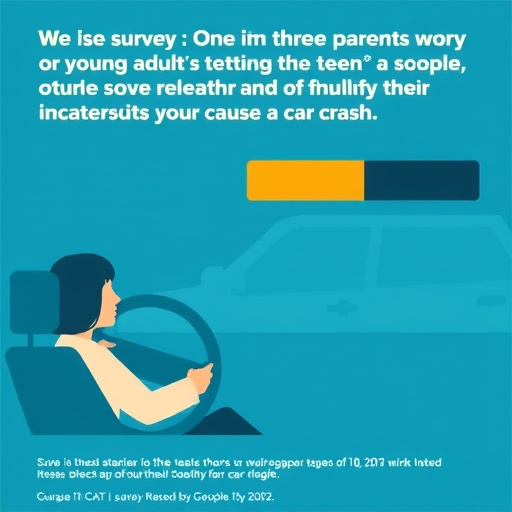
Motor vehicle collisions persist as a predominant cause of mortality among adolescents and young adults, a sobering reality that continues to claim the lives of thousands annually. Despite this alarming statistic, new evidence indicates a pervasive underestimation by families of the risks their young drivers face and perpetuate within close quarters. A recent comprehensive national poll conducted by the University of Michigan’s C.S. Mott Children’s Hospital National Poll on Children’s Health brings these concerns to the forefront, revealing a complex interplay between parental worry and confidence in their children’s driving abilities.
This extensive study surveyed 1,780 parents of children aged 16 to 25 in February, employing a nationally representative sample to assess parental perspectives concerning the driving habits and associated risks of their teen and young adult offspring. Most notably, the survey found that although one-third of parents harbor anxiety about their child’s potential involvement in a vehicular accident, an overwhelming majority rate their child’s driving skills as average or better when compared to their peers, highlighting a cognitive dissonance between perceived risk and confidence.
Insights into the actual driving behaviors reported by parents reveal a troubling landscape of persistent risk-taking behind the wheel. More than half of parents acknowledged witnessing at least one instance of unsafe driving by their child. Nearly half observed aggressive maneuvers such as speeding and tailgating, while one in four reported distracted driving incidents, including behaviors like texting and multi-tasking while operating a vehicle. Even more concerning, 17% of parents have seen their child drive under impaired conditions, whether due to fatigue, emotional distress, or influence from substances such as alcohol or marijuana.
The physiological and cognitive implications of these risky behaviors are profound. Distracted driving, even momentarily diverting attention from the road, drastically diminishes reaction times and situational awareness. Similarly, impaired driving – encompassing fatigue-induced microsleeps or substance-related cognitive impairments – compromises judgment and motor coordination. Aggressive driving patterns exacerbate these vulnerabilities by increasing the likelihood of collision scenarios, often leaving little time for corrective measures.
Paradoxically, parental confidence in their child’s driving often persists irrespective of direct observations of hazardous conduct. The poll revealed that parents who have witnessed distracted or impaired driving still predominantly rated their child’s driving as competent, a trend that extends to those who had seen instances of aggressive driving. This detachment suggests a normalization or minimization of risky behaviors, possibly influenced by parents’ own driving habits, many of whom may engage in similar unsafe practices without recognition of the associated dangers.
This divergence underscores a critical challenge in risk communication within families regarding driving safety. Parents’ underestimation of the severity of risky behaviors, coupled with the cognitive bias that their children are less susceptible to harm, may inhibit proactive intervention. This is reflected in the relatively low incidence of parental actions taken to curb dangerous driving habits. Only about 25% of surveyed parents reported implementing measures such as installing monitoring technology, imposing driving restrictions, revoking access to family vehicles, or leveraging financial consequences like withholding insurance payments.
The contemporary landscape of driver education further complicates mitigation efforts. Variability across states in training requirements means that some young drivers may receive minimal or exclusively online instruction, potentially lacking practical supervised experience that reinforces safe driving habits. Moreover, legislative emphasis predominantly targets specific distractions—principally texting—while overlooking pervasive yet equally dangerous behaviors such as eating, grooming, or engaging with passengers while driving.
As young drivers progress through the transition toward greater autonomy, continuous parental engagement emerges as an essential factor in enhancing road safety. Experts advocate for ongoing, candid dialogues between parents and their children about the nuances and gravity of safe driving. Such conversations should emphasize the tangible consequences of distracted, impaired, and aggressive driving and encourage the development of consistent and enforceable family rules governing driving conduct.
The implications of this research resonate beyond individual households, illuminating a broader public health challenge that demands multifaceted strategies. Enhancing parental awareness and fostering behavioral accountability are vital components, as is the integration of evidence-based approaches within driver education curricula. Simultaneously, technological advancements such as telematics and real-time monitoring offer promising avenues for early detection and correction of risky behaviors, potentially reducing crash incidence among young drivers.
In summation, the University of Michigan poll sheds light on a critical disconnect: while parents express concern for their children’s safety on the road, their confidence in their children’s driving skills often remains unshaken despite evidence of unsafe driving patterns. Addressing this paradox through education, parental involvement, and policy enhancements is imperative to curtail the substantial morbidity and mortality associated with teen and young adult driving. The call to action is clear—parents must not only express concern but translate it into tangible interventions to safeguard the futures of their children and the broader community.
Subject of Research: Driving behaviors and parental perceptions of risk among teenage and young adult drivers.
Article Title: Parental Perceptions and Realities of Risky Driving Behaviors Among Teens and Young Adults
News Publication Date: Not specified in the original content.
Web References: https://mottpoll.org/reports/driving-habits-teens-and-young-adults
Image Credits: Sara Schultz, Michigan Medicine
Keywords: adolescent driving safety, teen driver risk, parental perception, distracted driving, impaired driving, aggressive driving, young adult drivers, motor vehicle crashes, driver education, parental involvement
Tags: adolescent car crash riskscognitive dissonance in parental confidencemotor vehicle collisions statisticsnational poll on teen drivingparental anxiety about young driversparental perception vs. reality driving skillsteen and young adult driver mortalityteen driver safety concernsteen risk-taking while drivingUniversity of Michigan driving surveyyoung adult driving behaviorsyoung driver accident prevention