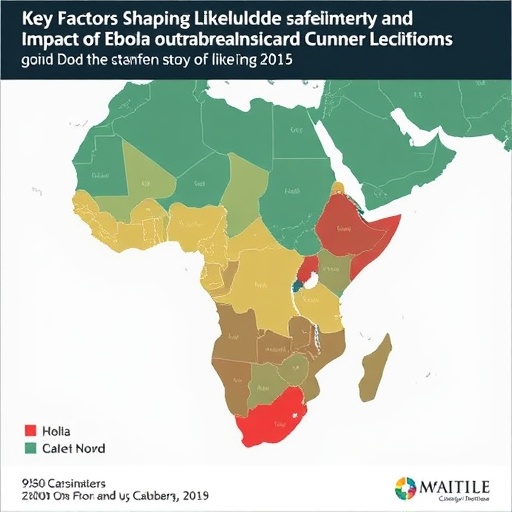
In the heart of Central and West Africa, where dense forests and winding rivers define the landscape, a persistent threat continues to challenge public health systems and global disease prevention efforts: Ebola virus disease. Since its discovery in 1976, Ebola has unleashed more than three dozen outbreaks, culminating in one of the deadliest epidemics between 2013 and 2016 that claimed over 11,000 lives. This hemorrhagic fever, marked by severe symptoms including fever, organ failure, and uncontrolled bleeding, spreads primarily through contact with infected bodily fluids, often making containment a monumental challenge. Yet, recent efforts spearheaded by researchers at Penn State University have cast new light on the intricate interplay of environmental and human factors that underpin these outbreaks, providing crucial insights into how Ebola emerges and propagates through populations.
At the core of this pioneering investigation lies an innovative approach to understanding Ebola’s spillover events—the critical moments when the virus first transfers from its wildlife reservoirs into human populations, igniting outbreaks. Penn State scientists, led by postdoctoral researcher Kelsee Baranowski, have deeply examined the environmental precursors to these spillovers by meticulously analyzing long-term climatic data and ecosystem health indicators in affected regions. Contrary to expectations, their findings reveal that no single environmental trigger consistently precedes spillover events. Instead, a mosaic of environmental conditions, varying in combination and intensity, appear to set the stage for Ebola’s stealthy emergence, highlighting the complex, multifactorial nature of zoonotic spillovers.
Simultaneously, this research disentangles the nuances of how human activities and movements influence the spread of Ebola subsequent to these initial spillovers. Recognizing the limitations of modern mobility data in some outbreak regions—largely due to technological constraints and data accessibility—the team adopted an inventive method by digitizing decades-old Michelin road and river maps dating from 1960 to 2020. These maps offer a proxy for human transit infrastructure, framing an invaluable dataset to examine the correlation between connectivity and early outbreak intensity. Their analyses established a robust positive correlation between the density of road and river networks and the magnitude of Ebola cases during the initial transmission phases, underscoring the dual role of infrastructure in both facilitating disease spread and potentially empowering outbreak management through enhanced surveillance capabilities.
In dissecting the origins of spillovers, the research emphasizes the enigmatic nature of the virus’s jumps from wildlife, particularly highlighting the pivotal role of species such as fruit bats, gorillas, chimpanzees, and antelopes. While fruit bats are widely regarded as natural Ebola reservoirs, the exact mechanisms of viral transmission—whether through contaminated feces, saliva, or other unknown vectors—remain incompletely understood. These animals, when hunted or otherwise contacted by humans, become unintended conduits for zoonotic transmission. Importantly, the researchers note that large human outbreaks arise not from multiple independent spillovers but from sustained human-to-human transmission following a single initial infection, complicating efforts to halt disease progression once established.
The environmental factors investigated include systematic examination of weather patterns and vegetation indices prior to outbreak occurrences. Rather than a single, glaring environmental anomaly, patterns suggest a confluence of conditions may collectively prime ecosystems for spillovers. Intriguingly, the anticipated role of deforestation in increasing spillover risk did not manifest strongly in their analyses, with notable forest loss events frequently predating spillovers by years, suggesting a more nuanced relationship between land use changes and Ebola emergence than traditionally postulated. Similarly, while human population growth showed some weak association with spillover sites within the two years preceding outbreaks, it did not emerge as a definitive predictor, indicating that demographic shifts alone cannot fully account for spillover dynamics.
Key to understanding Ebola’s propagation post-spillover is the mapping and quantification of human mobility and connectivity. Through their innovative use of paper maps digitized and archived in Penn State’s Donald W. Hamer Center for Maps and Geospatial Information, the team was able to reconstruct historical transit networks and assess their influence on outbreaks retrospectively. The positive correlation found between transport infrastructure density and early case numbers suggests that either greater connectivity amplifies the speed and breadth of virus spread or that well-connected areas have more effective reportability and case ascertainment. This insight holds notable implications for public health strategies, as it intimates that transit networks may simultaneously represent both vulnerabilities and assets during outbreak response.
These revelations extend beyond Ebola alone. The methodological framework and conceptual insights derived from this work hold significant promise for understanding and managing a wide array of communicable diseases that hinge on human mobility for their transmission. As global interconnectedness intensifies, this research offers a blueprint for leveraging transport infrastructure data to anticipate and curtail disease spread in real time. Moreover, the approach’s applicability is broad, poised to impact preparedness efforts not only in infectious disease outbreaks but also in natural disaster responses, where understanding movement patterns is paramount.
While the spotlight here rests on Ebola, the Penn State team is ambitiously extending their inquiry to encompass Marburg virus, a close viral cousin with similar transmission vectors linked to Egyptian fruit bats. By examining the environmental signals that precede Marburg spillovers and juxtaposing these with Ebola data, they hope to refine understanding of zoonotic spillover drivers more generally. Another exciting frontier involves retrospective analysis of environmental conditions during extended periods devoid of reported Ebola outbreaks, endeavoring to uncover silent or undetected spillover events that might have gone unnoticed and better delineate the full spectrum of outbreak emergence patterns.
Collaboration drives the strength of this multidisciplinary research effort. Alongside Baranowski, key contributors include associate professor Nita Bharti and colleagues from institutions including the University of Utah and Washington State University as well as the National Institute of Allergy and Infectious Diseases. Together, they blend expertise in infectious disease dynamics, epidemiology, geography, and environmental science, translating complex data into actionable insights. This teamwork manifests not only in their scholarly publications but also in openly accessible digital repositories, which provide transparency and extend the utility of their data resources to the broader scientific community.
Perhaps most compelling is how these findings could reshape public health maneuvering against Ebola and similarly transmitted viruses. The study urges public officials to integrate environmental surveillance with spatial analyses of human transit networks to devise preemptive measures and tailor intervention strategies optimized for local ecological and infrastructural landscapes. By doing so, it may be possible to attenuate outbreak severity, enhance rapid response protocols, and ultimately save lives in regions historically vulnerable and underserved.
Such impactful research underscores the value of bridging historical datasets with cutting-edge analytical tools to decode the complexities of pathogen emergence. It challenges conventional assumptions about the primacy of deforestation or simple demographic factors, instead advocating for a nuanced appreciation of the multifaceted drivers behind spillovers and epidemic growth. As infectious diseases continue to pose global threats, studies like this illuminate pathways toward more effective anticipation, prevention, and control—testaments to the power of informed, interdisciplinary science in safeguarding human health.
Subject of Research: Not applicable
Article Title: Multiple environmental conditions precede Ebola spillovers in Central Africa
News Publication Date: 28-Jan-2026
Web References:
– DOI: http://dx.doi.org/10.1098/rsbl.2025.0654
– GitHub Repository: https://github.com/bhartilab/EbolaMaps
– Penn State Donald W. Hamer Center for Maps and Geospatial Information: https://libraries.psu.edu/maps
References:
– Baranowski, K., Bharti, N., et al. (2026). Multiple environmental conditions precede Ebola spillovers in Central Africa. Biology Letters. DOI: 10.1098/rsbl.2025.0654
– Related paper in Scientific Reports on human movement and Ebola spread: DOI: 10.1038/s41598-025-33688-y
Image Credits: Nita Bharti, Penn State
Keywords: Infectious diseases, Viral infections, Disease outbreaks, Infectious disease transmission, Ebola virus, Public health
Tags: Central and West Africa Ebola risksEbola epidemic 2013-2016 analysisEbola hemorrhagic fever symptomsEbola outbreak environmental factorsEbola virus disease transmissionecosystem health and disease emergencehuman-wildlife interaction Ebola riskslong-term climatic impact on EbolaPenn State Ebola researchpublic health challenges in Ebola containmentspillover events from wildlife to humanszoonotic disease outbreak predictors