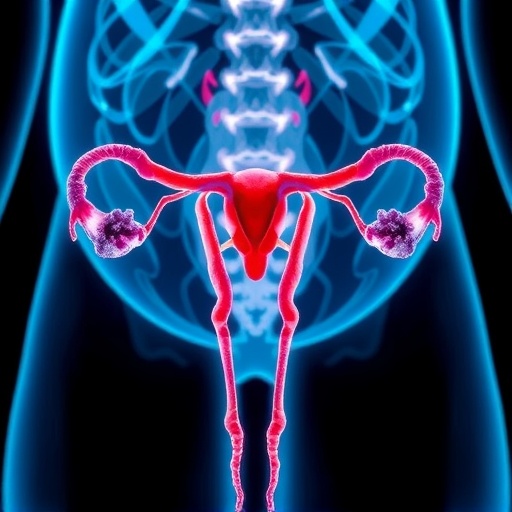
In a groundbreaking advancement that could redefine treatment paradigms for ovarian cancer, researchers at the University of California San Diego have elucidated a novel mechanism by which the immune system can be reprogrammed to more effectively target malignant ovarian tumors. Their investigation centered on the modulation of tumor-immune cell communication, specifically via the inhibition of a pivotal protein known as focal adhesion kinase (FAK), which is notoriously hyperactive in high-grade serous ovarian cancer—the most aggressive and prevalent subtype of ovarian malignancies.
High-grade serous ovarian cancer remains a formidable clinical challenge, largely due to its propensity for resistance to conventional chemotherapy and its ability to sculpt an immunosuppressive tumor microenvironment. This hostile milieu stifles the body’s natural immune defenses and has rendered many immunotherapeutic approaches relatively ineffective. Immune checkpoint inhibitors, which have revolutionized treatment in cancers such as melanoma and lung carcinoma, have yet to achieve comparable success in ovarian cancer, underscoring an urgent need for innovative strategies that alter the tumor landscape to favor immune activation.
The team’s research revealed that by pharmacologically inhibiting FAK activity within ovarian cancer cells, these tumors begin to secrete extracellular vesicles—nano-scale particles—that are enriched with omega-3 fatty acids. Omega-3 fatty acids, widely recognized for their anti-inflammatory properties in systemic physiology, assume a novel role here as signaling mediators within the tumor microenvironment. These vesicles are subsequently internalized by macrophages, versatile immune cells that can adopt either pro-tumor or anti-tumor phenotypes depending on the contextual signals they receive.
Upon uptake of the omega-3-laden vesicles, macrophages undergo a profound phenotypic reprogramming, shifting from an immunosuppressive state to an activated anti-tumor mode. This transformation is marked by the macrophages’ secretion of the chemokine CXCL13, a potent attractant of tertiary lymphoid structures (TLS). TLS are ectopic immune cell aggregates that resemble lymph nodes and function as immunological hubs, orchestrating robust and localized anti-cancer responses. Previous clinical correlations have identified the presence of TLS within tumors as a biomarker for favorable patient prognosis and heightened responsiveness to immunotherapy.
Critically, this mechanistic insight was substantiated in preclinical murine models where a combinatorial treatment regimen—consisting of a FAK inhibitor, low-dose chemotherapy, and immunotherapy—was employed. The therapeutic synergy not only curtailed tumor progression but also facilitated increased infiltration of immune effector cells, culminating in extended overall survival. These findings substantiate the premise that disrupting FAK signaling interrupts the immunosuppressive feedback loop commonly exploited by ovarian tumors, thereby restoring immune competency within the tumor microenvironment.
The implications of these findings extend beyond the biochemical and cellular level, offering a tangible translational pathway. FAK inhibitors are currently under clinical evaluation, and this study provides compelling rationale to incorporate these agents alongside chemo-immunotherapy regimens. This integrated approach seeks to convert the ovarian tumor milieu from one of immunological dormancy and tolerance into an inflamed and immunostimulatory state, thereby potentially overcoming the entrenched resistance mechanisms that have long impeded therapeutic success.
Moreover, the identification of a lipid-based intercellular communication axis between tumor cells and macrophages introduces an unexplored dimension of tumor immunology. The selective packaging of omega-3 fatty acids within extracellular vesicles and their subsequent role in immune modulation offers a rich vein of scientific inquiry, with potential applications not only in ovarian cancer but also across a spectrum of malignancies characterized by immune evasion.
Institutions such as UC San Diego’s Moores Cancer Center are now poised to lead future investigations that refine these therapeutic strategies. The elucidation of this pathway underscores the importance of a multidimensional approach to cancer therapy, one that integrates molecular targeting with immunomodulation and traditional cytotoxic modalities. This integrative strategy exemplifies the ongoing evolution of precision oncology designed to enhance patient survival and quality of life.
The foundational study was spearheaded by Dr. David D. Schlaepfer, a respected figure in reproductive sciences and oncology, whose collaborative efforts with immunobiologists at Sanford Burnham Prebys Medical Discovery Institute underscore the multidisciplinary nature intrinsic to such complex biomedical research. Supported by prestigious institutions including the National Institutes of Health and the National Science Foundation, the work stands as a testament to rigorous scientific inquiry backed by robust funding frameworks.
Published in the esteemed journal Cell Reports, the research not only charts new territory in ovarian cancer biology but also establishes a preclinical blueprint for clinical translation. As the oncology community eagerly anticipates the results of forthcoming clinical trials examining FAK inhibitors’ efficacy, this study provides a well-founded scientific cornerstone advocating for combination regimens that harness immune system reactivation.
In essence, the revelation that inhibition of focal adhesion kinase can convert ovarian tumors from immune-excluding fortresses into vulnerable targets for immune destruction heralds a promising new era in cancer therapy. By harnessing the power of omega-3 fatty acid-mediated intercellular communication and macrophage re-education, these insights provide renewed hope for patients battling one of the most intractable forms of cancer.
Subject of Research: Immune system reprogramming in ovarian cancer through focal adhesion kinase inhibition.
Article Title: Not provided.
News Publication Date: Not provided.
Web References:
Cell Reports Publication
DOI: 10.1016/j.celrep.2026.117009
References:
The original study as published in Cell Reports by UC San Diego research teams and collaborators.
Image Credits: UC San Diego Health Sciences
Keywords: Ovarian cancer, Focal adhesion kinase (FAK), Immunotherapy, Macrophage reprogramming, Omega-3 fatty acids, Tumor microenvironment, Tertiary lymphoid structures, CXCL13, Extracellular vesicles, Chemokines, Immune activation, Cancer immunology
Tags: cancer microenvironment modulationchallenges with immune checkpoint inhibitorsextracellular vesicles in ovarian cancerfocal adhesion kinase inhibitionhigh-grade serous ovarian cancer researchimmune system reprogramming in cancerimmunosuppressive tumor microenvironmentnovel immunotherapeutic strategiesomega-3 fatty acids in cancer therapyovarian cancer treatment breakthroughsovercoming chemotherapy resistancetumor-immune cell communication