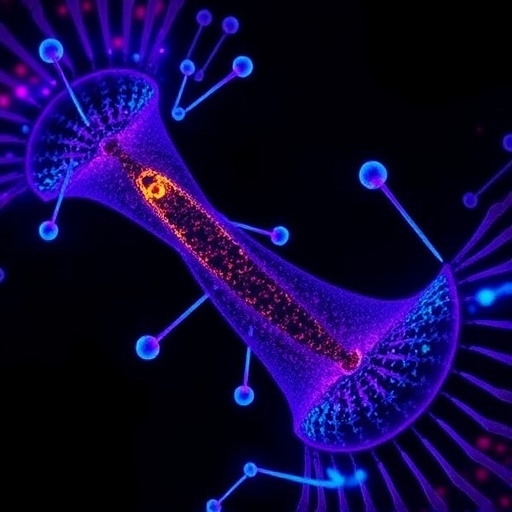
In a groundbreaking discovery published in Molecular Cell, researchers at the University of North Carolina at Charlotte have revealed a surprising mechanism by which an exceptionally rare protein, CBX2, controls the formation of large-scale gene-silencing structures within cells. This finding uncovers how as few as three molecules of CBX2 can orchestrate the assembly of repressive condensates that are pivotal for guiding embryonic stem cells towards their destined fates. The study challenges prior assumptions about the behavior of Polycomb group proteins and sheds light on the intricate molecular choreography underlying cell identity, development, and epigenetic regulation.
Polycomb protein complexes, crucial regulators of gene repression, have long intrigued scientists due to their elusive physical properties and mechanisms. Traditionally, it was believed that these complexes established gene repression through widespread protein interactions and classical phase separation. However, the scarcity of some Polycomb proteins like CBX2 within the cell—present at barely detectable levels—posed a formidable challenge to understanding their operational principles. By employing state-of-the-art single-molecule microscopy combined with precise genetic engineering, the UNC Charlotte team was able to count and observe these elusive molecules one by one, a feat never before achieved in this context.
Their observations overturned previous models: rather than forming condensates through a dense network of interactions among many molecules, Polycomb condensates in mouse embryonic stem cells (mESCs) begin with tiny clusters of only three CBX2 molecules. This minimal core acts as a seed, drawing in additional Polycomb components, including PRC1 and PRC2 complexes, to construct multicomponent repressive hubs. These hubs are essential for molding the epigenome by positioning the histone modification H3K27me3, which marks chromatin for gene silencing. This discovery reveals the outsized influence of an extremely low-abundance protein, redefining our understanding of epigenomic regulation dynamics.
Subsequent analyses demonstrated that the quantity of CBX2 within these condensates changes dramatically as cells differentiate. In neural progenitor cells, the number of CBX2 molecules per condensate increases fivefold compared to embryonic stem cells, reflecting how cell fate decisions remodel repressive chromatin landscapes. Genome-wide mapping via CUT&Tag and CUT&RUN techniques revealed that CBX2 preferentially binds at PRC2 nucleation sites—genomic regions where H3K27me3 deposition is initiated—stressing its fundamental role in spatially organizing the epigenome.
To dissect the molecular underpinnings of CBX2 function, the researchers engineered a separation-of-function mutant, CBX2^PSM, which retains chromatin-binding ability but cannot self-cluster. This mutant exhibited a stark failure to form condensates in live cells, requiring concentrations over 100 times higher than normal to condense in vitro. Intriguingly, despite normal chromatin affinity, H3K27me3 became aberrantly mislocalized, accumulating in DNA-dense regions rather than forming proper Polycomb domains. These perturbations revealed that self-clustering, rather than mere chromatin binding, is indispensable for functional Polycomb domain formation.
This insight carries profound implications for the regulation of developmental gene expression programs. When differentiation was experimentally induced in CBX2^PSM cells, the resultant embryoid bodies showed marked defects in outgrowth and neural progenitor cell formation. The reduction in Nestin-positive cells—a hallmark of neural progenitors—highlighted a failure of these mutant cells to execute developmental programs. This provides compelling evidence that CBX2 self-clustering acts as a foundational event in enabling cells to commit to specific fates, much like a raindrop requires a nucleus upon which to form.
The revelations presented here culminated in the proposal of a refined mechanistic model termed nucleation and bridging induced phase separation (NBiPS). This model marries the concepts of nucleation—a localized initiation event—with chromatin bridging to explain condensate formation in scenarios where classical liquid-liquid phase separation is insufficient due to low protein abundance. According to NBiPS, CBX2 first binds to nucleation sites on chromatin, creating small nucleoprotein assemblies. These then recruit CBX7 and associated PRC1 complexes, which bridge chromatin fibers, facilitating the stable recruitment and activation of PRC2 for H3K27me3 deposition. As this process progresses, the condensate evolves into a fully functional Polycomb domain, capable of enforcing gene repression.
NBiPS provides a unifying framework to reconcile previous in vitro and in vivo observations regarding Polycomb complex behavior and offers a compelling explanation for how scarce proteins can nonetheless coordinate large-scale chromatin architecture. This insight is poised to revolutionize our grasp of epigenetic control mechanisms and encourages a reevaluation of models for nuclear compartmentalization by low-abundance regulatory factors.
The implications of these findings extend into the realm of human health and disease. Polycomb group protein dysfunction has been implicated in various developmental disorders and malignancies, but the precise molecular drivers behind these pathologies remained obscure. By illuminating how CBX2 and its self-clustering capability underpin stable gene silencing and cell fate commitment, this study lays the groundwork for future therapeutic interventions aimed at modulating epigenetic states in diseases linked to aberrant Polycomb activity.
Beyond basic biology, the study also underscores the power of cutting-edge single-molecule imaging technologies combined with precise genome editing tools to tackle long-standing questions in molecular biology. The ability to visualize and quantify individual protein molecules within living cells is transforming our capacity to decipher complex regulatory networks with unprecedented precision, promising transformative advances across biomedical sciences.
Looking ahead, further research will be critical to determine how the balance of Polycomb protein interactions is modulated during development and in disease states, and whether similar nucleation-based mechanisms operate in other epigenetic regulators. Such investigations promise to deepen our understanding of the molecular tapestries that sculpt cellular identity and function throughout life.
Subject of Research: Cells
Article Title: Self-clustering of three CBX2 molecules drives PRC2 to promote facultative heterochromatinization of Polycomb target genes
News Publication Date: 4-Mar-2026
Web References:
10.1016/j.molcel.2026.02.009
Image Credits: UNC Charlotte
Keywords
Polycomb group proteins, Chromatin, Nucleation, Single molecule imaging
Tags: CBX2 protein gene silencingembryonic stem cell fate controlepigenetic regulation of developmentgene repression protein complexesgenetic engineering in epigeneticsmolecular condensates epigenome organizationphase separation in gene silencingPolycomb group protein mechanismsrare protein molecular dynamicssingle-molecule microscopy gene regulationstem cell differentiation epigeneticsUNC Charlotte molecular biology research