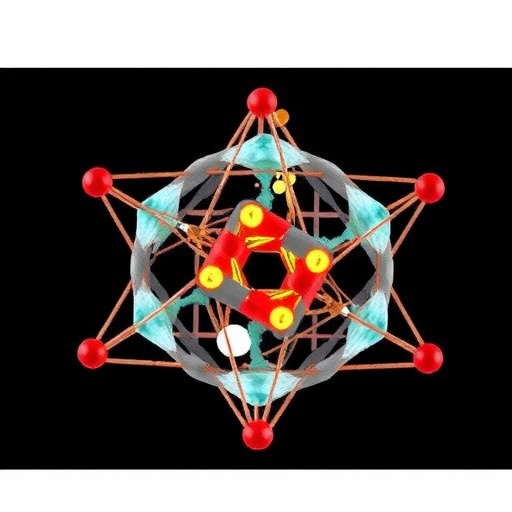
A surge in big-data and quantum-device development is pushing materials toward the atomic scale, where conventional magnetism often fails. One key limitation is the superparamagnetic effect, which erases magnetic memory and hampers high-density information storage. In response, single-molecule magnets (SMMs) have emerged as precision-built quantum materials, offering slow magnetic relaxation and hysteresis even at the level of individual molecules.
Beyond magnetism itself, researchers are now asking whether SMMs can act as “sensing bridges” that convert magnetic-field changes into mechanical strain. Such magnetoelastic coupling could expand the impact of SMM technology into areas ranging from adaptive sensors to quantum-enabled actuation. In a recent breakthrough, a team led by Professor Zheng Yanzhen identified a SMM that changes shape when exposed to magnetic fields, and they coined the term “single-molecule magnetostrictor.”
Magnetostriction in traditional solids is commonly linked to magnetic domain rearrangement or shifts in magnetic anisotropy axes. However, the researchers report that exchange-coupling-driven magnetostriction has not been clearly demonstrated in molecular systems. The key to their strategy lies in isolating the fundamental interaction between Fe(III) and Gd(III) spins inside the cubic {Fe8Gd8} crystal, while suppressing contributions that would obscure the mechanism.
To achieve this, the team used isostructural diamagnetic-substitution “background subtraction” models, including {Fe8Y8} and {Sc8Gd8}. The study confronted a massive quantum problem—up to a Hilbert space of 10^13—handled through Quantum Monte Carlo simulations based on the Stochastic Series Expansion method. High-frequency/high-field electron paramagnetic resonance (HF-EPR) measurements gave a g-value of 2.03 for {Fe8Gd8}, indicating that single-ion anisotropy is negligible. Complementary low-temperature heat-capacity experiments (0.2–10 K) showed no λ-type anomalies, arguing against long-range magnetic ordering.
Using a high-resolution capacitive dilatometer at 2 K under a 7 T magnetic field, the researchers measured saturation magnetostriction, λs, reaching 50 ppm. Remarkably, this magnitude is comparable to benchmark polycrystalline ferromagnetic metals such as industrial iron and nickel. When the team combined QMC results with a mean-field framework, the theoretical strain response matched experimental data closely.
These converging lines of evidence point to a single cause: pronounced low-temperature magnetostriction arises from intramolecular ferromagnetic coupling between Fe(III) and Gd(III). The resulting large spin ground state responds rapidly to applied fields, producing macroscopic crystal striction. The work therefore establishes a new conceptual class of magnetostrictive materials rooted in single-molecule physics.
The findings were published online in the National Science Review under the title “Single-molecule magnetostrictor: an {Fe8Gd8} cubic crystal exhibits temperature-dependent magnetostriction.” Doctoral student Li Dongyang and Researcher Qin Lei served as co-first authors, while corresponding authors include Professor Zheng Yanzhen and Assistant Professor Zhai Yuanqi from Xi’an Jiaotong University, along with Researcher Fu Zhendong from Songshan Lake Materials Laboratory. The study was supported by the National Natural Science Foundation of China and related funding sources.
Keywords
Single-molecule magnet, magnetostriction, quantum Monte Carlo, electron paramagnetic resonance, magnetoelastic coupling, Fe–Gd exchange coupling, strain response, spin ground state, cubic crystal, quantum sensing
Subject of Research: Single-molecule magnetostrictor based on the {Fe8Gd8} cubic crystal
Article Title: Single-molecule magnetostrictor: an {Fe8Gd8} cubic crystal exhibits temperature-dependent magnetostriction
News Publication Date: Not provided
Web References: http://dx.doi.org/10.1093/nsr/nwag300
References: 10.1093/nsr/nwag300
Image Credits: ©Science China Press
Tags: adaptive magnetic sensorsatomic-scale magnetic propertiesFe(III)-Gd(III) spin interactionsisostructural substitution modelsmagnetic-field-induced shape changemagnetoelastic coupling in molecular systemsmolecular-scale magnetostrictionquantum materials for data storagequantum-enabled actuationsingle-molecule magnetostrictorsuperparamagnetic effect mitigationtemperature-dependent magnetic behavior