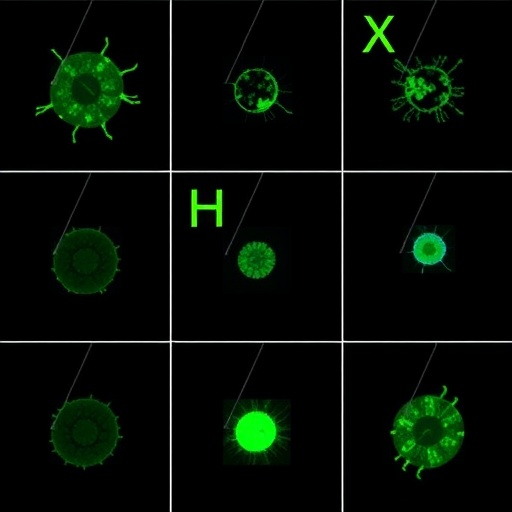
In a groundbreaking advancement published in Light: Science & Applications on March 3, 2026, researchers have unveiled a revolutionary technique that dramatically enhances the capabilities of photoacoustic microscopy (PAM) to achieve super-resolution functional imaging without the need for labeling. This pioneering work, led by Zhong, Wang, Lee, and colleagues, presents a transformative approach to visualize cellular activities with unprecedented clarity and detail, pushing the boundaries of biomedical imaging and opening new frontiers for cellular and molecular biology.
Photoacoustic microscopy is a cutting-edge imaging technique that harnesses the photoacoustic effect, wherein pulsed laser light absorption induces ultrasonic emission from biological tissues. These ultrasonic waves are then captured to create high-contrast, high-resolution images of tissue structure and function. Traditionally, PAM has been constrained by limitations in spatial resolution and the necessity for external contrast agents or labels to track specific cellular components, which often impede dynamic monitoring and can introduce toxicity or artifact signals.
Addressing these challenges, the research team developed a label-free cell tracking methodology integrated within a super-resolution functional PAM framework. This innovative system bypasses the need for exogenous markers by exploiting intrinsic optical absorption contrasts of endogenous cellular molecules. By meticulously analyzing the subtle, fluctuating photoacoustic signals originating from native biomolecules, the researchers successfully monitored individual cell dynamics and functions in vivo with remarkable resolution surpassing previous limits.
Central to this breakthrough is the application of advanced signal processing algorithms combined with high-frequency ultrasonic detection, which enhances spatial resolution beyond the classical acoustic diffraction limit traditionally associated with PAM. These methods include sophisticated deconvolution and computational reconstruction techniques that sharpen images and delineate cellular features with nanoscale precision. The result is a non-invasive, real-time visualization platform capable of capturing intricate cellular behaviors within complex tissue environments.
This novel super-resolution functional PAM approach fundamentally improves both functional sensitivity and spatial accuracy, enabling detailed investigation of physiological processes such as oxygen metabolism, cellular morphology changes, and intercellular interactions. The capacity to perform label-free tracking fosters a profound reduction in experimental complexity and artifact generation, which historically hindered the interpretation of dynamic biological phenomena.
The researchers demonstrated the profound utility of their technique by tracking live cells in various biological systems, including vascular networks and tumor microenvironments, providing unparalleled insight into the cellular responses to physiological stimuli and pathological alterations. Their imaging results revealed subtle variations in cell shapes and locations, correlated with functional states, which were previously undetectable through conventional PAM or fluorescence microscopy approaches.
The implications of this study are vast. It sets a new standard for non-invasive, high-resolution imaging that can be translated into preclinical and clinical research settings. For example, it offers potential applications in cancer diagnostics, where detecting heterogeneous cellular function within tumors is critical for treatment planning and monitoring. It also holds promise for neuroscience investigations, enabling the study of neuronal cell behavior and neurovascular coupling without perturbing native physiological conditions.
Moreover, this super-resolution functional PAM technique paves the way for exploring dynamic cellular environments over extended periods, providing continuity and context to longitudinal studies in living organisms. By eliminating the dependency on fluorescent dyes and other labeling compounds, it circumvents the photobleaching and cytotoxicity issues that have traditionally limited the duration and fidelity of live-cell imaging experiments.
The integration of machine learning algorithms with this imaging protocol further propels its analytical power. These algorithms enhance signal extraction from noisy data, allowing precise quantification of cellular features and functions with minimal human intervention. This combination of artificial intelligence and cutting-edge microscopy technology represents an exciting frontier in biomedical imaging research.
Technically, the instrumentation merges ultrashort pulsed lasers optimized for wavelength-specific excitation of endogenous chromophores, with innovative detection arrays capable of capturing broadband ultrasonic signals with exceptionally high signal-to-noise ratios. This meticulously engineered system ensures that even the most subtle cellular absorption variations contribute meaningfully to image formation, facilitating detection of minuscule structural and functional differences.
In conclusion, Zhong and colleagues’ work embodies a paradigm shift in functional photoacoustic microscopy. By marrying label-free cell tracking with super-resolution capabilities, they have unlocked a pathway toward non-invasive, high-fidelity imaging of living cells that retains molecular-level detail without the drawbacks of traditional labeling techniques. Their findings not only enhance the toolset available to biomedical researchers but also promise to accelerate discoveries in cell biology, pathology, and medical diagnostics.
As this innovative technology becomes more accessible and further refined, it is anticipated that numerous scientific disciplines will benefit from its unique capacity to visualize cellular environments dynamically and non-invasively. Ultimately, this breakthrough heralds a future where detailed, real-time cellular imaging is routine, transforming both fundamental research and clinical practice.
Article References:
Zhong, F., Wang, Z., Lee, Y. et al. Super-resolution functional photoacoustic microscopy via label-free cell tracking. Light Sci Appl 15, 146 (2026). https://doi.org/10.1038/s41377-026-02235-3
Image Credits: AI Generated
DOI: 03 March 2026
Tags: dynamic cell monitoring without labelsendogenous biomolecules imagingfunctional photoacoustic imaginghigh-resolution biomedical imagingintrinsic optical absorption contrastlabel-free cell trackingmolecular biology imaging techniquesnon-invasive cellular visualizationphotoacoustic microscopy advancementspulsed laser photoacoustic effectsuper-resolution photoacoustic microscopyultrasonic emission imaging