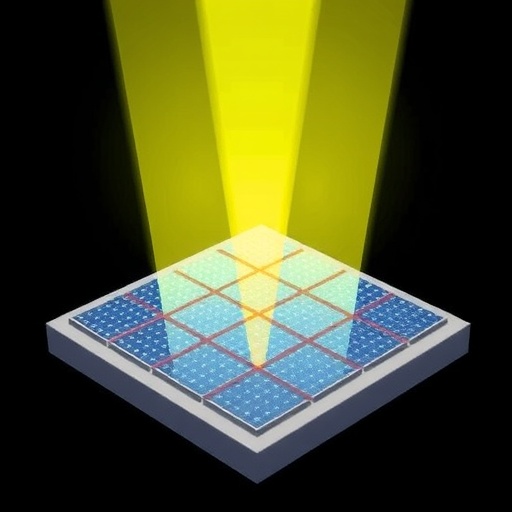
In the relentless pursuit of enhancing solar cell efficiency, crystalline silicon technology has long held the spotlight, powering much of the photovoltaic industry. Despite continuous advancements, the full theoretical potential of these solar cells, especially those utilizing tunnel oxide passivating contact (TOPCon) technology, has eluded industrial-scale applications. A leap towards closing this efficiency gap has now been reported through a groundbreaking dual-sided electrical refinement strategy, promising unprecedented gains in real-world operating conditions.
The newly unveiled methodology brings to the fore a certified efficiency of 26.66% on industrial-scale TOPCon solar cells using M10-size wafers, a remarkable benchmark that signals a turning point in photovoltaic performance. Historically, industrial TOPCon cells have faced challenges that capped their performance below the Auger recombination limit—the fundamental recombination barrier that dictates maximum achievable efficiency in silicon solar cells. This innovation intricately re-engineers both the front and rear interfaces of the solar cell, tackling conventional bottlenecks head-on through material and structural optimization.
At the forefront of this approach is the introduction of a high-sheet-resistance boron emitter on the front side of the wafer. This modification is more than a trivial change in doping parameters—it redefines the front junction’s passivation landscape. By elevating the sheet resistance, the boron emitter mitigates parasitic recombination losses and enhances surface passivation quality, pivotal for the efficient collection of photogenerated carriers. This adjustment fosters an environment where minority carriers are better preserved, directly uplifting the open-circuit voltage and overall cell efficiency.
Coupled with this, the implementation of a meticulously optimized grid design breathes new life into carrier transport dynamics. The grid, which is responsible for collecting and channeling charge carriers to external circuits, had traditionally faced a trade-off between shading losses and series resistance. By refining the grid geometry and materials, the new design achieves a harmonious balance—minimizing shading while concurrently reducing resistive losses. This fine-tuning ensures that carriers navigate the electrode pathways with minimal energy dissipation, translating to higher fill factors and enhanced power output.
The back side of the solar cell, often overlooked, has undergone an equally sophisticated transformation. Here, a double-layer tunnel oxide silicon/polysilicon structure takes center stage. This architectural innovation addresses the pernicious issue of silver-induced degradation—a phenomenon where silver atoms from the electrodes diffuse into the silicon substrate, compromising the passivation and electronic quality of the wafer. By establishing a robust physical and chemical barrier, this double-layer configuration effectively halts such silver migration, safeguarding the integrity of the silicon interface over time and under operational stress.
Central to the efficacy of this rear-side configuration is the use of a high-crystallinity polysilicon layer embedded within the double-layer stack. High crystallinity ensures fewer structural defects within the polysilicon, which in turn diminishes recombination sites and stabilizes electrical properties. Moreover, the refinement of phosphorus doping concentration within the silicon substrate manifests as a strategic balance—reducing the prevalence of inactive dopants that do not contribute to conductivity but potentially induce recombination pathways. This controlled doping profile results in superior passivation and carrier lifetimes, pivotal for elevating the cell’s efficiency ceiling.
In addition to these bulk and interface enhancements, the technique incorporates a locally thinned polysilicon layer on the rear side, an innovation with profound implications for bifacial cell performance. Bifacial solar cells have the unique capability to harvest light from both sides, and thus their efficiency depends heavily on the optical and electrical characteristics of their rear surfaces. By selectively thinning the polysilicon layer, the researchers achieved a notable increase in bifaciality—ascending to an impressive 88.3%. This heightened bifacial response not only boosts overall energy yield but also aligns with emerging deployment architectures seeking multi-directional light utilization.
This holistic dual-sided refinement approach challenges the preconceived limitations often encountered in industrial-scale TOPCon solar cells. Historically, scaling high-efficiency laboratory prototypes to commercial production often results in performance penalties due to variability and manufacturing constraints. Here, the meticulous engineering details cater explicitly to industrial realities, ensuring the refinements translate into robust, scalable manufacturing processes with consistent quality and reliability.
One of the subtle yet critical elements lies in the interplay between the enhanced passivation layers and carrier dynamics. Passivation quality intricately affects the surface recombination velocity—a parameter dictating how readily photogenerated carriers recombine at surfaces instead of contributing useful current. By simultaneously optimizing the front boron emitter and rear double-layer passivation, the cell reduces cumulative recombination losses from both major interfaces. This bilateral refinement paves the way toward approaching the elusive Auger recombination limit, which governs ultimate silicon solar cell performance.
Another layer of complexity tackled with this research is the mitigation of silver-induced degradation, a challenge posed by the widespread use of silver paste electrodes in commercial photovoltaic manufacturing. Silver’s tendency to diffuse into silicon not only deteriorates passivation but also introduces energy levels that act as recombination centers. The innovative double-layer tunnel oxide/polysilicon configuration breaks this diffusion path, extending the operational longevity and efficiency stability of the solar cells—a critical factor for real-world deployment and investor confidence.
Beyond technical intricacies, the researchers’ efforts also herald environmental and economic implications. By refining existing silicon solar cell architectures leveraging mature silicon technology, this approach avoids the necessity for exotic or rare materials, keeping production costs competitive while amplifying efficiency. This combination is vital for the global energy transition, where affordability and scalability must coexist with high performance to accelerate solar adoption worldwide.
In the broader context of photovoltaic innovation, these findings demonstrate a significant stride in closing the gap between record laboratory efficiencies and commercially deployable modules. The work exemplifies how nuanced understanding of materials science, doping profiles, and interface chemistry can amalgamate into palpable efficiency improvements that are not mere incremental gains but sizable leaps forward.
This research underscores the ongoing vitality of silicon-based photovoltaics in the sustainable energy landscape, reiterating that optimization at the micro and nano scales continues to unlock new frontiers. The achievement of a 26.66% efficiency for industrial-scale TOPCon solar cells indicates that high-performance modules compatible with existing manufacturing infrastructure are within reach—potentially catalyzing a phase of accelerated cost reductions and widespread adoption.
By envisioning solar technology through a dual-sided lens, this innovation encourages the industry to rethink traditional cell architectures and adopt multidimensional optimization strategies. Repairing inefficiencies on both the front and rear surfaces simultaneously demonstrates a level of engineering sophistication that bodes well for future explorations, where further refinements could push silicon efficiency even closer to its theoretical limits.
Looking forward, challenges such as module integration, long-term field stability, and adaptation to emerging cell formats remain areas of active research. Nevertheless, the industrial readiness of these improvements paints a promising future where high-efficiency silicon photovoltaics could dominate beyond record lab cells, establishing new benchmarks for commercial solar energy production.
This breakthrough not only represents a triumph of metallurgical and semiconductor engineering but also reflects the persistent spirit of innovation fueling the renewable energy revolution. With such advances in TOPCon solar cells, the moment to harness the sun’s vast potential more effectively has arrived, promising a greener, more sustainable energy future for all.
Subject of Research: Industrial-scale tunnel oxide passivating contact (TOPCon) silicon solar cells efficiency enhancement.
Article Title: Dual-side electrical refinement enables efficient industrial tunnel oxide passivating contact silicon solar cells.
Article References:
Yang, Z., Chen, S., Mao, J. et al. Dual-side electrical refinement enables efficient industrial tunnel oxide passivating contact silicon solar cells. Nat Energy (2026). https://doi.org/10.1038/s41560-026-01982-2
Image Credits: AI Generated
DOI: https://doi.org/10.1038/s41560-026-01982-2
Tags: Auger recombination limit in silicon cellscertified 26.66% solar cell efficiencycrystalline silicon photovoltaic technologydual-sided electrical refinement strategyfront and rear interface optimizationhigh-sheet-resistance boron emitterindustrial tunnel oxide solar cellsindustrial-scale photovoltaic advancementsM10-size wafer solar cellsmaterial and structural optimization in solar cellspassivating contact solar cellsTOPCon solar cell efficiency improvement