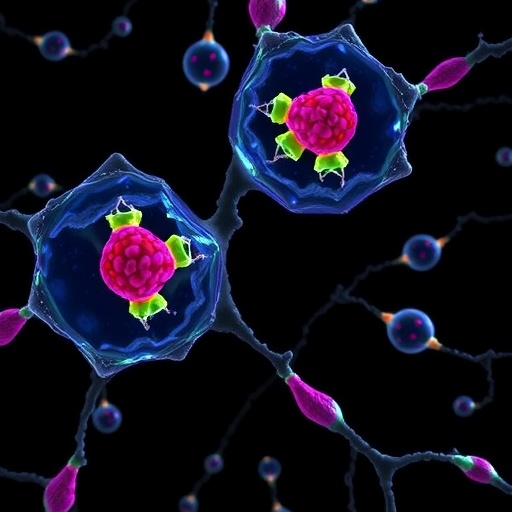
In a groundbreaking study that may redefine our understanding of cellular organization, researchers at Scripps Research have unveiled an unexpected and intricate internal architecture within biomolecular condensates. For years, these dynamic, droplet-like structures inside cells were thought to be simple, liquid-like entities lacking any defined internal form. This new research, however, reveals that some condensates are composed of elaborate networks of filamentous proteins, forming a precisely organized scaffold crucial for their biological functions. This discovery not only challenges existing dogma but also opens promising avenues for therapeutic strategies targeting diseases ranging from cancer to neurodegeneration.
Biomolecular condensates play pivotal roles in the cell by compartmentalizing biochemical reactions without the need for traditional membrane boundaries. They orchestrate complex processes such as gene expression regulation and protein quality control while maintaining a dynamic state. Traditionally, due to their liquid-like behavior—exhibiting merging, flowing, and rapid molecular exchange—condensates were considered structurally amorphous. This posed significant challenges for therapeutic targeting, as the absence of defined molecular features rendered drug design exceedingly difficult.
The team at Scripps Research, led by associate professor Keren Lasker, used advanced cryo-electron tomography (cryo-ET) to solve this long-standing puzzle at unprecedented resolution. Focusing on a bacterial model system, they examined PopZ, a protein that forms condensates at the poles of rod-shaped bacterial cells. These PopZ assemblies organize key protein factors necessary for precise cell division. Cryo-ET images revealed that PopZ condensates are far from amorphous; instead, they possess a highly ordered filamentous ultrastructure. This architectural network imparts distinct physical properties to the condensates, including surface tension and mechanical stability, which are essential for their biological role.
To dissect the specific contributions of this filamentous architecture, the researchers introduced mutations that disrupted filament formation within PopZ. Remarkably, these mutations caused condensates to become excessively fluid, altering their mechanical properties and impairing their function in live bacteria. Cells harboring these mutant condensates exhibited halted growth and severe defects in DNA segregation, unequivocally demonstrating that the condensate’s structural integrity is indispensable for cellular viability. This finding underscores that a condensate’s function is intimately tied not just to its molecular components but to its higher-order organization.
Adding another layer of complexity, the study employed single-molecule Förster resonance energy transfer (FRET) to probe conformational changes in PopZ molecules based on their condensate localization. This technique detects minute distance changes within proteins through energy transfer between fluorescent probes, providing insights into dynamic molecular rearrangements. The Lasker lab discovered that PopZ adopts distinct conformations inside versus outside the condensate environment, pointing to a responsive interplay between protein structure and condensate architecture. This insight opens exciting possibilities for bioengineering condensates with programmable functions by manipulating protein conformations.
Beyond bacterial systems, the implications extend deeply into human biology. Similar filament-supported condensates have been implicated in critical cellular quality control mechanisms. For example, condensates responsible for sequestering and degrading damaged or aggregation-prone proteins help prevent cellular toxicity—a key factor in neurodegenerative disorders like amyotrophic lateral sclerosis (ALS). Moreover, condensates regulating cellular growth serve as tumor suppressors; when their structure or formation is compromised, unchecked proliferation ensues, contributing to cancers such as prostate, breast, and endometrial carcinomas.
The discovery that condensate ultrastructure is both definable and essential elevates our conceptual framework of intracellular organization. It also suggests a transformative therapeutic paradigm: drugs could be designed to target and modulate the filamentous scaffold within condensates, restoring normal function in disease states. This structural foothold dramatically expands the potential druggable landscape beyond traditional protein targets, heralding a new era in precision medicine.
The multi-disciplinary nature of the study combined cutting-edge structural biology techniques, advanced microscopy, and molecular biophysics. Collaborators from Scripps Research, including professors Ashok Deniz and Raphael Park, contributed expertise in single-molecule spectroscopy and computational modeling to unravel condensate dynamics. Their integration of cryo-ET with FRET measurements exemplifies how convergent technologies can address complex biological questions inaccessible to any single method.
This research not only overturns a fundamental assumption in cell biology but also lays a robust foundation for future studies exploring condensate architecture across diverse organisms and cell types. By elucidating the principles that govern the assembly and function of condensates, scientists now have critical knowledge to investigate pathological condensate states linked to disease and aging. The insights gleaned may also inspire synthetic biology approaches to harness engineered condensates for therapeutic delivery and cellular reprogramming.
In summary, the revelation of a filamentous ultrastructure within PopZ condensates represents a scientific milestone. It shifts the paradigm from viewing biological condensates as simple liquids to recognizing them as intricately organized and structurally sophisticated compartments integral to cellular health. As researchers delve deeper into the architectural codes that define these membrane-less organelles, the prospect of innovative treatments targeting their unique structures becomes increasingly tangible, promising new solutions for some of medicine’s most intractable challenges.
Subject of Research: The internal architecture of biomolecular condensates, focusing on the filamentous ultrastructure of PopZ protein condensates and their role in cellular function.
Article Title: The filamentous ultrastructure of the PopZ condensate is required for its cellular function
News Publication Date: 2-Feb-2026
Web References:
https://www.nature.com/articles/s41594-025-01742-y
References:
Lasker, K., Scholl, D., Deniz, A., Park, R. et al. The filamentous ultrastructure of the PopZ condensate is required for its cellular function. Nature Structural & Molecular Biology, 2026.
Image Credits:
Scripps Research
Keywords:
Cell biology, biomolecular condensates, protein filaments, cryo-electron tomography, Förster resonance energy transfer, PopZ protein, cellular compartmentalization, neurodegeneration, cancer, protein conformation, membrane-less organelles, bacterial cell division
Tags: advanced imaging for cellular structuresbiomolecular condensate architecturecellular organization and cancer therapycryo-electron tomography in cell biologydynamic cellular droplets structurefilamentous protein scaffolds in cellsintracellular phase separation and diseasemembrane-less organelles in gene regulationneurodegeneration therapeutic targetsPopZ protein in bacterial modelsprotein quality control mechanismstargeting biomolecular condensates in disease