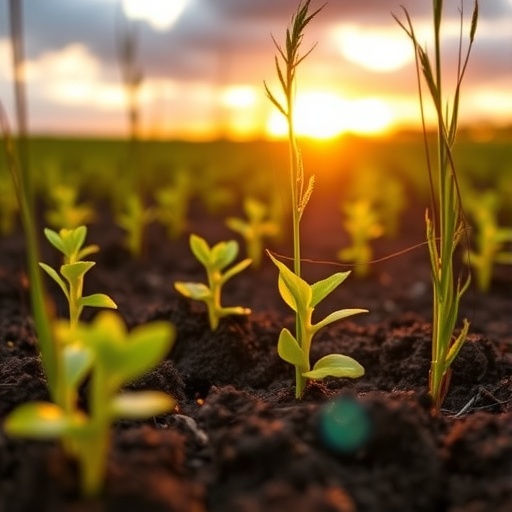
In a groundbreaking study published in the journal Sustainable Carbon Materials, researchers have uncovered the pivotal role of biochar in transforming contaminated soils into safer grounds for crop production by modulating the bioavailability of heavy metals, particularly cadmium, in agricultural environments. This innovative research delves into the microscale interactions within soil, revealing how biochar creates a unique microenvironment, termed the “charosphere,” which fundamentally alters soil chemistry and restricts the mobility of toxic cadmium ions, thereby significantly reducing their uptake by wheat plants.
Cadmium contamination in soil represents a critical environmental and public health challenge globally. Originating from various anthropogenic sources such as mining, industrial waste, and phosphate fertilizers, cadmium’s persistence in soil poses a direct threat to crop safety and human health. When absorbed by plants, cadmium accumulates in edible tissues, entering the food chain and contributing to severe health issues including renal dysfunction and bone demineralization. Addressing this contamination requires innovative, scalable, and sustainable soil remediation strategies, which this new research ambitiously tackles through the application of biochar.
Biochar, a carbon-rich material derived from the pyrolysis of agricultural residues such as wheat straw, has long been recognized for its soil amendment properties including enhanced nutrient retention and increased carbon sequestration. However, this study shifts focus to the microscopic zones of influence exerted by biochar particles in soil matrices. Through a meticulously designed microcolumn experimental setup, the researchers were able to observe soil chemical gradients at intervals as fine as two millimeters, tracking changes over a four-week incubation period. This unprecedented spatial resolution allowed them to quantify the limits and effectiveness of the so-called charosphere in real-time.
The charosphere, a previously underexplored concept, emerges as a critical determinant in soil chemical dynamics. Surrounding each biochar particle, this zone exhibited a marked elevation in pH, shifting the soil environment towards slight alkalinity, and a concurrent increase in dissolved organic carbon concentrations. These chemical alterations collectively reduced the solubility and mobility of cadmium ions, thereby immobilizing them and preventing their translocation through soil water to plant roots. This mechanistic insight underscores the importance of micro-scale soil heterogeneity in governing contaminant fate.
Quantitative measurements from the study demonstrated a substantial decline in bioavailable cadmium within a radius of 2 to 8 millimeters around biochar particles. Correspondingly, wheat plants cultivated in biochar-amended soils showed a remarkable decrease in cadmium concentrations: shoot tissues reflected up to a 28% reduction, while root tissues exhibited an even more pronounced 46% decline relative to controls grown in untreated contaminated soils. These findings suggest an effective barrier function afforded by the charosphere, directly mitigating plant exposure to hazardous metals.
Delving into the physicochemical interactions at the biochar-soil interface, the researchers identified specific oxygen-containing functional groups on biochar surfaces as key players in cadmium binding. Through complexation and ion-exchange reactions, these groups capture cadmium ions, forming stable organo-metallic complexes that render the metal biologically inaccessible. Importantly, the study observed an enhancement in these binding capacities over time, attributed to ongoing soil microbial and chemical processes that generate additional active sites on biochar surfaces, amplifying its remediation efficacy.
The study also highlighted the relationship between biochar application rates and the spatial extent of the charosphere. Increased quantities of biochar not only expanded the radius of contaminant immobilization but also intensified the chemical modifications in the immediate soil environment. This dose-dependent response suggests that optimization of biochar dosage is critical for maximizing heavy metal stabilization while maintaining soil health. However, the researchers emphasized that the proximity of biochar particles to plant roots is equally vital, proposing that targeted placement techniques could enhance the protective effects without necessitating excessive application volumes.
Beyond its contaminant immobilization properties, biochar integration into soil embodies a holistic approach to sustainable agriculture. Derived from biomass waste, biochar recycling contributes to carbon sequestration, energy conservation, and the reduction of greenhouse gas emissions. By transforming agricultural byproducts like wheat straw into functional soil amendments, this approach fosters circular economy principles, bridging waste management with environmental restoration and food security objectives.
This pioneering work offers the first quantitative demonstration of engineered biochar microzones as effective interfaces for controlling heavy metal bioavailability in agricultural soils. It opens promising avenues for the development of tailored biochar materials with optimized surface chemistries and structural properties designed explicitly for contaminant mitigation. Moreover, the insights gained call for innovative application strategies emphasizing spatial precision to leverage microenvironmental advantages.
Future research directions envisioned by the authors include extensive field trials to validate laboratory findings under diverse soil types and environmental conditions. Emphasis will be placed on refining biochar preparation methods to augment functional groups responsible for metal binding, as well as integrating biochar amendments with other sustainable soil management practices. Ultimately, these multidisciplinary efforts aim to enhance food safety on contaminated lands while promoting ecosystem resilience and sustainable agricultural productivity.
In summary, this study charts a significant advance in environmental science by elucidating the micro-scale processes through which biochar modifies heavy metal dynamics in soil. The nuanced understanding of the charosphere effect not only elevates biochar’s role from a general soil enhancer to a targeted remediation agent but also aligns with global imperatives for safe, sustainable, and resilient food production systems. As such, biochar emerges as a potent tool in the global challenge of mitigating soil pollution and ensuring the safety of agricultural outputs.
Subject of Research: Not applicable
Article Title: Biochar-induced charosphere microenvironment modulates soil cadmium bioavailability and wheat uptake
News Publication Date: 28-Jan-2026
Web References:
https://doi.org/10.48130/scm-0025-0016
References:
Cui L, Wang W, Quan G, Wang H, Hina K, et al. 2026. Biochar-induced charosphere microenvironment modulates soil cadmium bioavailability and wheat uptake. Sustainable Carbon Materials 2: e004 doi:10.48130/scm-0025-0016
Image Credits:
Liqiang Cui, Wei Wang, Guixiang Quan, Hui Wang, Kiran Hina, Qaiser Hussain, Yuming Liu, & Jinlong Yan
Keywords
Black carbon, Environmental chemistry, Environmental sciences
Tags: agricultural safety and healthbiochar in agriculturebiochar microzonescadmium soil contaminationcarbon sequestration in soilcharosphere interactionsenhancing soil chemistryenvironmental impact of cadmiumheavy metal uptake in cropsinnovative agricultural practicessustainable soil remediationwheat plant health and cadmium