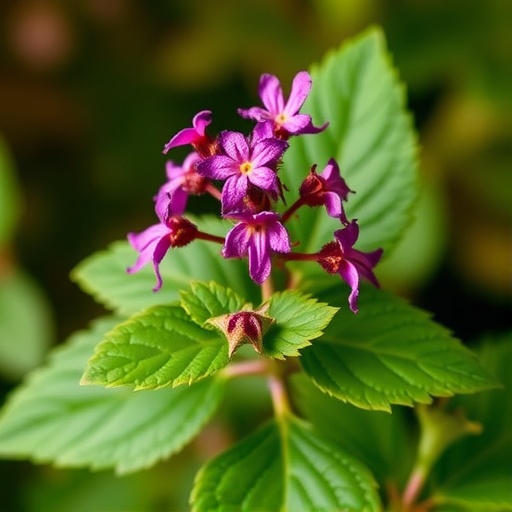
Allergic asthma remains a chronic respiratory condition marked by airway hyperresponsiveness, excessive mucus production, and infiltration of inflammatory cells such as eosinophils and T helper 2 (Th2) lymphocytes. Central to the disease’s pathogenesis is the dysregulated activation of nuclear factor kappa-light-chain-enhancer of activated B cells (NF-κB) and mitogen-activated protein kinases (MAPKs), including the p38 pathway, both of which orchestrate the transcription of pro-inflammatory mediators. By attenuating these pathways, Perilla frutescens var. acuta ushers in a wave of anti-inflammatory events that could mitigate the severity of allergic asthma and potentially modify its chronic trajectory.
This revelation stems from meticulous experiments employing murine models sensitized with ovalbumin to mimic human allergic asthma. Researchers administered extracts of Perilla frutescens var. acuta and observed a pronounced reduction in airway inflammation, evaluated through histological assessments that revealed decreased eosinophilic infiltration and diminished mucosal thickening. Complementary molecular analyses indicated that treatment effectively suppressed NF-κB nuclear translocation and phosphorylation of p38 MAP kinase, disrupting the cascade responsible for cytokine production and immune cell recruitment in the airways.
.adsslot_a37B5TGQIv{ width:728px !important; height:90px !important; }
@media (max-width:1199px) { .adsslot_a37B5TGQIv{ width:468px !important; height:60px !important; } }
@media (max-width:767px) { .adsslot_a37B5TGQIv{ width:320px !important; height:50px !important; } }
ADVERTISEMENT
What sets this botanical intervention apart is not only its efficacy but also its specificity in targeting signaling pathways without broadly suppressing the immune system, a frequent complication in current therapeutic regimens. Conventional asthma medications, particularly corticosteroids, though effective, come hand-in-hand with adverse immunosuppressive side effects. The selective modulation of NF-κB and p38 by Perilla frutescens extracts thus offers a promising therapeutic window that balances efficacy and safety.
Bioactive constituents believed to underlie these anti-inflammatory mechanisms include a spectrum of phenolic compounds, flavonoids, and rosmarinic acid derivatives intrinsic to Perilla frutescens. These phytochemicals have known antioxidant properties and an ability to modulate signal transduction cascades by interacting with kinases and transcription factors. The study’s findings suggest these compounds synergize to inhibit the phosphorylation events critical for activating inflammatory gene expression, thereby attenuating the downstream secretion of IL-4, IL-5, and IL-13 cytokines intimately involved in eosinophil attraction and IgE production.
The suppression of the NF-κB pathway is particularly noteworthy because NF-κB acts as the gatekeeper of numerous inflammatory genes, including those encoding for cytokines, chemokines, and adhesion molecules. The study revealed that extract treatment prevented the degradation of IκBα, an inhibitor protein that retains NF-κB in the cytoplasm, thus curtailing its capacity to translocate into the nucleus and propagate inflammatory signaling. Simultaneously, inhibiting p38 MAP kinase activity interrupts stress-activated signaling that amplifies cytokine gene transcription, further dampening inflammatory amplification loops.
Beyond cellular signaling observations, functional assessments measured respiratory parameters indicative of airway hyperreactivity. Mice receiving Perilla frutescens var. acuta extracts displayed significantly improved lung function, with reduced airway resistance and enhanced airflow following allergen challenge. These physiological improvements correlated well with molecular findings, collectively underscoring the therapeutic potential of this plant extract in restoring respiratory homeostasis disturbed in allergic asthma.
Furthermore, the safety profile of the botanical treatment was rigorously evaluated. Unlike broad-spectrum immunosuppressants, administration of Perilla frutescens extracts did not perturb systemic immune parameters or induce cytotoxicity in bronchial epithelial cells, adding to the appeal of this herbal approach for long-term management of asthma. The prospect of integrating such phytotherapeutics into existing treatment paradigms points toward an era where plant-derived bioactives complement or offer alternatives to synthetic drugs.
The implications of these findings extend beyond asthma management. Given the central role of NF-κB and p38 MAPK pathways in various chronic inflammatory and autoimmune diseases, Perilla frutescens var. acuta may emerge as a candidate for wider applications in inflammatory disorders. Its influence on key intracellular pathways posits it as a molecular modulator worthy of exploration in conditions characterized by aberrant inflammation including rheumatoid arthritis, inflammatory bowel disease, and even certain cancers.
Moreover, this research underscores the invaluable contribution of ethnobotany and traditional medicine to contemporary pharmacology. Perilla’s historical application in treating respiratory and allergic conditions provides a biological rationale supported today by rigorous scientific validation. The journey from folk remedy to molecularly elucidated therapeutic agent exemplifies the translational power of integrating ancient wisdom with modern biomedical research.
While promising, future investigation is warranted to isolate and characterize individual compounds responsible for Perilla frutescens’ bioactivity and to optimize dosing strategies. Clinical trials will be essential to confirm efficacy and safety in human populations, understand pharmacokinetics, and evaluate long-term outcomes. Additionally, mechanistic studies employing gene knockouts or pathway-specific inhibitors could further clarify the molecular interplay governing the extract’s anti-inflammatory effects.
This study exemplifies a paradigm shift towards harnessing nature’s pharmacopoeia to tackle complex immunological diseases. The intersection of molecular biology, pharmacognosy, and clinical research paves the way for novel, safer, and more sustainable therapies. With allergic asthma affecting millions globally and healthcare systems facing burdens of chronic disease management, Perilla frutescens var. acuta offers a beacon of hope for more effective and less harmful treatment modalities.
Subject of Research: Perilla frutescens Britton var. acuta Kudo’s effects on OVA-induced allergic asthma through modulation of intracellular inflammatory signaling pathways.
Article Title: Perilla frutescens Britton var. acuta Kudo ameliorates OVA-induced allergic asthma via inhibiting NF-κB and p38 signaling pathways.
Article References:
Choi, J., Yoo, E.B., Park, J. et al. Perilla frutescens Britton var. acuta Kudo ameliorates OVA-induced allergic asthma via inhibiting NF-κB and p38 signaling pathways. Food Sci Biotechnol (2025). https://doi.org/10.1007/s10068-025-01968-y
Image Credits: AI Generated
DOI: https://doi.org/10.1007/s10068-025-01968-y
Tags: airway inflammation reductionallergic asthma treatmentanti-inflammatory botanical extractsasthma pathogenesis researchbioactive compounds in herbschronic respiratory conditionsEastern medicinal herbsimmune response modulationNF-kB signaling inhibitionp38 MAP kinase pathwayPerilla frutescens medicinal propertiestherapeutic approaches to allergies