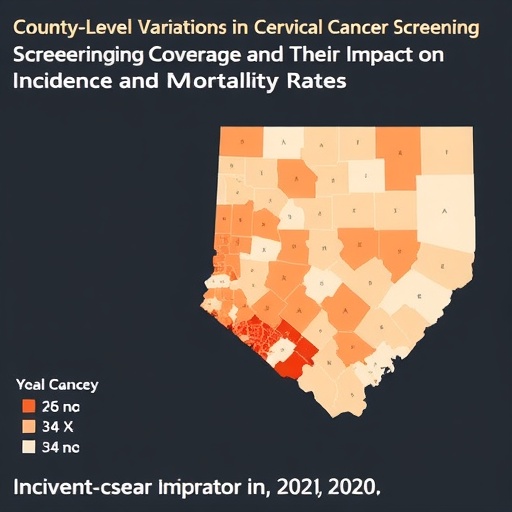

A recent comprehensive study published in JAMA Network Open has unveiled stark disparities in cervical cancer incidence and outcomes linked to screening coverage across different counties in the United States. The investigation highlights a near doubling in cervical cancer cases, alongside more frequent late-stage diagnoses and elevated mortality rates in counties characterized by persistently low cervical cancer screening rates compared to those with consistently high coverage. Intriguingly, these high-risk counties tend to be rural and economically disadvantaged, underscoring the intersection of healthcare access and socioeconomic factors in cancer prevention and control.
Cervical cancer, while largely preventable through regular screening and early intervention, continues to present a significant public health challenge, especially in populations with limited access to preventive services. This study represents a pivotal analysis of county-level data over an extended period, scrutinizing patterns of screening uptake and correlating them with cancer incidence and mortality statistics. The findings demand critical attention to how healthcare delivery systems and policy frameworks can better address these geographic and demographic disparities.
Employing robust epidemiological methods, the research team analyzed cervical cancer screening coverage longitudinally, categorizing counties based on their screening rates over successive measurement periods. This approach allowed for the identification of counties with “repeatedly low” coverage, shedding light on persistent gaps rather than isolated or transient shortfalls in screening. The linkage of these patterns with cancer registry data illuminated the profound consequences of sustained screening deficits.
.adsslot_hWy2t38YiP{width:728px !important;height:90px !important;}
@media(max-width:1199px){ .adsslot_hWy2t38YiP{width:468px !important;height:60px !important;}
}
@media(max-width:767px){ .adsslot_hWy2t38YiP{width:320px !important;height:50px !important;}
}
ADVERTISEMENT
The biological underpinnings of cervical cancer progression accentuate the importance of early detection. Human papillomavirus (HPV) infection is the primary etiological factor driving the malignant transformation of cervical epithelial cells. Without timely identification and treatment of precancerous lesions detected through screening cytology or HPV testing, cancers are more likely to develop and advance to incurable stages. This study’s revelation that counties with inadequate screening face disproportionately late-stage diagnoses signifies failures in intercepting disease evolution during its most manageable phases.
Rurality emerged as a key determinant in low screening coverage counties. Geographic isolation often correlates with diminished healthcare infrastructure, fewer specialized providers, and transportation barriers that compound challenges in accessing gynecologic and preventive services. Moreover, lower income levels prevalent in these regions further restrict healthcare utilization, reflecting systemic inequities that transcend individual behavior. Together, these factors create a mosaic of vulnerability that amplifies cancer risks and worsens outcomes.
The study also draws attention to the critical role of public health initiatives and policy reforms aimed at increasing screening coverage. Despite longstanding recommendations endorsing routine cervical cancer screening via Pap tests and, more recently, co-testing with HPV assays, compliance remains uneven. This research underscores the urgency of deploying multifaceted strategies — including mobile clinics, patient education, and insurance coverage expansion — tailored to underserved rural and low-income populations.
Mortality data from the study reinforce the life-saving impact of preventive screening. Counties with lagging screening rates were not only more likely to report higher cancer incidence but also suffered increased death rates attributable to cervical cancer. This correlation accentuates how delayed diagnosis and treatment failures cascade into poorer survival, imposing substantial human and economic costs on affected communities.
Technological advances in cervical cancer screening, such as the advent of high-risk HPV testing and self-sampling techniques, hold promise for expanding coverage, especially in hard-to-reach populations. The study’s findings can serve as a catalyst for integrating such innovations into public health programs, thereby dismantling barriers and closing the gap between high and low screening counties. Additionally, data-driven resource allocation informed by granular epidemiologic analyses can optimize interventions.
This investigation contributes vital insights to the global agenda for cancer control, aligned with the World Health Organization’s call for cervical cancer elimination as a public health problem. By spotlighting the persistent disparities within the US context, the research advocates for equity-focused strategies that address social determinants and structural impediments to screening access. Only through sustained commitment and targeted interventions can the burden of cervical cancer be effectively mitigated.
In conclusion, this rigorous study elucidates the pronounced disparities in cervical cancer incidence, late-stage diagnosis, and mortality tied to screening inequities across US counties. The findings delineate a clear public health mandate: to intensify efforts to enhance screening uptake, particularly in rural and economically disadvantaged areas, thereby improving early detection and survival outcomes. Such endeavors are integral to reducing preventable suffering and progressing toward equitable cancer care.
For further inquiries or collaboration, the corresponding author, Dr. Trisha L. Amboree, PhD, MPH, is available via email at [email protected]. Media representatives may contact Jim Michalski at JAMA Network for additional information on this pivotal study.
Subject of Research: Cervical Cancer Screening Coverage and Its Impact on Incidence and Mortality
Article Title: Not explicitly provided
News Publication Date: Not explicitly provided
Web References: Not explicitly provided
References: doi:10.1001/jamanetworkopen.2025.26709
Image Credits: Not provided
Keywords: Cervical cancer
Tags: cervical cancer mortality rates analysiscervical cancer screening disparitiescounty-level cervical cancer incidenceepidemiological study on cervical cancerhealthcare policy and cancer controlJAMA Network Open cervical cancer researchlate-stage cervical cancer diagnosislong-term screening coverage trendspreventive services access disparitiespublic health challenges in cancer screeningrural healthcare access issuessocioeconomic factors in cancer prevention