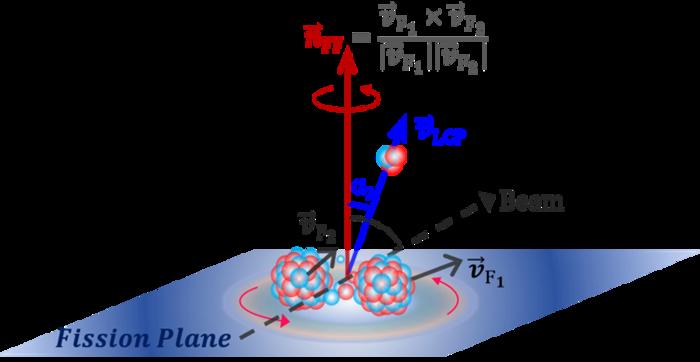

In the realm of nuclear physics, the intricate behaviors of nuclear matter under extreme conditions continue to challenge and inspire researchers. A groundbreaking study led by physicists Zhigang Xiao and Yijie Wang has unveiled novel insights into the isospin dynamics occurring within fast-rotating heavy ion collision systems, particularly those operating at Fermi energies. Their work sheds new light on the mechanisms by which neutron-rich particles are preferentially emitted, especially from regions outside the conventional fission plane, offering an unprecedented window into the symmetry energy properties that govern the nuclear equation of state.
Heavy ion collisions (HICs) present fertile ground for exploring the complex interactions and collective motions of nuclear matter. Traditionally, broad inclusive observations in these collisions have provided valuable, albeit limited, views of subatomic behaviors. This new research pivots towards three-body coincidence measurements involving one light charged particle alongside two fission fragments. Such precision allows for the reconstruction of the fission plane and the detailed analysis of isospin spatial distributions—an approach that elegantly captures the fast, collective dynamical processes at play in these fast-fission systems.
The phenomenon of isospin migration, wherein neutron-rich particles migrate preferentially in certain spatial directions during fission, emerges as a critical aspect of these fast-rotating systems. The research team has documented a striking enhancement of neutron-rich particle emission originating outside the fission plane itself. This observation not only refines our understanding of isospin transport but also directly informs on the behavior of symmetry energy—a pivotal component of the nuclear matter equation of state that influences properties ranging from nuclear stability to astrophysical phenomena such as neutron stars.
.adsslot_On8lB1fhsX{width:728px !important;height:90px !important;}
@media(max-width:1199px){ .adsslot_On8lB1fhsX{width:468px !important;height:60px !important;}
}
@media(max-width:767px){ .adsslot_On8lB1fhsX{width:320px !important;height:50px !important;}
}
ADVERTISEMENT
Central to this research is the use of CSHINE (Compact Spectrometer for Heavy IoN Experiment), an advanced detection platform painstakingly developed over a decade. This state-of-the-art system integrates silicon strip telescopes, parallel plate avalanche chambers, high-energy gamma arrays, and neutron detectors, providing comprehensive capabilities for simultaneous measurement of charged particles, fission fragments, photons, and neutrons. The exceptional coincidence measurement capabilities of CSHINE were instrumental in capturing the subtle correlations required to elucidate the isospin migration phenomena with such clarity.
The methodology underpinning the study involved capturing three-body coincidence events that included one light charged particle and two fission fragments, enabling researchers to effectively recreate the geometry of the fission process and examine isospin distributions in a multidimensional context. By doing so, they uncovered the spatiotemporal dynamics of isospin migration with high resolution—a significant leap beyond previous inclusive or two-particle studies.
The enhanced emission of neutron-rich particles from locations outside the established fission plane indicates complex underlying nuclear transport mechanisms influenced by the rapid rotation and collective motion intrinsic to fast-fission. These findings suggest that angular momentum and other collective variables strongly modulate isospin transport, potentially altering the nuclear matter symmetry energy coefficient locally. Such nuanced understanding has been virtually unattainable until now.
From a theoretical perspective, this research offers a compelling link between microscopic nuclear dynamics and the macroscopic equation of state parameters. The symmetry energy term, which delineates the energy difference between neutron-rich and proton-rich nuclear matter, is notoriously difficult to constrain experimentally. The insights gained here provide valuable empirical constraints that are vital for refining nuclear models, especially those applicable at intermediate and high excitation energies under rapid rotation conditions.
The implications of this study extend far beyond nuclear physics laboratories. In astrophysics, understanding how nuclear matter behaves under extreme angular momentum and density conditions resonates directly with scenarios occurring in neutron star crusts and supernova explosions. The observed isospin migration dynamics afford clues into nucleosynthesis pathways and the internal structure of dense stellar remnants where neutron-rich matter dominates.
Moreover, the enhanced precision in characterizing isospin transport mechanisms could herald advances in applied nuclear technology. Nuclear reactors and accelerator-driven systems depend heavily on accurate modeling of fission processes. Insights into how neutron-rich isotopes are emitted and transported during fission could inform approaches for optimizing fuel cycles, managing reaction rates, and enhancing reactor safety through better predictions of reaction byproducts under high angular momentum states.
In their future endeavors, the research group aims to probe how the initial conditions of the heavy ion collision—specifically nuclear species, energy, and angular momentum inputs—influence the observed isospin migration and transport dynamics. By systematically varying these parameters, they hope to unravel the fundamental correlations that govern nuclear matter under diverse extreme conditions, thereby enriching experimental and theoretical nuclear science.
This study significantly enriches our comprehension of nuclear matter behavior in fast-rotating systems, bridging experimental observations with sophisticated theoretical frameworks. It demonstrates how cutting-edge detection technologies like CSHINE enable breakthroughs in capturing fleeting subatomic events with exceptional fidelity, driving nuclear physics research into new frontiers.
The full body of research can be accessed through the digital object identifier: 10.1007/s41365-025-01742-z, published in the renowned peer-reviewed journal Nuclear Science and Techniques. This journal, under the auspices of the Shanghai Institute of Applied Physics, Chinese Academy of Sciences, is committed to disseminating high-quality nuclear science research across a global audience—playing a critical role in advancing nuclear physics, nuclear energy research, and related scientific fields.
Subject of Research: Not applicable
Article Title: The enhancement of neutron-rich particle emission from out-of-fission-plane in Fermi energy heavy ion reactions
News Publication Date: 9-Jun-2025
Web References: http://dx.doi.org/10.1007/s41365-025-01742-z
Image Credits: Yijie Wang
Keywords
Nuclear physics, Nuclear energy, Nuclear fission
Tags: collective motions of nuclear matterfast-rotating heavy ion collisionsFermi energy interactionsfission plane reconstruction techniquesheavy ion collision systemsisospin dynamics in nuclear collisionsisospin migration phenomenonneutron-rich particle emissionprecision analysis of fission fragmentssubatomic behavior in extreme conditionssymmetry energy properties in nuclear matterthree-body coincidence measurements in fission