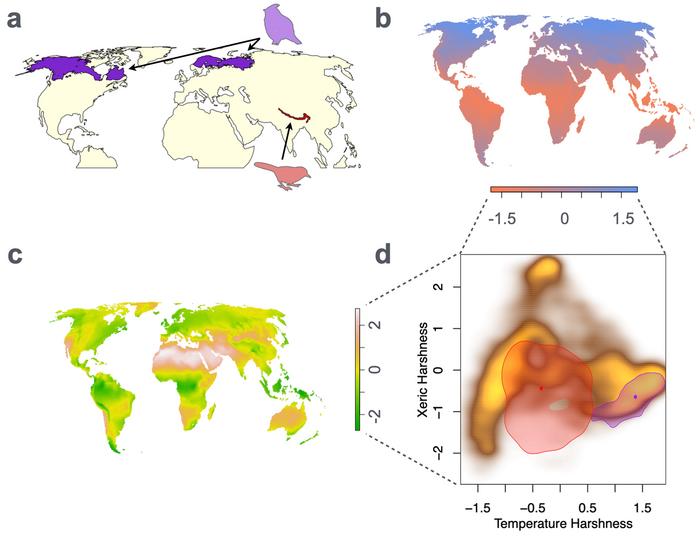
The research team, led by Carlos Botero, associate professor of integrative biology, employed sophisticated data-driven modeling that integrated nearly half a million observational records collected by citizen scientists worldwide through eBird. This wealth of high-resolution occurrence data enabled the researchers to go beyond traditional mapping of species’ physical ranges, allowing them to map species onto what they term a “climate space.” This innovative conceptual model aggregates key climatic factors, primarily temperature and precipitation, across Earth’s terrestrial surface — mechanistically capturing the complex gradients in harshness and variability that define the environmental constraints of each species.
One of the study’s most striking revelations came from comparing two ecologically distinct birds: the Bohemian waxwing, whose breeding range spans a vast swath of the Arctic, and the chestnut-crowned laughingthrush, whose distribution is geographically restricted to a narrow Asian arc centered on Nepal and Bhutan. Despite occupying a smaller and more geographically fragmented area, the laughingthrush exhibits a broader climate niche than the waxwing. The waxwing, adapted to a very specific and extreme set of Arctic climate conditions, faces an underestimated vulnerability; its survival hinges on a narrow climatic envelope, rendering it potentially more susceptible to perturbations linked to climate change.
This paradox fundamentally challenges the conventional wisdom that associates large population size and broad distribution with resilience to environmental change and reduced extinction risk. Botero emphasizes that the breadth of the climate niche provides a more nuanced and informative lens for assessing species’ vulnerability. Large-range species confined to specialized and extreme climatic niches may harbor cryptic extinction risks that traditional assessments, focused on spatial extent alone, fail to detect.
Further complicating this picture is the study’s investigation into brain size relative to body size, a proxy often linked to behavioral flexibility and adaptability in animals. Counterintuitively, the analysis demonstrated that species with relatively larger brains tend to be climate specialists rather than generalists. This finding suggests that cognitive sophistication, which often enables flexible responses to environmental challenges, may coincide with evolutionary specialization to narrow climate regimes, thereby increasing these species’ susceptibility to rapid climate shifts rather than buffering them.
The researchers argue that this duality likely reflects evolutionary trade-offs wherein large-brained birds have optimized their behavior and physiology for thrive under specific, stable climate conditions, thereby sacrificing broader adaptability. This insight nuances prevailing assumptions and highlights the importance of considering multifactorial interactions—including physiology, behavior, and environmental tolerance—when forecasting species’ responses to global change.
From a methodological standpoint, the study stands out for its integration of citizen science data with robust climatic modeling. eBird, a global bird observation platform, has revolutionized species distribution mapping by providing scientists with exhaustive, geo-referenced occurrence datasets that capture temporal and spatial dynamics with unprecedented granularity. This partnership has opened new frontiers in ecological research, enabling assessments that encompass global biogeographic patterns and climate-behavior relationships previously unattainable at such scales.
The climate space framework introduced by the team is particularly compelling. By categorizing terrestrial landscapes along temperature and precipitation harshness axes, the approach distills complex climatic variability into interpretable dimensions. This facilitates comparative analyses across continents and taxa, enabling researchers to identify regions and species where climate change might trigger the most severe ecological impacts.
The study also underscores that climate niches are shaped not just by mean environmental conditions but by their predictability and variability over time. Such temporal nuances are critical because species often evolve adaptations not just to specific climatic averages but to the range and frequency of environmental fluctuations. Consequently, climate instability itself may induce population stress and elevate extinction risks, even in areas that might seem climatically suitable in the short term.
Botero emphasizes that conservation strategies must transcend simplistic risk factor checklists in favor of an integrated understanding of species’ climates niches, evolutionary traits, and ecological contexts. “It is the unexpected interactions that matter most,” he notes, urging conservationists and policymakers to embrace complexity rather than rely on isolated metrics. This is especially urgent as climate change accelerates, rendering previously stable habitats inhospitable and reshuffling species distributions on a global scale.
With support from the U.S. National Science Foundation, Botero and his co-author João Fabrício Mota Rodrigues highlight that their findings refine our understanding of climate change vulnerability and invite a reconsideration of how extinction risks are assessed. The novel combination of big data, behavioral ecology, and climate modeling propels this research into the forefront of conservation science, with clear implications for identifying at-risk species that might otherwise be overlooked due to their seemingly abundant populations or vast ranges.
In essence, the study brings to light a sobering reality: the apparent security offered by large populations and expansive ranges may mask hidden perils embedded within narrow climatic specializations. As global temperatures climb and precipitation patterns become more erratic, even seemingly robust bird species may find themselves on precarious footing. This refined perspective underscores the urgent need for dynamic models that capture the interplay of climate niche breadth and evolutionary specialization to better forecast species’ futures amid a rapidly changing planet.
Subject of Research:
Not applicable
Article Title:
The global determinants of climate niche breadth in birds
News Publication Date:
17-Apr-2025
Web References:
https://www.nature.com/articles/s41467-025-58815-1
References:
10.1038/s41467-025-58815-1
Image Credits:
Credit: Carlos Botero/University of Texas at Austin.
Keywords:
Climate change adaptation, Birds, Ecological niches, Species distribution, Risk assessment, Climate change, Biodiversity conservation, Endangered species
Tags: avian adaptability to climate variabilitybiodiversity loss and climate resiliencecitizen science and bird observation dataClimate change impact on bird speciesclimate niche modeling in birdsecological consequences of climate shiftsenvironmental factors influencing avian survivalgeographical range and extinction riskinnovative research in ornithologyNature Communications bird study findingsspecies distribution and climate constraintstemperature and precipitation effects on wildlife