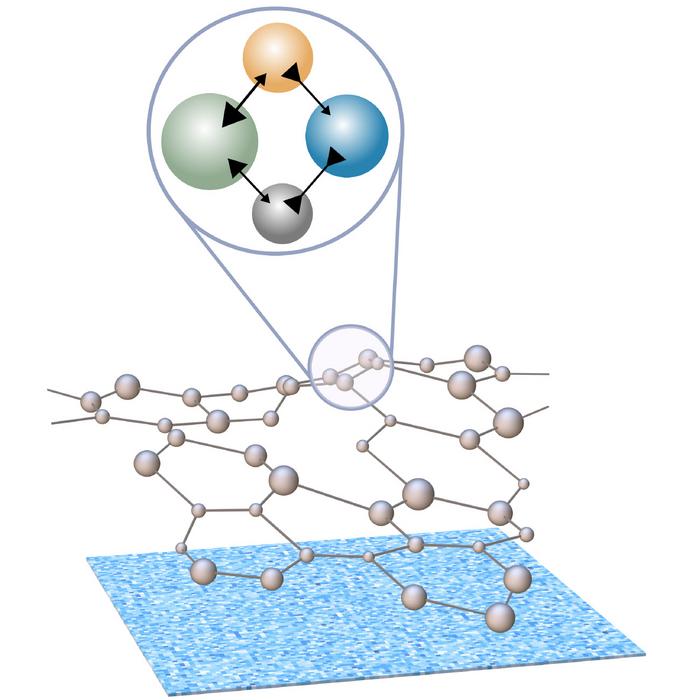

In the intricate world of biological organization, the choreography of cellular components underpins life’s most fundamental processes. Researchers at the Max Planck Institute for Dynamics and Self-Organization have made groundbreaking strides in unraveling how complex biological patterns emerge from simple, underlying principles. Their latest study reveals that non-reciprocal interactions—that is, interactions where one entity attracts another while being repelled in return—can fundamentally redefine how biological systems stabilize and adapt, leading to a broad spectrum of dynamic states previously unexplored in living matter.
Traditional models of cellular organization have largely relied on reciprocal interactions, where forces between particles or components are mutual and balanced. These symmetrical interactions typically yield passive systems that evolve toward equilibrium, where particles self-organize into stable, predictable patterns. However, the MPI-DS team’s computational simulations have challenged this paradigm by introducing non-reciprocal forces into multispecies mixtures, demonstrating that these asymmetric interactions drive the system far from equilibrium, producing unique steady and transient behaviors that are highly sensitive to interaction parameters.
At the heart of this research is the concept that biological systems do not merely settle into static patterns but dynamically explore multiple organizational states. By tuning the degree of non-reciprocity in their model mixtures, the scientists observed emergent phenomena such as stable molecular condensates without membrane boundaries and waves of traveling information reminiscent of signaling cascades within cells. These findings highlight a mechanism by which cells might harness non-reciprocal interaction networks to flexibly regulate their internal architecture and communication pathways, thereby sustaining life processes under fluctuating environmental or physiological conditions.
Non-reciprocal interaction networks introduce a directional bias into the interaction landscape. This bias breaks detailed balance and injects activity that prevents simple homogenization or static clustering. Instead, components engage in complex feedback loops where the influence one particle exerts is not necessarily matched in kind by the recipient. Such asymmetry is a hallmark of active matter systems but has rarely been explored with the granularity necessary to connect it to biological function. The MPI-DS investigators employed state-of-the-art computational modeling techniques to systematically map how differing levels of asymmetry affect collective behavior, revealing a rich phase space of pattern formation and dynamical regimes.
The emergent stability observed in these models arises from a balance of competing non-reciprocal forces that can suppress runaway aggregation or dissolution, effectively creating “chaotic condensates”—stable yet highly dynamic assemblies that recycle their components continuously. These clusters differ from classical phase-separated bodies because their constituents do not remain fixed but instead participate in ongoing dynamic flux. This feature could provide a physical basis for biomolecular condensates observed in cells, which mediate critical functions such as gene regulation, signal transduction, and stress response without the confinement of membranes.
Moreover, the ability of non-reciprocal interactions to produce traveling waves of information posits a novel framework for understanding how cells propagate signals over distance. Unlike diffusion-based mechanisms typically employed in modeling cellular signaling, non-reciprocal coupling enables directional transport of activity pulses. This could have profound implications for the design principles of cellular communication networks, ensuring rapid, robust, and adaptable signal transduction necessary for complex behaviors such as coordinated movement or developmental patterning.
The implications of this research extend beyond biological systems into the design of synthetic materials and active colloids. By emulating non-reciprocal interactions, engineers could create responsive materials capable of autonomously reorganizing their internal structures in reaction to external stimuli. Such materials could revolutionize fields from targeted drug delivery to soft robotics, where adaptability and dynamic stability are prized attributes.
Intriguingly, these findings provoke fundamental questions about the origin of life and the evolution of cellular complexity. Non-reciprocal mechanisms may have been instrumental in fostering the first organized protocellular structures, providing a pathway from random molecular mixtures to structured, functional assemblies. Understanding these principles could therefore illuminate the steps leading from chemistry to biology, enriching our grasp of life’s emergence.
The MPI-DS team’s approach combines theoretical physics with computational biology, leveraging multiscale simulations that capture interactions from molecular to mesoscale levels. Their model incorporates realistic interaction potentials and considers multispecies mixtures, reflecting the compositional diversity found within cells. Such interdisciplinarity exemplifies the power of physics-inspired frameworks applied to biophysical problems, enabling the discovery of universal principles underlying biological order and function.
This research aligns with a growing body of work emphasizing the role of nonequilibrium processes in biology. Life itself is characterized by constant flux, energy consumption, and active maintenance of organization far from thermodynamic equilibrium. Non-reciprocal interactions provide a concrete mechanism for how these nonequilibrium conditions give rise to novel structures and behaviors, potentially bridging the gap between molecular biochemistry and system-level physiology.
Critically, while this study leverages computational modeling, it paves the way for experimental validation. Advanced imaging and manipulation techniques in cell biology could soon test predictions regarding the formation and dynamics of non-reciprocal condensates and signal waves. Such experimental synergy would cement these theoretical insights as foundational aspects of cellular organization.
In summation, the discovery that non-reciprocal interactions can stabilize dynamic, adaptable structures in biological mixtures represents a transformative advance in our understanding of life at the microscale. By elucidating how asymmetry in interactions drives complex spatiotemporal patterns, the MPI-DS team has opened new avenues for exploring cellular mechanics, the origins of biological order, and the design of innovative active materials.
—
Subject of Research: Cells
Article Title: Enhanced Stability and Chaotic Condensates in Multispecies Nonreciprocal Mixtures
News Publication Date: 7-Apr-2025
Web References: http://dx.doi.org/10.1103/PhysRevLett.134.148301
Image Credits: MPI-DS
Keywords
Cellular organization, Molecular structure, Self assembly, Asymmetry, Interaction networks
Tags: asymmetrical interactions in naturebiological system stabilitycellular organization dynamicscomplex biological patternscomputational simulations in biologydynamic states in living matteremergent phenomena in biologyenzyme activityMax Planck Institute researchmultispecies mixture behaviornon-equilibrium biological systemsnon-reciprocal interactions