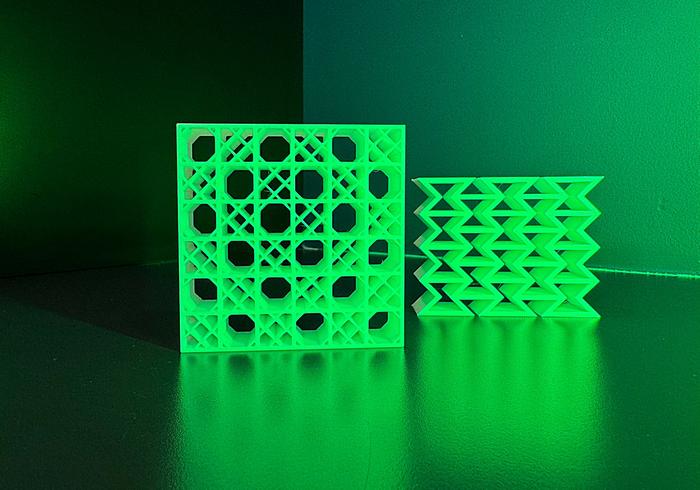

In a remarkable convergence of biomimicry and engineering, researchers at RMIT University have unveiled a cutting-edge double lattice structure inspired by the deep-sea sponge, specifically the Venus’ flower basket. This biologically inspired material exhibits exceptional compressive strength and stiffness, exhibiting properties that have the potential to revolutionize architectural designs and product manufacturing. As the demand for more robust and sustainable materials increases, this innovative lattice design promises to offer significant advantages over conventional construction materials, enhancing both performance and sustainability.
The design team, led by Dr. Jiaming Ma, conducted extensive research and optimization of the lattice structure. Their investigations demonstrated its impressive combination of stiffness and strength, paired with a unique ability to contract when subjected to compressive forces. This auxetic behavior distinguishes their creation from traditional materials, which typically become thinner under tension or bulge when compressed. The implications of this behavior are profound, particularly for engineering applications that demand high energy absorption and impact distribution.
Natural auxetic materials, such as tendons and certain animal skins, have long since been recognized for their unusual deformation characteristics. However, these materials often exhibit limited stiffness and energy absorption, restricting their practical applications. The double lattice structure developed by the RMIT team overcomes these limitations by harnessing the power of nature’s designs. Dr. Ma emphasized that when combined, the lattice’s individual components maintain their shape while outperforming existing auxetic materials, particularly those based on the traditional re-entrant honeycomb designs.
The study’s findings, published in the journal Composite Structures, reveal that the new lattice structure is not only 13 times stiffer than current auxetic materials but can also absorb 10% more energy while retaining its auxetic properties. This advancement offers a staggering 60% greater strain range compared to its predecessors, suggesting newfound possibilities for various engineering applications.
The research team’s efforts have opened doors to a multitude of exciting applications for this biomimetic lattice. As Dr. Ngoc San Ha observed, the high stiffness and energy absorption characteristics make the new material an ideal candidate for sustainable construction solutions, protective gear, and high-performance sports equipment. For instance, the bioinspired lattice could potentially replace traditional steel frames in building construction, leading to reduced material usage while maintaining structural integrity.
Beyond construction, the unique properties of the double lattice structure pave the way for advancements in protective gear, such as bulletproof vests and lightweight sports gear. Medical applications also seem promising; the innovative design could be utilized in developing implants and devices that require resilience and adaptability under varying stress conditions.
Professor Mike Xie, affiliated with the project, reiterated the importance of drawing inspiration from nature. He pointed out that biomimicry not only creates aesthetically pleasing designs but also leads to intelligent solutions that have been refined through millions of years of evolution. His insights highlight the potential for sustainable engineering solutions forged from natural principles.
As the RMIT research team continues to advance their innovations, they have already begun the process of testing their designs using computer simulations and practical lab experiments. Recent studies included testing a 3D printed sample made from thermoplastic polyurethane. Future endeavors aim to translate their findings into steel prototypes, integrating concrete and rammed earth techniques, which utilize compacted natural materials.
Dr. Ma has indicated that while the primary focus remains on the construction sector, the features of the new lattice structure present additional advantages, such as mitigating vibrations during earthquakes through its energy-absorbing capabilities. This presents a significant opportunity to enhance building resilience in earthquake-prone areas.
Furthermore, the research team is on the verge of integrating machine learning algorithms into their design process. This integration is pivotal for optimizing their material compositions further and potentially devising programmable materials that could adapt to various environmental conditions or stressors, offering unprecedented versatility in material design.
Publication of their groundbreaking research titled “Auxetic behavior and energy absorption characteristics of a lattice structure inspired by deep-sea sponge” is set for January 2, 2025. This work not only signifies a leap in materials science but also emphasizes the importance of ecological insights in developing future technologies and architectural practices.
In conclusion, the research at RMIT University stands as a testament to the marriage of biology and engineering. The development of the double lattice structure signifies not only a notable achievement in material science but also a potential paradigm shift in how designers and engineers approach sustainable construction and innovative application of materials, propelling society towards a future built on smarter, more resilient designs.
Subject of Research: N/A
Article Title: Auxetic behavior and energy absorption characteristics of a lattice structure inspired by deep-sea sponge
News Publication Date: N/A
Web References: N/A
References: N/A
Image Credits: RMIT University
Keywords
Biomimicry, auxetic materials, deep-sea sponge, lattice structure, RMIT University, sustainable construction, engineering innovations, material science.
Tags: advanced manufacturing techniquesarchitectural design innovationsauxetic behavior in materialsbiomimicry in engineeringcompressible material technologyhigh energy absorption materialsimpact distribution technologiesinnovative lattice structuresRMIT University researchsustainable construction materialsultra-strong materialsVenus flower basket inspiration