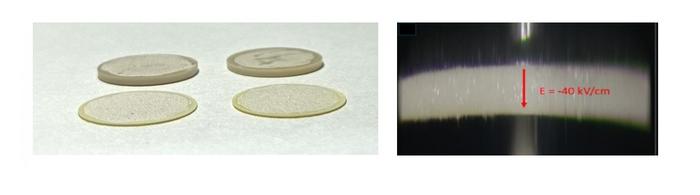
In a groundbreaking study recently published in the prestigious journal Nature, researchers from the Indian Institute of Science (IISc) have made remarkable advances in the field of piezoelectric materials. Their work highlights how simply reducing the thickness of piezoelectric ceramic materials can significantly enhance their performance. This revelation not only challenges existing paradigms but also opens up new pathways for designing advanced piezoelectric devices that are both efficient and environmentally friendly.
Piezoelectric materials possess the unique ability to deform under an applied electric field, making them valuable in a myriad of applications including medical imaging and precision actuators. Traditionally, single crystal materials have been favored for their extraordinary capability to exhibit high electrostrain, which measures how much a material can deform longitudinally when an electric field is applied. However, the practicalities of manufacturing and the associated costs render these materials suitable only for niche applications. On the other hand, the more cost-effective alternatives—polycrystalline piezoelectric ceramics—exhibit comparatively less electrostrain. The best of these materials typically show longitudinal strain values ranging from 0.2% to 0.4%, and these limitations have prompted researchers to explore ways to enhance their performance significantly.
The team, led by Gobinda Das Adhikary, a former PhD candidate in the Department of Materials Engineering, has embarked on a quest to break through this electrostrain ceiling. Their efforts have led them to investigate a commonly used ceramic called lead zirconate titanate or PZT. In a remarkable discovery, they found that by simply reducing the thickness of a PZT disc from 0.7 mm to 0.2 mm, they were able to achieve a substantial increase in electrostrain—from 0.3% to an impressive 1%. This finding suggests that the mechanical properties of piezoceramics are highly dependent on their geometrical dimensions.
Collaboration played a crucial role in this study, particularly with scientists at the European Synchrotron Radiation Facility (ESRF). Through advanced X-ray diffraction experiments, the team was able to visualize the changes happening at the microstructural level. They discovered that the thinner discs not only deformed more readily but also exhibited enhanced domain switching, a phenomenon critical to piezoelectric functionality. The intimate relationship between thickness and electrostrain became evident as the researchers noted that the domains in the 0.2 mm discs felt a closer proximity to the surface, allowing them to switch orientations more freely and thus increase the overall strain.
What stands out in this research is its emphasis on the implications for lead-free piezoelectric materials. Traditional piezoelectrics, such as the widely used PZT, contain lead, a substance that raises environmental and health concerns. The researchers highlighted a critical misconception surrounding electrostrain measurements in some lead-free materials, where high values were often attributed to bending rather than actual longitudinal deformation. This bending can mislead researchers into believing they have developed a superior product when in fact, the performance metrics may not be accurate.
In their pursuit to enhance piezoelectric performance, the researchers stumbled upon the role of atomic defects, specifically oxygen vacancies, often formed during the high-temperature manufacturing process. These vacancies can skew the expected behavior of piezoceramics by creating imbalances that affect how domains switch under an applied electric field. Through meticulous experimentation and analysis, the researchers demonstrated that reducing these defects can yield not only a better understanding of bending phenomena but can also enhance the longitudinal strain to levels potentially beyond 1%.
Looking to the future, this groundbreaking study represents more than just a scientific advancement; it is a clarion call for a paradigm shift in how piezoelectrics are engineered and tested. The researchers emphasize the importance of transcending traditional manufacturing methods and exploring innovative techniques that reduce detrimental defects while maximizing performance. Their study also underscores the necessity of reevaluating measurement techniques, as reliance on outdated or incorrect methods can inadvertently misguide the quest for better materials.
Researchers are now poised to leverage these insights for various applications in modern technology. The potential to develop more efficient actuators and sensors, while simultaneously addressing environmental concerns, presents an exciting avenue for future research. Moreover, the implications of their findings extend beyond academia and could significantly influence industries reliant on reliable piezoelectric materials.
As the scientific community and engineering fields continue to absorb the implications of these findings, it is clear that the future of piezoelectric materials is brighter than ever. The combination of fundamental research and practical application will pave the way for innovations that not only enhance technological capabilities but also foster environmental responsibility.
In conclusion, this cutting-edge research not only redefines the understanding of piezoelectric materials but also sets a foundation for a new generation of devices that could one day transform how we use technology in everyday life.
Subject of Research: Piezoceramic materials and their electrostrain properties
Article Title: Longitudinal strain enhancement and bending deformations in piezoceramics
News Publication Date: 8-Jan-2025
Web References: Nature Article
References: DOI: 10.1038/s41586-024-08292-1
Image Credits: Rajeev Ranjan lab
Keywords
piezoelectric materials, electrostrain, PZT, lead-free ceramics, IISc, domain switching, oxygen vacancies, strain enhancement