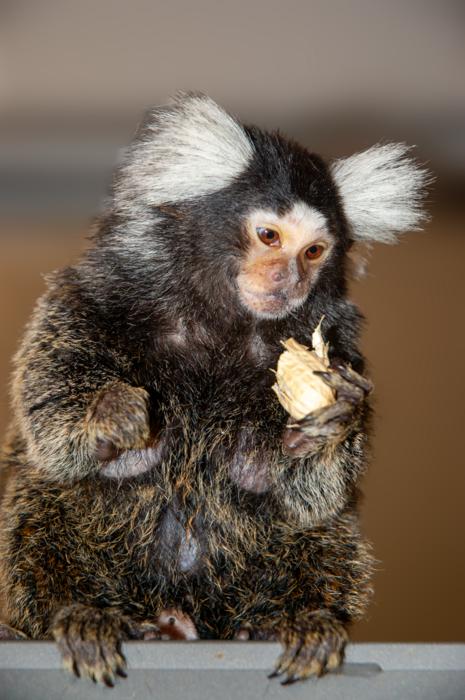
New study from Hebrew University reveals that marmoset monkeys use specific calls, known as “phee-calls,” to name each other, a behavior previously known to exist only in humans, dolphins, and elephants. This discovery highlights the complexity of social communication in marmosets and suggests that their ability to vocally label each other may provide valuable insights into the evolution of human language.
New study from Hebrew University reveals that marmoset monkeys use specific calls, known as “phee-calls,” to name each other, a behavior previously known to exist only in humans, dolphins, and elephants. This discovery highlights the complexity of social communication in marmosets and suggests that their ability to vocally label each other may provide valuable insights into the evolution of human language.
LINK to pictures https://drive.google.com/drive/folders/1VjzO-70hk27UVX_IuQ6FTsHgmCgk9PCH?usp=drive_link
Credit for pictures and sound: David Omer Lab
In a groundbreaking discovery, researchers from Hebrew University have found that marmoset monkeys use specific vocal calls, called “phee-calls,” to identify and communicate with each other. This ability to vocally label others has only been seen in humans, dolphins, and elephants until now.
Naming of others is a highly advanced cognitive ability observed in social animals and, until recently, was known to exist only in humans, dolphins, and elephants. Interestingly, our closest evolutionary relatives, nonhuman primates, appeared to lack this ability altogether.
In a new study published today in Science, a team of researchers from the Hebrew University, led by Dr. David Omer from the Safra Center for Brain Sciences (ELSC), made a groundbreaking discovery: for the first time, they found that marmoset monkeys use specific calls, called “phee-calls”, to name each other.
To uncover this, the researchers, led by graduate student Guy Oren, recorded natural conversations between pairs of marmosets, as well as interactions between monkeys and a computer system. They found that these monkeys use their “phee-calls” to address specific individuals. Even more interestingly, the marmosets could discern when a call was directed at them and responded more accurately when it was.
“This discovery highlight the complexity of social communication among marmosets,” explains Omer. “These calls are not just used for self-localization, as previously thought— marmosets use these specific calls to label and address specific individuals”.
The study also revealed that family members within a marmoset group use similar vocal labels to address different individuals and employ similar sound features to code different names, resembling the use if names and dialects in humans. This learning appears to occur even among adult marmosets who are not related by blood, suggesting that they learn both vocal labels and dialect from other members of their family group.
The researchers believe that this vocal labeling may have evolved to help marmosets stay connected in their dense rainforest habitat, where visibility is often limited. By using these calls, they can maintain their social bonds and keep the group cohesive.
“Marmosets live in small monogamous family groups and take care of their young together, much like humans do,” says Omer. “These similarities suggest that they faced comparable evolutionary social challenges to our early pre-linguistic ancestors, which might have led them to develop similar communicating methods.”
This research provide new insights into how social communication and human language might have evolved. The ability of marmosets to label each other with specific calls suggests they have developed complex brain mechanisms, potentially analogous to those that eventually gave rise to language in humans.
The study opens up exciting avenues for further research into how our own communication abilities may have evolved and what we can learn from these social nonhuman primates.
Journal
Science
DOI
10.1126/science.adp3757
Method of Research
Experimental study
Subject of Research
Animals
Article Title
Vocal Labeling of Others by Nonhuman Primates
Article Publication Date
29-Aug-2024