The chemical and energy industries depend upon catalysts to drive the reactions used to create their products. Many important reactions use heterogeneous catalysts — meaning that the catalysts are in a different phase of matter than the substances they are reacting with, such as solid platinum reacting with gases in an automobile’s catalytic converter.
Credit: CNSI at UCLA
The chemical and energy industries depend upon catalysts to drive the reactions used to create their products. Many important reactions use heterogeneous catalysts — meaning that the catalysts are in a different phase of matter than the substances they are reacting with, such as solid platinum reacting with gases in an automobile’s catalytic converter.
Scientists have investigated the surface of well-defined single crystals, illuminating the mechanisms underlying many chemical reactions. However, there is much more to be learned. For heterogeneous catalysts, their 3D atomic structure, their chemical composition and the nature of their active sites, where reactions take place, have long remained elusive.
Now, research led by members of the California NanoSystems Institute at UCLA has determined the 3D atomic coordinates, chemical makeup and surface composition of heterogenous nanocatalysts — sized on the scale of billionths of a meter — used in chemical reactions driven by electricity.
The team’s technique could profoundly impact the fundamental understanding of catalysts’ active sites and enable engineers to rationally design nanocatalysts in a way that optimizes their performance, whereas current methods are closer to trial and error.
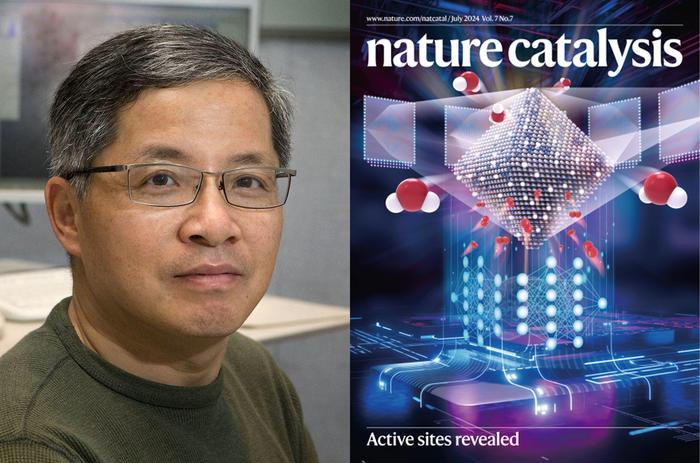
The study, which appeared on the cover of the July issue of Nature Catalysis, was led by corresponding authors and CNSI members Jianwei “John” Miao, a professor of physics and astronomy at the UCLA College; Yu Huang, the Traugott and Dorothea Frederking Endowed Professor and the chair of the materials science and engineering department at the UCLA Samueli School of Engineering; and Philippe Sautet, a distinguished professor of chemical and biomolecular engineering and the vice chair for graduate education at UCLA Samueli.
Using advances they developed for a microscopy technique called atomic electron tomography, the team studied 11 nanoparticles consisting of either a platinum-nickel alloy alone or that alloy plus traces of molybdenum, another metal that can serve as a catalyst. The researchers were able to measure a host of characteristics at atomic resolution, including the nanoparticles’ facets, their surface indentations, and the relative orderliness of the catalysts’ structures and chemical components.
The data from atomic electron tomography were plugged into artificial intelligence models trained based on fundamental principles of physics and chemistry. With the algorithms, the investigators identified the active sites where catalysis takes place. Those findings were then validated with real-world measurements.
The scientists’ observations revealed that chemical activity at the surface platinum sites varies widely — by several orders of magnitude. The team conducted a comprehensive analysis of the relationship between the nanocatalysts’ structure and chemical activity at the level of individual atoms to formulate an equation providing quantitative insights into the nanocatalysts’ active sites.
Although this study focused on platinum-based alloy nanocatalysts in a specific electrochemical reaction, the general method can be applied with a wide range of nanocatalysts for various reactions to determine the local 3D positions of atoms, as well as the catalysts’ elemental makeup and surface composition.
The study’s co-first authors are Yao Yang of Westlake University in China and UCLA’s Jihan Zhou, Zipeng Zhao and Geng Sun. Other co-authors are Saman Moniri, Yongsoo Yang, Ziyang Wei, Yakun Yuan and Yang Liu, all of UCLA; Colin Ophus, Jim Ciston and Peter Ercius of Lawrence Berkeley National Laboratory’s Molecular Foundry; Cheng Zhu and Hendrik Heinz of the University of Colorado at Boulder; and Qiang Sun and Qingying Jia of Northeastern University.
Journal
Nature Catalysis
Method of Research
Experimental study
Article Title
Atomic-scale identification of active sites of oxygen reduction nanocatalysts