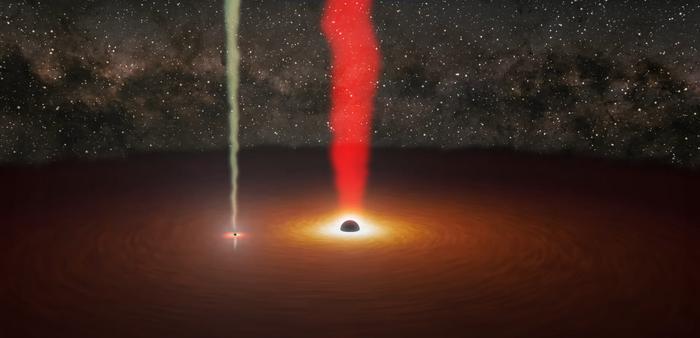
Credit: NASA/JPL-Caltech/R. Hurt (IPAC) & M. Mugrauer (AIU Jena)
Several international research groups have already confirmed the theory that there are two black holes at the centre of the distant galaxy OJ 287, first suggested by astronomers at the University of Turku, Finland. A new study shows that satellite observations conducted in 2021 revealed the smaller black hole of the pair for the first time.
In 2021, NASA’s exoplanet-hunting satellite was pointed towards the galaxy OJ 287 to help astronomers confirm the theory initially proposed by researchers at the University of Turku, Finland, of two black holes at the centre of the galaxy.
The Transiting Exoplanet Survey Satellite (TESS) is designed to discover thousands of exoplanets in orbit around the brightest dwarf stars in the sky. TESS is finding planets ranging from small, rocky worlds to giant planets, showcasing the diversity of planets in our galaxy. It has so far found 410 confirmed exoplanets or ”new worlds” circling stars other than the Sun.
In 2021, TESS spent several weeks studying another kind of system, a far-away galaxy called OJ 287. Researchers have found indirect evidence that a very massive black hole in OJ 287 is orbiting a giant black hole 100 times its size.
To verify the existence of the smaller black hole, TESS monitored the brightness of the primary black hole and the jet associated with it. Direct observation of the smaller black hole orbiting the larger one is very difficult, but its presence was revealed to the researchers by a sudden burst of brightness. This kind of an event had never been observed in OJ287 before, but researcher Pauli Pihajoki from the University of Turku in Finland predicted the event in his doctoral dissertation already in 2014. According to his dissertation, the next flare was expected to take place in late 2021, and several satellites and telescopes were focused on the object at the time.
The TESS satellite detected the expected flare on 12 November 2021 at 2 am GMT, and the observations were recently published in a study by Shubham Kishore, Alok Gupta (Aryabhatta Research Institute of Observational Sciences, India) and Paul Wiita (The College of New Jersey, USA). The event lasted only 12 hours. This short duration shows that it is very difficult to find a burst of great brightness unless its timing is known in advance. In this case, the Turku researchers’ theory proved correct, and TESS was directed at OJ 287 at just the right time. The discovery was also confirmed by NASA’s Swift telescope, which was also pointed at the same target.
In addition, a large international collaboration led by Staszek Zola from the Jagiellonian University in Cracow, Poland, detected the same event by using telescopes in different parts of the Earth, so that it was always nighttime at least at one of the telescope locations throughout the entire day. Moreover, a group from Boston University, USA, led by Svetlana Jorstad and other observers confirmed the discovery by studying the polarisation of light before and after the flare.
In a new study combining all the previous observations, Professor Mauri Valtonen and his research team at the University of Turku have shown that the 12-hour burst of light came from the smaller black hole in orbit and its surroundings.
The fast burst of brightness occurs when the smaller black hole “swallows” a large slice of the accretion disk surrounding the larger black hole, turning it into an outward jet of gas. The jet of the smaller black hole is then brighter than that of the larger black hole for about twelve hours. This makes the colour of OJ287 less reddish, or “yellow”, instead of the normal red. After the burst, the red colour returns. The “yellow” colour indicates that for the 12-hour period, we are seeing the light from the smaller black hole. The same results can be inferred from other features of the light emitted from OJ287 over the same time period.
“Therefore, we can now say that we have ‘seen’ an orbiting black hole for the first time, in the same way that we can say that TESS has seen planets orbiting other stars. And just as with planets, it is extremely difficult to get a direct image of the smaller black hole. In fact, because of OJ 287’s great distance, which is close to four billion light years, it will probably take a very long time before our observation methods have developed enough to catch a picture even of the larger black hole,” says Professor Valtonen.
“However, the smaller black hole may soon reveal its existence in other ways, as it is expected to emit nano-Hertz gravitational waves. The gravitational waves of OJ 287 should be detectable in the coming years by the maturing pulsar timing arrays,” says A. Gopakumar from the Tata Institute of Fundamental Research in India.
Journal
The Astrophysical Journal Letters
DOI
10.3847/2041-8213/ad4d9b
Article Title
Evidence of Jet Activity from the Secondary Black Hole in the OJ 287 Binary System
Article Publication Date
11-Jun-2024