• HOME
  • NEWS
  • EXPLORE
    • CAREER
      • Companies
      • Jobs
    • EVENTS
    • iGEM
      • News
      • Team
    • PHOTOS
    • VIDEO
    • WIKI
  • BLOG
  • COMMUNITY
    • FACEBOOK
    • INSTAGRAM
    • TWITTER
Saturday, February 7, 2026
BIOENGINEER.ORG
No Result
View All Result
  • Login
  • HOME
  • NEWS
  • EXPLORE
    • CAREER
      • Companies
      • Jobs
        • Lecturer
        • PhD Studentship
        • Postdoc
        • Research Assistant
    • EVENTS
    • iGEM
      • News
      • Team
    • PHOTOS
    • VIDEO
    • WIKI
  • BLOG
  • COMMUNITY
    • FACEBOOK
    • INSTAGRAM
    • TWITTER
  • HOME
  • NEWS
  • EXPLORE
    • CAREER
      • Companies
      • Jobs
        • Lecturer
        • PhD Studentship
        • Postdoc
        • Research Assistant
    • EVENTS
    • iGEM
      • News
      • Team
    • PHOTOS
    • VIDEO
    • WIKI
  • BLOG
  • COMMUNITY
    • FACEBOOK
    • INSTAGRAM
    • TWITTER
No Result
View All Result
Bioengineer.org
No Result
View All Result
Home NEWS Science News Chemistry

Reverse electrodialysis heat engine with helium-gap diffusion distillation: Energy efficiency analysis

Bioengineer by Bioengineer
May 29, 2024
in Chemistry
Reading Time: 2 mins read
0
Schematic diagram of REDHE
Share on FacebookShare on TwitterShare on LinkedinShare on RedditShare on Telegram

The depletion of energy resources poses a significant threat to the development of human society. Specifically, a considerable amount of low-grade heat (LGH), typically below 100 °C, is currently being wasted. However, if harnessed effectively, it has the potential to significantly improve overall energy utilization efficiency and subsequently reduce carbon dioxide emissions.
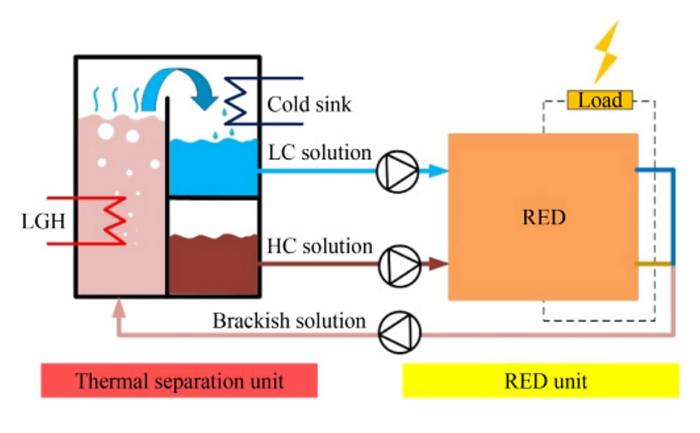
Schematic diagram of REDHE

Credit: HIGHER EDUCATION PRESS

The depletion of energy resources poses a significant threat to the development of human society. Specifically, a considerable amount of low-grade heat (LGH), typically below 100 °C, is currently being wasted. However, if harnessed effectively, it has the potential to significantly improve overall energy utilization efficiency and subsequently reduce carbon dioxide emissions.

A research group of Junyong Hu from Taiyuan University of Technology has concentrated on developing a new type of reverse electrodialysis heat engine (REDHE). It can efficiently convert LGH into electricity and has emerged as a promising technology in recent years. REDHE incorporates helium-gap diffusion distillation (HGDD) as the thermal separation (TS) unit. The team employed a validated mathematical model to analyze the impact of various operational and structural parameters on the performance of REDHE.

It was found that maintaining a moderate molality of the cold stream, increasing the inlet temperatures of hot and cold streams, lengthening the channels for hot and cold streams, and minimizing the thickness of helium gaps can significantly improve the performance of REDHE. Especially, the REDHE achieved a maximum energy conversion efficiency of 2.96% by reducing the thickness of helium gaps to 3 mm and extending the length of the stream channels to 5 m.

This research is significant as it provides a new technological approach to the effective utilization of low-grade heat energy. The development of the novel REDHE not only helps alleviate energy shortages but also reduces carbon emissions, offering substantial practical application value and environmental benefits for promoting sustainable energy development.


Journal

Frontiers in Energy

DOI

10.1007/s11708-024-0947-3

Method of Research

Experimental study

Subject of Research

Not applicable

Article Title

Reverse electrodialysis heat engine with helium-gap diffusion distillation: Energy efficiency analysis

Article Publication Date

30-Apr-2024

Share12Tweet8Share2ShareShareShare2

Related Posts

blank

Breakthrough in Environmental Cleanup: Scientists Develop Solar-Activated Biochar for Faster Remediation

February 7, 2026
blank

Cutting Costs: Making Hydrogen Fuel Cells More Affordable

February 6, 2026

Scientists Develop Hand-Held “Levitating” Time Crystals

February 6, 2026

Observing a Key Green-Energy Catalyst Dissolve Atom by Atom

February 6, 2026

POPULAR NEWS

  • Robotic Ureteral Reconstruction: A Novel Approach

    Robotic Ureteral Reconstruction: A Novel Approach

    82 shares
    Share 33 Tweet 21
  • Digital Privacy: Health Data Control in Incarceration

    63 shares
    Share 25 Tweet 16
  • Study Reveals Lipid Accumulation in ME/CFS Cells

    57 shares
    Share 23 Tweet 14
  • Breakthrough in RNA Research Accelerates Medical Innovations Timeline

    53 shares
    Share 21 Tweet 13

About

We bring you the latest biotechnology news from best research centers and universities around the world. Check our website.

Follow us

Recent News

Evaluating Pediatric Emergency Care Quality in Ethiopia

TPMT Expression Predictions Linked to Azathioprine Side Effects

Improving Dementia Care with Enhanced Activity Kits

Subscribe to Blog via Email

Success! An email was just sent to confirm your subscription. Please find the email now and click 'Confirm' to start subscribing.

Join 73 other subscribers
  • Contact Us

Bioengineer.org © Copyright 2023 All Rights Reserved.

Welcome Back!

Login to your account below

Forgotten Password?

Retrieve your password

Please enter your username or email address to reset your password.

Log In
No Result
View All Result
  • Homepages
    • Home Page 1
    • Home Page 2
  • News
  • National
  • Business
  • Health
  • Lifestyle
  • Science

Bioengineer.org © Copyright 2023 All Rights Reserved.