• HOME
  • NEWS
  • EXPLORE
    • CAREER
      • Companies
      • Jobs
    • EVENTS
    • iGEM
      • News
      • Team
    • PHOTOS
    • VIDEO
    • WIKI
  • BLOG
  • COMMUNITY
    • FACEBOOK
    • INSTAGRAM
    • TWITTER
Tuesday, June 2, 2026
BIOENGINEER.ORG
No Result
View All Result
  • Login
  • HOME
  • NEWS
  • EXPLORE
    • CAREER
      • Companies
      • Jobs
        • Lecturer
        • PhD Studentship
        • Postdoc
        • Research Assistant
    • EVENTS
    • iGEM
      • News
      • Team
    • PHOTOS
    • VIDEO
    • WIKI
  • BLOG
  • COMMUNITY
    • FACEBOOK
    • INSTAGRAM
    • TWITTER
  • HOME
  • NEWS
  • EXPLORE
    • CAREER
      • Companies
      • Jobs
        • Lecturer
        • PhD Studentship
        • Postdoc
        • Research Assistant
    • EVENTS
    • iGEM
      • News
      • Team
    • PHOTOS
    • VIDEO
    • WIKI
  • BLOG
  • COMMUNITY
    • FACEBOOK
    • INSTAGRAM
    • TWITTER
No Result
View All Result
Bioengineer.org
No Result
View All Result
Home NEWS Science News Biology

UBC research helps migrating salmon survive mortality hot-spot

Bioengineer by Bioengineer
April 19, 2024
in Biology
Reading Time: 2 mins read
0
Releasing tagged coho salmon
Share on FacebookShare on TwitterShare on LinkedinShare on RedditShare on Telegram

When Kevin Ryan and the other hardworking volunteers at Mossom Creek Hatchery in Port Moody, B.C. release young coho smolts into the ocean, they’re never quite certain how many will return as adults.
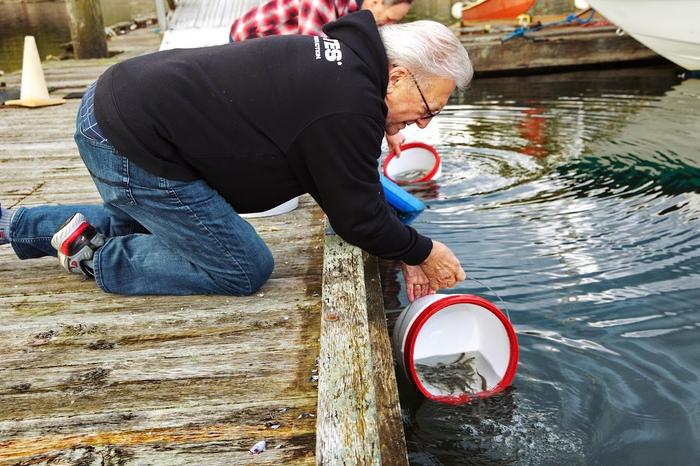
Releasing tagged coho salmon

Credit: Photo credit: Mossom Creek Hatchery

When Kevin Ryan and the other hardworking volunteers at Mossom Creek Hatchery in Port Moody, B.C. release young coho smolts into the ocean, they’re never quite certain how many will return as adults.

Mossom releases between 5,000 and 10,000 coho smolts each year, and is one of the few hatcheries to release coho directly into the ocean, rather than into a river. Until now, no research had looked at the success of direct ocean releases of coho.

UBC researchers used acoustic telemetry to tag and track coho on their journey. The results were revealing: only 60 per cent of the fish remained alive three kilometres from release. Fewer than one-quarter reached the Lions Gate Bridge 20 kilometres away.

“While low survival is not surprising during this life stage, we discovered that most mortality occurred close to the release location, likely due to predators,” said Dr. Scott Hinch, a professor in the department of forest and conservation sciences who heads the Pacific Salmon Ecology and Conservation Lab at UBC.

“Our results confirm recent studies that Burrard Inlet is a ‘mortality hot-spot’ for juvenile salmon but also suggests ways to increase the fish’s chances of survival, such as by changing the locations and ways of releasing fish.”

The hatchery will start testing different release locations, including various marine sites, and also directly into Mossom Creek.

“With the guidance of Dr. Hinch’s team, we’ll tag and monitor these fish from their release as smolts through to their return as adults to determine which approaches work best,” said Ryan, the hatchery president.

Like other community hatcheries, Mossom’s primary focus is on public education about natural resources and acting as stewards of local salmon creeks.

“As salmon runs continue to decline,” Dr. Hinch noted, “it is more important than ever to support community and volunteer-led hatcheries to improve ways to help these fish surviving their remarkable journey.”

Dr. Hinch and Mr. Ryan are available for interviews. Interview language(s): English


Journal

North American Journal of Fisheries Management

DOI

10.1002/nafm.10979

Method of Research

Observational study

Subject of Research

Animals

Article Title

Acoustic telemetry tracking of Coho Salmon smolts released from a community-run hatchery into a marine inlet reveals low early ocean survival

Article Publication Date

3-Mar-2024

Share12Tweet8Share2ShareShareShare2

Related Posts

Why Most Biology Education Guidelines Overlook Society — UW Researchers Highlight the Consequences — Biology

Why Most Biology Education Guidelines Overlook Society — UW Researchers Highlight the Consequences

June 2, 2026
Mount Sinai Scientists Identify Significant Genetic Factors in Postpartum Psychosis, Shedding Light on Severe Maternal Mental Illness — Biology

Mount Sinai Scientists Identify Significant Genetic Factors in Postpartum Psychosis, Shedding Light on Severe Maternal Mental Illness

June 2, 2026

Jumping Genes Surprise Scientists on the Y Chromosome

June 1, 2026

Ohio Wall Lizards Overcame Genetic Bottleneck Through Reproduction, Study Finds

May 29, 2026

POPULAR NEWS

  • ESMO 2025: mRNA COVID Vaccines Enhance Efficacy of Cancer Immunotherapy

    320 shares
    Share 128 Tweet 80
  • Multi-Hospital Study Reveals Long Covid Burden Is Twice as High as Current Estimates

    85 shares
    Share 34 Tweet 21
  • Saying Goodbye to PGY-6: Pediatric Fellowship Realities

    63 shares
    Share 25 Tweet 16
  • Common Food Preservatives Associated with Elevated Blood Pressure and Increased Heart Disease Risk

    57 shares
    Share 23 Tweet 14

About

We bring you the latest biotechnology news from best research centers and universities around the world. Check our website.

Follow us

Recent News

Psychological, Functional Factors Shape Elderly Care Quality

Hybrid Deep Learning Enhances Pressure Analysis in Reservoirs

Ultrathin Free-Standing Two-Dimensional Peptide Crystals

Subscribe to Blog via Email

Enter your email address to subscribe to this blog and receive notifications of new posts by email.

Join 82 other subscribers
  • Contact Us

Bioengineer.org © Copyright 2023 All Rights Reserved.

Welcome Back!

Login to your account below

Forgotten Password?

Retrieve your password

Please enter your username or email address to reset your password.

Log In
No Result
View All Result
  • Homepages
    • Home Page 1
    • Home Page 2
  • News
  • National
  • Business
  • Health
  • Lifestyle
  • Science

Bioengineer.org © Copyright 2023 All Rights Reserved.