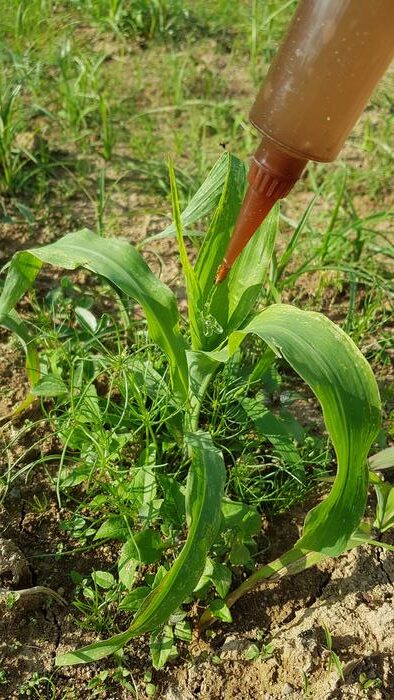
The fall armyworm is a destructive corn pest, which recently arrived in Africa and Asia from the Americas and began causing major yield losses and increased use of insecticides, which pose environmental and human health risks. Entomopathogenic nematodes are soil-dwelling roundworms that can parasitize and kill fall armyworms with no risks to people or the environment, but application can be tricky because the nematodes are susceptible to desiccation and UV radiation from sunlight. Patrick Fallet and colleagues report success using an innocuous biodegradable gel made from carboxymethyl cellulose that protects nematodes and keeps them hydrated. In field trials in Rwanda, the gel system, which was developed by the authors, outperformed a commercial liquid nematode formulation and the insecticide cypermethrin. When applied to the whorl of the corn plant 3–4 times throughout the season, the nematode gel decreased caterpillar infestation by about 50% and yielded an additional ton of maize (corn) per hectare. Because the nematodes kill fall armyworms with the aid of evolutionarily nimble symbiotic bacteria, the armyworm is unlikely to develop resistance. According to the authors, the nematode gel technology represents a promising alternative to chemical insecticides, with no deleterious effects on farmers, consumers, livestock, or the environment. According to the authors, selecting local strains of nematodes and developing caulking gun-like devices specifically designed for use by small holder-farmers could make the approach appealing and cost-effective.
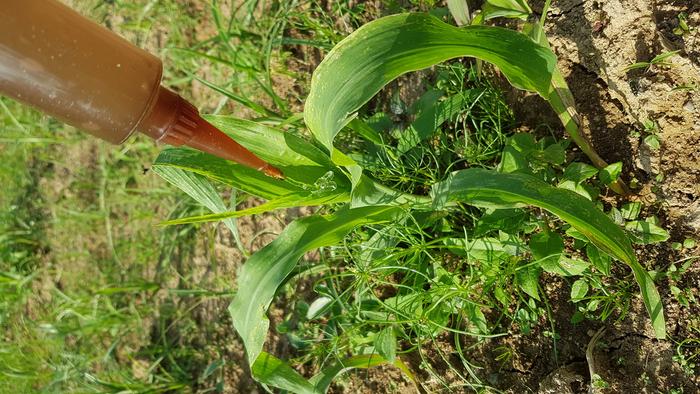
Credit: Patrick Fallet
The fall armyworm is a destructive corn pest, which recently arrived in Africa and Asia from the Americas and began causing major yield losses and increased use of insecticides, which pose environmental and human health risks. Entomopathogenic nematodes are soil-dwelling roundworms that can parasitize and kill fall armyworms with no risks to people or the environment, but application can be tricky because the nematodes are susceptible to desiccation and UV radiation from sunlight. Patrick Fallet and colleagues report success using an innocuous biodegradable gel made from carboxymethyl cellulose that protects nematodes and keeps them hydrated. In field trials in Rwanda, the gel system, which was developed by the authors, outperformed a commercial liquid nematode formulation and the insecticide cypermethrin. When applied to the whorl of the corn plant 3–4 times throughout the season, the nematode gel decreased caterpillar infestation by about 50% and yielded an additional ton of maize (corn) per hectare. Because the nematodes kill fall armyworms with the aid of evolutionarily nimble symbiotic bacteria, the armyworm is unlikely to develop resistance. According to the authors, the nematode gel technology represents a promising alternative to chemical insecticides, with no deleterious effects on farmers, consumers, livestock, or the environment. According to the authors, selecting local strains of nematodes and developing caulking gun-like devices specifically designed for use by small holder-farmers could make the approach appealing and cost-effective.
Journal
PNAS Nexus
Article Title
Entomopathogenic nematodes as an effective and sustainable alternative to control the fall armyworm in Africa
Article Publication Date
16-Apr-2024