As any surfer will tell you, waves pack a powerful punch. Now, we are one step closer to capturing the energy behind the ocean’s constant ebb and flow with an improved “blue energy” harvesting device. Researchers report in ACS Energy Letters that simply repositioning the electrode — from the center of a see-sawing liquid-filled tube to the end where the water crashes with the most force — dramatically increased the amount of wave energy that could be harvested.
Credit: Adapted from ACS Energy Letters 2024, DOI: 10/1021.acsenergylett.4c00072
As any surfer will tell you, waves pack a powerful punch. Now, we are one step closer to capturing the energy behind the ocean’s constant ebb and flow with an improved “blue energy” harvesting device. Researchers report in ACS Energy Letters that simply repositioning the electrode — from the center of a see-sawing liquid-filled tube to the end where the water crashes with the most force — dramatically increased the amount of wave energy that could be harvested.
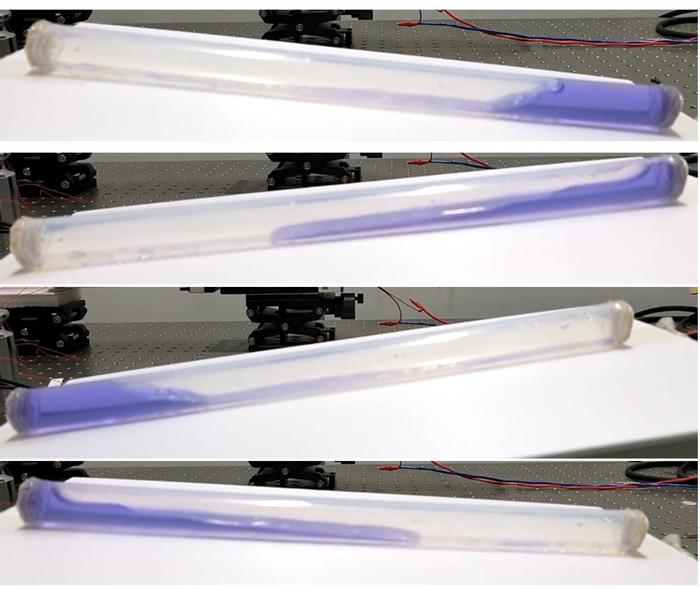
The tube-shaped wave-energy harvesting device improved upon by the researchers is called a liquid–solid triboelectric nanogenerator (TENG). The TENG converts mechanical energy into electricity as water sloshes back and forth against the inside of the tube. One reason these devices aren’t yet practical for large-scale applications is their low energy output. Guozhang Dai, Kai Yin, Junliang Yan and colleagues aimed to increase a liquid–solid TENG’s energy harvesting ability by optimizing the location of the energy-collecting electrode.
The researchers used 16-inch clear plastic tubes to create two TENGs. Inside the first device, they placed a copper foil electrode at the center of the tube — the usual location in conventional liquid–solid TENGs. For the new design, they inserted a copper foil electrode at one end of the tube. The researchers then filled the tubes a quarter of the way with water and sealed the ends. A wire connected the electrodes to an external circuit.
Placing both devices on a benchtop rocker moved water back and forth within the tubes and generated electrical currents by converting mechanical energy — the friction from water hitting or sliding against the electrodes — into electricity. Compared to the conventional design, the researchers found that the optimized design increased the device’s conversion of mechanical energy to electrical current 2.4 times. In another experiment, the optimized TENG blinked an array of 35 LEDs on and off as water entered the section of the tube covered by the electrode and then flowed away, respectively. The researchers say these demonstrations lay the foundation for larger scale blue-energy harvesting from ocean waves and show their device’s potential for other applications like wireless underwater signaling communications.
The authors acknowledge funding from the National Natural Science Foundation of China and the National Key Research and Development Program of China, and acknowledge computing resources from the High Performance Computing Center of Central South University.
The paper’s abstract will be available on April 3 at 8 a.m. Eastern time here: http://pubs.acs.org/doi/abs/10.1021/acsenergylett.4c00072
###
The American Chemical Society (ACS) is a nonprofit organization chartered by the U.S. Congress. ACS’ mission is to advance the broader chemistry enterprise and its practitioners for the benefit of Earth and all its people. The Society is a global leader in promoting excellence in science education and providing access to chemistry-related information and research through its multiple research solutions, peer-reviewed journals, scientific conferences, eBooks and weekly news periodical Chemical & Engineering News. ACS journals are among the most cited, most trusted and most read within the scientific literature; however, ACS itself does not conduct chemical research. As a leader in scientific information solutions, its CAS division partners with global innovators to accelerate breakthroughs by curating, connecting and analyzing the world’s scientific knowledge. ACS’ main offices are in Washington, D.C., and Columbus, Ohio.
To automatically receive news releases from the American Chemical Society, contact [email protected].
Note: ACS does not conduct research, but publishes and publicizes peer-reviewed scientific studies.
Follow us: X, formerly Twitter | Facebook | LinkedIn | Instagram
Journal
ACS Energy Letters
DOI
10.1021/acsenergylett.4c00072
Article Title
Space Volume Effect in Tube Liquid–Solid Triboelectric Nanogenerator for Output Performance Enhancement
Article Publication Date
3-Apr-2024