California, a state known for its aggressive greenhouse gas reduction policies, is ironically the nation’s greatest emitter of one: sulfuryl fluoride.
Credit: Khamar Hopkins/Johns Hopkins University
California, a state known for its aggressive greenhouse gas reduction policies, is ironically the nation’s greatest emitter of one: sulfuryl fluoride.
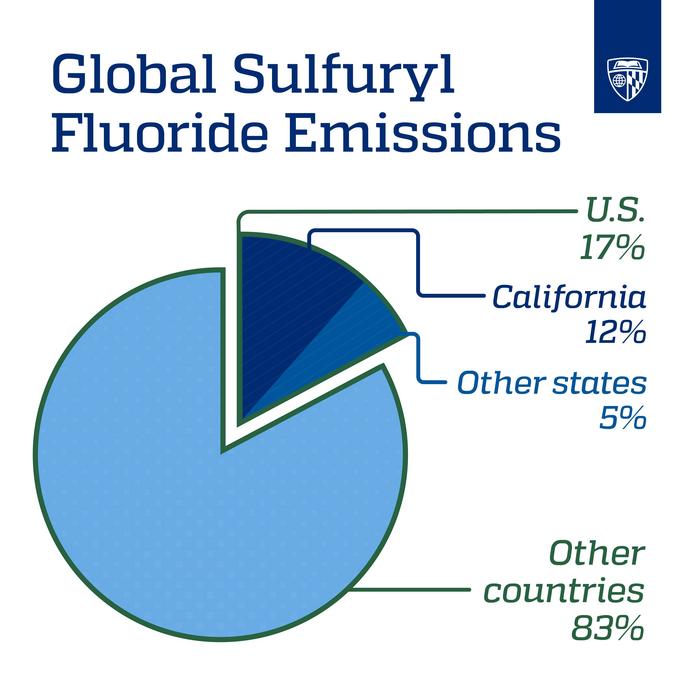
As much as 17% of global emissions of this gas, a common pesticide for treating termites and other wood-infesting insects, stem from the United States. The majority of those emissions trace back to just a few counties in California, finds a new study led by Johns Hopkins University.
“When we finally mapped it out, the results were puzzling because the emissions were all coming from one place,” said co-author Scot Miller, an assistant professor of environmental health and engineering at Johns Hopkins who studies greenhouse gases and air pollutants. “Other greenhouse gases like carbon dioxide and methane are found everywhere across the U.S. On our sulfuryl fluoride map, only California lit up like a Christmas tree.”
Miller and lead author Dylan Gaeta, a PhD candidate at Johns Hopkins, analyzed more than 15,000 air samples collected between 2015 and 2019 by NOAA Global Monitoring Laboratory scientists. The researchers factored in wind speed, direction, and other meteorological variables to trace the chemicals back to their point of origin.
The team found 60-85% of sulfuryl fluoride emissions in the U.S. come from California, primarily Los Angeles, Orange, and San Diego counties, despite California being a national leader in reducing greenhouse gas emissions, including publishing a comprehensive plan to achieve net-zero emissions by 2045.
“We can now show not only where but also how and why this gas is being emitted,” Gaeta said. “In order to get to net-zero emissions, we need a complete inventory of what greenhouse gases are out there.”
The findings published today in Communications Earth & Environment.
First approved by the U.S. Environmental Protection Agency for use as a pesticide in 1959, sulfuryl fluoride gained popularity after countries around the world agreed to phase out more reactive fumigants that were depleting the ozone layer, the researchers said.
Because California has kept thorough records of pesticide use, the team was able to attribute the vast majority, roughly 85% of the state’s sulfuryl fluoride emissions, to structural fumigation—the practice of sealing an infested structure with an airtight tent, pumping gas into the tent to eradicate the pests, and afterward venting the gas directly into the atmosphere. Roughly 15% came from agricultural and commodities fumigation.
Once emitted, the gas spreads and stays for more than 40 years in the atmosphere, where it contributes to global warming by trapping heat and sending it back down to the Earth’s surface, the researchers said. Average concentrations of sulfuryl fluoride in the atmosphere are low; however, humans have been emitting the man-made gas for decades at a rate faster than it can breakdown naturally.
“Without some form of intervention, sulfuryl fluoride is going to keep accumulating in our atmosphere. For most greenhouse gases, California has been very intentional about how it’s going to reduce emissions,” Gaeta said. “This one has slipped under the radar.”
Efforts to reduce greenhouse gas emissions generally focus on carbon because it poses the greatest threat to global warming. But, Miller said, researchers are working to get a more complete picture of the risks from other greenhouse gases.
Sulfuryl fluoride is one of the few treatments to rid buildings of drywood termites, a common regional pest that can form colonies in high, hard-to-reach parts of wooden structures. It’s also used at shipping ports to kill pests before they can hitch a ride to other parts of the world.
“It really is a double-edged sword. Sulfuryl fluoride is less harmful than the banned fumigants, but it also contributes to global warming,” Miller said. “California’s track record shows that it’s been looking at out-of-the-box, creative ways to reduce its greenhouse gas emissions. I think knowing better what the emissions are and what impact they have will give the state the information it needs to help holistically develop greenhouse gas reduction strategies.”
The researchers shared findings with the California Air Resources Board and the Bay Area Air Quality Management District.
This work was made possible by NSF program grants 2121641 and 2121739; NOAA grants NA21OAR4310233, NA21OAR4310234, NA14OAR0110139, NA14OAR0110140, and NA17OAR4320101; and NASA grant NNX15AJ06G.
Authors include: Johns Hopkins PhD candidate Mingyang Zhang; Scripps Institution of Oceanography researcher Jens Mühle; NOAA researchers Isaac J. Vimont, John B. Miller, Kathryn McKain, Lei Hu, Bianca C. Baier, Molly Crotwell, and Benjamin R. Miller; and Jianing Bao, a former Johns Hopkins graduate student.
Graphic: The United States is responsible for as much as 17% of the global emissions of sulfuryl fluoride, a potent greenhouse gas. About 60-85% of U.S. emissions come from California, according to a study published in Communications Earth & Environment. Credit/ Khamar Hopkins, Johns Hopkins University
###
Johns Hopkins University news releases are available online, as is information for reporters. To arrange an interview with a Johns Hopkins expert, contact a media representative listed above. Find more Johns Hopkins experts on the Experts Hub, and more Johns Hopkins stories on the Hub.
Journal
Communications Earth & Environment
DOI
10.1038/s43247-024-01294-x
Article Title
California dominatesU.S. emissions of the pesticide and potent greenhouse gas sulfuryl fluoride
Article Publication Date
3-Apr-2024