(Santa Barbara, Calif.) — A collaboration between research groups at the University of California, TU Dresden in Germany and Cedars-Sinai Guerin Children’s in Los Angeles has identified a mechanism by which embryonic cells organize themselves to send signals to surrounding cells, telling them where to go and what to do. While these signaling centers have been known to science for a while, how individual cells turn into organizers has been something of a mystery.
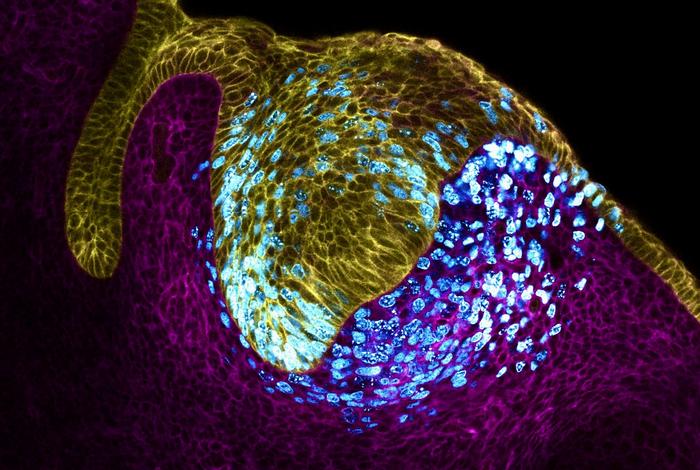
Credit: Neha Pincha Shroff and Pengfei Xu
(Santa Barbara, Calif.) — A collaboration between research groups at the University of California, TU Dresden in Germany and Cedars-Sinai Guerin Children’s in Los Angeles has identified a mechanism by which embryonic cells organize themselves to send signals to surrounding cells, telling them where to go and what to do. While these signaling centers have been known to science for a while, how individual cells turn into organizers has been something of a mystery.
Until now. In a paper published in the journal Nature Cell Biology, the researchers find that cells are literally pressed into becoming organizers.
“We were able to use microdroplet techniques to figure out how the buildup of mechanical pressure affects organ formation,” said co-corresponding author Otger Campàs, former associate professor of mechanical engineering at UC Santa Barbara, who is currently managing director, professor and chair of tissue dynamics at the Physics of Life Excellence Cluster of TU Dresden.
Peer pressure
Finding out how cells decide to become organizers during the formation of organs remains a central challenge in the study of embryogenesis, and is key to understanding embryonic development.
“By understanding how an embryo forms organs, we can start to ask questions about what goes wrong in children born with congenital malformations,” said fellow co-author Ophir Klein, MD, executive director of Cedars-Sinai Guerin Children’s, where he is also the David and Meredith Kaplan Distinguished Chair in Children’s Health.
Building on techniques previously developed by Campàs, in which minute droplets inserted between developing embryonic cells sense the forces exerted by cells on each other, and through observations of an embryonic incisor tooth, the researchers found that pressure influences a cell’s fate — they feel the squeeze and use this information to organize themselves.
“It’s like those toys that absorb water and grow in size,” said Neha Pincha Shroff, a postdoctoral scholar in the School of Dentistry at UCSF, and co-lead author of the study. “Just imagine that happening in a confined space. What happens in the incisor knot is that the cells multiply in number in a fixed space and this causes a pressure to build up at the center, which then becomes a cluster of specialized cells.” The researchers found that the cells feeling the stronger pressure stop growing and start sending signals to organize the other surrounding cells in the tooth.
Embryos use several of these signaling centers to guide cells as they form tissues and organs. Cells around these centers receive stronger or weaker signals depending on their location, and they make decisions accordingly. Like building skyscrapers or bridges, sculpting our organs involves tight planning, a lot of coordination and the right structural mechanics. Failure in any of these processes can be catastrophic when it comes to building a bridge, and it can also be damaging for us when growing in the womb.
“This work may lead to additional research into how birth defects are formed and can be prevented,” Klein remarked.
Seeing how pressure works in embryonic development opens up further research possibilities, according to Campàs.
“It is really exciting that pressure has a role in establishing signaling centers,” he said. “It will be interesting to see if or how mechanical pressure affects other important developmental processes.”
Investigators Pengfei Xu (co-first author), Sangwoo Kim, Elijah Shelton, Ben Gross, Yucen Liu, Carlos Gomez, Qianlin Ye, Tingsheng Yu Drennon, Jimmy Hu, and Jeremy Green also participated in the study.
Journal
Nature Cell Biology