Scientists believe that planetary systems like our solar system contain more rocky objects than gas-rich ones. Around our sun, these include the inner planets – Mercury, Venus, Earth and Mars – the asteroid belt and the Kuiper belt objects such as Pluto.
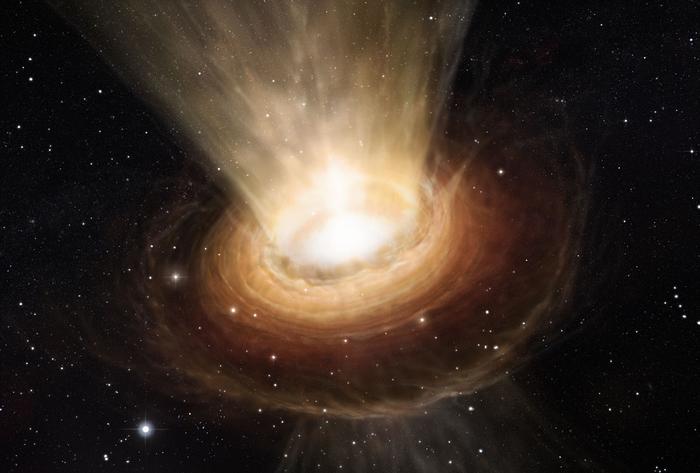
Credit: ESO/M. Kornmesser
Scientists believe that planetary systems like our solar system contain more rocky objects than gas-rich ones. Around our sun, these include the inner planets – Mercury, Venus, Earth and Mars – the asteroid belt and the Kuiper belt objects such as Pluto.
Jupiter, Saturn, Uranus and Neptune, on the other hand, contain mostly gas. But scientists also have known for a long time that planet-forming disks start out with 100 times more mass in gas than solids, which leads to a pressing question: When and how does most of the gas leave a nascent planetary system?
A new study led by Naman Bajaj at the University of Arizona Lunar and Planetary Laboratory, published in the Astronomical Journal, provides answers. Using the James Webb Space Telescope, or JWST, the team obtained images from such a nascent planetary system – also known as a circumstellar disk – in the process of actively dispersing its gas into surrounding space.
“Knowing when the gas disperses is important as it gives us a better idea of how much time gaseous planets have to consume the gas from their surroundings,” said Bajaj, a second-year doctoral student at UArizona’s Lunar and Planetary Laboratory. “With unprecedented glimpses into these disks surrounding young stars, the birthplaces of planets, JWST helps us uncover how planets form.”
During the very early stages of planetary system formation, planets coalesce in a spinning disk of gas and tiny dust around the young star, according to Bajaj. These particles clump together, building up into bigger and bigger chunks called planetesimals. Over time, these planetesimals collide and stick together, eventually forming planets. The type, size and location of planets that form depend on the amount of material available and how long it remains in the disk.
“So, in short, the outcome of planet formation depends on the evolution and dispersal of the disk,” Bajaj said.
At the heart of this discovery is the observation of T Cha, a young star – relative to the sun, which is about 4.6 billion years old – enveloped by an eroding circumstellar disk notable for a vast dust gap, spanning approximately 30 astronomical units, or au, with one au being the average distance between the Earth and the sun.
Bajaj and his team were able, for the first time, to image the disk wind, as the gas is referred to when it slowly leaves the planet-forming disk. The astronomers took advantage of the telescope’s sensitivity to light emitted by an atom when high-energy radiation – for example, in starlight – strips one or more electrons from its nucleus. This is known as ionization, and the light emitted in the process can be used as a sort of chemical “fingerprint” – in the case of the T Cha system, tracing two noble gases, neon and argon. The observations also mark the first time a double ionization of argon has been detected in a planet-forming disk, the team writes in the paper.
“The neon signature in our images tells us that the disk wind is coming from an extended region away from the disk,” Bajaj said. “These winds could be driven either by high-energy photons – essentially the light streaming from the star – or by the magnetic field that weaves through the planet-forming disk.”
In an effort to differentiate between the two, the same group, this time led by Andrew Sellek, a postdoctoral researcher at Leiden University in the Netherlands, performed simulations of the dispersal driven by stellar photons, the intense light streaming from the young star. They compared these simulations to the actual observations and found dispersal by high-energy stellar photons can explain the observations, and hence cannot be excluded as a possibility. That study concluded that the amount of gas dispersing from the T Cha disk every year is equivalent to that of Earth’s moon. These results will be published in a companion paper, currently under review with the Astronomical Journal.
While neon signatures had been detected in many other astronomical objects, they weren’t known to originate in low-mass planet-forming disks until first discovered in 2007 with JWST’s predecessor, NASA’s Spitzer Space Telescope, by Ilaria Pascucci, a professor at LPL who soon identified them as a tracer of disk winds. Those early findings transformed research efforts focused on understanding gas dispersal from circumstellar disks. Pascucci is the principal investigator on the most recent observing project and a co-author on the publications reported here.
“Our discovery of spatially resolved neon emission – and the first detection of double ionized argon – using the James Webb Space Telescope could become the next step towards transforming our understanding of how gas clears out of a planet-forming disk,” Pascucci said. “These insights will help us get a better idea of the history and impact on our own solar system.”
In addition, the group has also discovered that the inner disk of T Cha is evolving on very short timescales of decades; they found that the spectrum observed by JWST differs from the earlier spectrum detected by Spitzer. According to Chengyan Xie, a second-year doctoral student at LPL who leads this in-progress work, this mismatch could be explained by a small, asymmetric disk inside of T Cha that has lost some of its mass in the short 17 years that have elapsed between the two observations.
“Along with the other studies, this also hints that the disk of T Cha is at the end of its evolution,” Xie said. “We might be able to witness the dispersal of all the dust mass in T Cha’s inner disk within our lifetime.”
Co-authors on the publications include Uma Gorti with the SETI Institute, Richard Alexander with the University of Leicester, Jane Morrison and Andras Gaspar with the UArizona’s Steward Observatory, Cathie Clarke with the University of Cambridge, Giulia Ballabio with Imperial College London, and Dingshan Deng with the Lunar and Planetary Laboratory.
DOI
10.3847/1538-3881/ad22e1
Method of Research
Observational study
Subject of Research
Not applicable
Article Title
The American Astronomical Society, find out more. The Institute of Physics, find out more. THE FOLLOWING ARTICLE ISOPEN ACCESS JWST MIRI MRS Observations of T Cha: Discovery of a Spatially Resolved Disk Wind
Article Publication Date
4-Mar-2024