Namibia’s legendary fairy circles are mysterious, circular, bald patches in the dry grasslands on the edge of the Namib Desert. Their formation has been researched for decades and has recently been the subject of much debate. With extensive fieldwork, researchers from the University of Göttingen in Germany and Ben Gurion University in Israel investigated how freshly germinated grass dies inside the fairy circle. Their results show that the grass withers due to a lack of water inside the fairy circle. The topsoil, comprised of the top 10 to 12 centimetres of the soil, acts as a kind of “death zone” in which fresh grass cannot survive for long. The new grass dies between 10 and 20 days after the rain. According to the researchers, the fact that it shows no signs of termite damage disproves a competing theory. The results were published in the journal Perspectives in Plant Ecology, Evolution and Systematics.
Credit: Stephan Getzin
Namibia’s legendary fairy circles are mysterious, circular, bald patches in the dry grasslands on the edge of the Namib Desert. Their formation has been researched for decades and has recently been the subject of much debate. With extensive fieldwork, researchers from the University of Göttingen in Germany and Ben Gurion University in Israel investigated how freshly germinated grass dies inside the fairy circle. Their results show that the grass withers due to a lack of water inside the fairy circle. The topsoil, comprised of the top 10 to 12 centimetres of the soil, acts as a kind of “death zone” in which fresh grass cannot survive for long. The new grass dies between 10 and 20 days after the rain. According to the researchers, the fact that it shows no signs of termite damage disproves a competing theory. The results were published in the journal Perspectives in Plant Ecology, Evolution and Systematics.
For the study, the scientists analysed 500 individual grass plants in four regions of the Namib by taking measurements of root and leaf lengths, carrying out statistical analyses, as well as collecting and comparing photographic evidence. They also took several hundred measurements of soil moisture during or after the 2023 and 2024 rainy seasons.
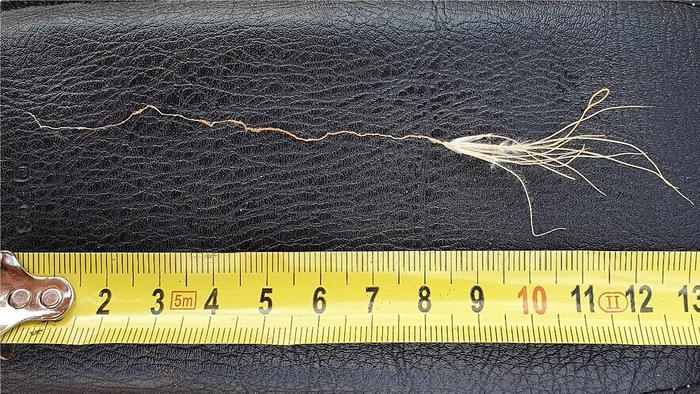
This showed that the topsoil is very susceptible to drying out. During and after the rainy season, the soil moisture here is three to four times lower than the soil at a depth of around 20 centimetres. In addition, the topsoil is significantly drier within the fairy circle than outside during the period of grass growth after ample rainfall. Under these conditions, freshly germinated grasses cannot survive in the fairy circle: they dry out because they cannot reach the deeper, more moist layers of soil with their roots, which are on average 10 centimetres long.
In contrast, the large, perennial clumps of grass that grow at the edge of the fairy circle benefit from being able to access the soil water to a depth of 20 to 30 centimetres and below. These clumps of grass quickly turn green after the rain. “With their well-developed root system, these clumps of grass soak up the water particularly well. After the rain, they have a huge competitive advantage over the freshly germinated grasses in the fairy circle. The new grass only loses a small amount of water via transpiration from its small leaves, resulting in insufficient ‘suction power’ to pull new water from deeper soil layers,” explains first author Dr Stephan Getzin, Göttingen University’s Ecosystem Modelling Department.
The measurement data also show that the physical conductivity of the water is high in the first 20 days after the rain, particularly in the upper soil, and decreases with depth. As a result, the clumps of grass primarily draw water from the top 10 to 20 centimetres of the soil. Getzin says: “This is the cause of the death of the new grass in the fairy circle. Continuous soil moisture measurements over several years support this conclusion. This is because the soil water in the fairy circle only decreases noticeably quickly with the strengthening and regrowth of the surrounding grass after rain.” According to the researchers, this testifies to the basic function of the fairy circles as water sources for the drought-stressed grass of the Namib. The round shape of the fairy circles is formed by the grass itself, as this creates the maximum supply of soil water for itself. “This self-organisation can be described as ‘swarm intelligence’. It is a systematic adaptation to a lack of resources in arid regions,” say Getzin and his colleague Dr Hezi Yizhaq.
In their study, Getzin and Yizhag also comment on the theory that termites shorten the roots of fresh grass in the fairy circle by feeding on them, causing the new grass to die. “In an extensive discussion of the publications on the sand termite theory, we show that so far not a single field study with systematic measurement data on the root length of dying grasses has shown that termite feeding on the roots of newly germinated grasses create the Namib fairy circles,” the researchers say.
They also highlight a concern in that the supporters of the sand termite theory cite other research as “evidence” for the killing of fresh grass due to termite herbivory on the roots, but in fact the cited articles do not even deal with this specific subject matter.
Getzin’s findings from his research into the fairy circles can be found at www.fairy-circles.info. The research findings are explained in this video: https://youtu.be/KoWyV01wR7o.
Original publication: Stephan Getzin & Hezi Yizhaq. Desiccation of undamaged grasses in the topsoil causes Namibia’s fairy circles – Response to Jürgens & Gröngröft (2023). Perspectives in Plant Ecology, Evolution and Systematics (2024). DOI: https://doi.org/10.1016/j.ppees.2024.125780
Contact:
Dr Stephan Getzin
University of Göttingen
Faculty of Forest Sciences and Forest Ecology
Department of Ecosystem Modelling
Tel: +49 (0)551 39-23414
Email: [email protected]
www.uni-goettingen.de/en/112105.html
DOI
10.1016/j.ppees.2024.125780
Method of Research
Observational study
Subject of Research
Not applicable
Article Title
Desiccation of undamaged grasses in the topsoil causes Namibia’s fairy circles – Response to Jürgens & Gröngröft (2023)
Article Publication Date
19-Mar-2024