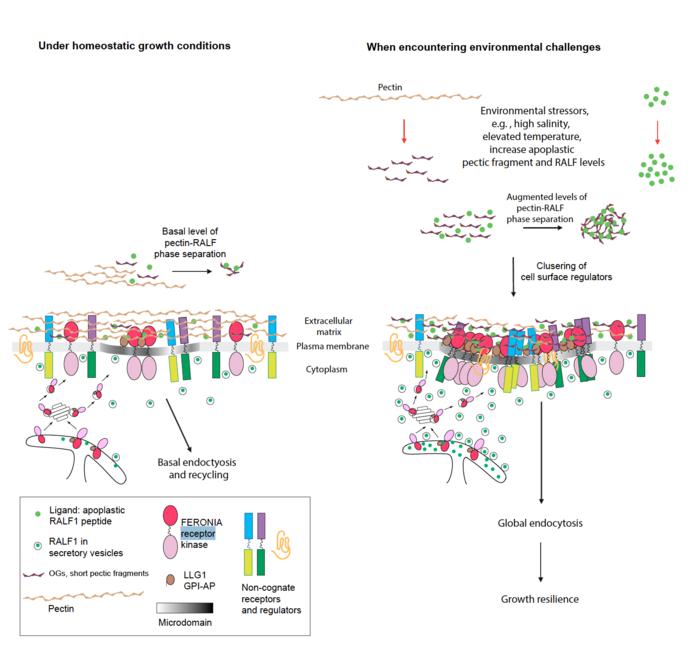
AMHERST, Mass. – A team of researchers from the University of Massachusetts Amherst recently published a pioneering study that answers a central question in biology: how do organisms rally a wide range of cellular processes when they encounter a change—either internally or in the external environment—to thrive in good times or survive the bad times? The research, focused on plants and published in Cell, identifies the interactions between four compounds: pectin, receptor proteins FERONIA and LLG1 and the signal RALF peptide. In particular, the team discovered that a molecular condensation process, called liquid-liquid phase separation, that occurs between pectin and RALF at the cell wall-cell membrane interface governs how a stimulus triggers many cellular processes. Together, these processes generate a response advantageous to the plant.
Credit: Liu et al., 2024.
AMHERST, Mass. – A team of researchers from the University of Massachusetts Amherst recently published a pioneering study that answers a central question in biology: how do organisms rally a wide range of cellular processes when they encounter a change—either internally or in the external environment—to thrive in good times or survive the bad times? The research, focused on plants and published in Cell, identifies the interactions between four compounds: pectin, receptor proteins FERONIA and LLG1 and the signal RALF peptide. In particular, the team discovered that a molecular condensation process, called liquid-liquid phase separation, that occurs between pectin and RALF at the cell wall-cell membrane interface governs how a stimulus triggers many cellular processes. Together, these processes generate a response advantageous to the plant.
“Biologists often work linearly: we observe as a stimulus comes in, and then we monitor a specific response along a certain cellular pathway that we believe is behind that response. But in reality, cells maintain a multitude of pathways, which are carefully maintained and need to be coordinated all the time,” says Alice Cheung, Distinguished Professor of Biochemistry and Molecular Biology at UMass Amherst and the paper’s senior author.
Cheung and her long-time collaborator and co-senior author Hen-Ming Wu have contemplated the question of stimulus and response ever since they discovered back in 2010 and 2015 that the FERIONIA-LLG1 receptor pair is an ideal candidate to tease apart the challenging puzzle. FERONIA-LLG1 impacts almost all aspects of plant life – growth from a just-sprouted seedling to mature and reproducing the next generation, and sustaining all kinds of challenges in between, like diseases and climatic extremes.
“It has taken many years from two very dedicated junior colleagues, postdoc James Ming-Che Liu and graduate student Jessica Fang-Ling Yeh, the co-first authors of the paper, and a recently graduated molecular and cellular biology Ph.D. student, Robert Yvon,” Cheung says. “Together they completed a set of studies that started from different but deliberately designed angles to provide a cohesive story, which is otherwise impossible to tell.”
The investigation began with an inquiry into how the signal (or ligand) RALF affects FERONIA-LLG1 in the cell membrane. The team observed some puzzling results: the cell didn’t simply take-up FERONIA-LLG1 into the cell, a process known as endocytosis and a typical response; every cell membrane molecule the team tested was affected. Furthermore, unlike typical ligand-receptor interaction, the ligand RALF remained outside the cell in a pectin-rich extracellular matrix called the cell wall.
The team then examined the biochemical and biophysical interactions between the four molecules, how these interactions affect the behavior of these molecules on the cellular level and how they affect plant physiological outcomes using two often-encountered environmental stresses: elevated temperature and salinity.
The results provide, for the first time, a mechanism to explain how plant cells coordinate many different pathways in response to a single stress signal to become more resilient and survive. The work also demonstrates for the first time how phase-separation at the cell wall-cell membrane interface, the frontline where a plant cell detects and responds to outside stimuli, can profoundly affect a collective cellular response. Cheung adds that “the work could not have been done without the core facilities in the Institute of Applied Life Sciences and the input of James Chambers, director of the Light Microscopy Core and a co-author on the paper.”
Contacts: Alice Cheung, [email protected]
Daegan Miller, [email protected]
Journal
Cell
DOI
10.1016/j.cell.2023.11.038
Article Title
Extracellular pectin-RALF phase separation mediates FERONIA global signaling function