If you hate the rain, you have something in common with wolf spiders.
Credit: JOSEPH FUQUA II
If you hate the rain, you have something in common with wolf spiders.
Researchers at the University of Cincinnati found that wolf spiders can’t signal others or perceive danger from predators as easily on rain-soaked leaves compared to dry ones. Even communicating with would-be mates is harder after it rains.
The study was published in the Journal of Insect Behavior.
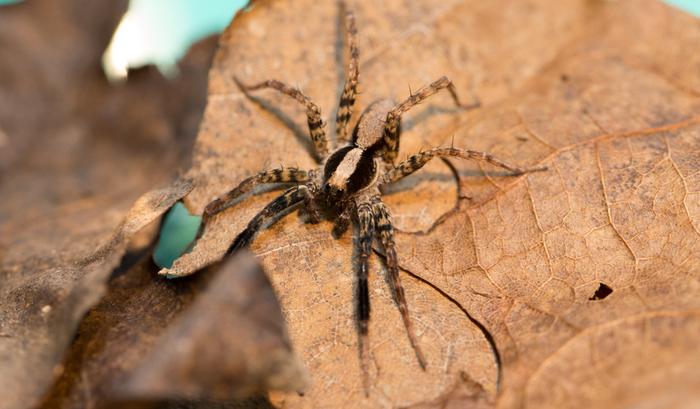
Biologists in UC’s College of Arts and Sciences studied Schizocosa ocreata, a wolf spider found across much of the United States. Males respond to chemical signals from females by using a combination of visual and vibratory signals for courtship.
Spiders don’t have ears, but sense sound in vibrations using specialized sense organs in their eight legs. The vibrations from sound carry much better in dry leaves.
Wolf spiders are especially attuned to the calls of predatory birds like blue jays that feast on spiders, particularly during nesting season when their offspring eat virtually nothing else, lead author and UC Professor George Uetz said.
“Birds preferentially feed spiders to their offspring because spiders have 50 times the amount of taurine than insects,” Uetz said. “And taurine is critical for the development of the hippocampus of nestlings’ brains. The hippocampus is associated with spatial memory, which is really important for birds.”
The spring nesting season coincides with the spiders’ mating season. Male wolf spiders are especially vulnerable to birds when they try to woo a mate with a flashy display, which involves drumming their exaggeratedly furry front legs on the leaves in front of them.
The UC study found that male spiders become motionless and “freeze” when a blue jay calls nearby. And they stay frozen longer on dry leaves than on wet ones, possibly because the dry leaves provide a better early warning than wet ones that dampen vibrations.
Uetz said the striped black and brown spiders have remarkable camouflage when they remain motionless.
“If they remain still, they just disappear,” he said.
“Like lots of predators, blue jays are visually oriented,” Uetz said. “They’re very visually acute. For them, movement really is the key.”
With climate change increasing the frequency and duration of spring rains, wolf spiders will face increasing ecological challenges, Uetz said.
“Spring is coming a little earlier. What we’re seeing is there’s a shift in the life cycle of the spiders,” Uetz said. “If global warming shifts the annual life cycle of the spiders, that will push them out of synchrony with the nesting season of the birds, which is more closely tied to daylight cues.”
Wet leaves didn’t discourage male spiders from courting females. Male spiders increased visual signaling to compensate for the inability to use vibrations. But spiders that could use dry leaves to communicate to females had more mating success.
UC graduate Rachel Gilbert, a study co-author, said spiders can be important bellwethers of environmental change.
“Spiders are very important to local ecosystems, both as a predator of insects and as a major food source to larger animals like birds,” she said.
The study was funded by grants from the National Science Foundation.
Journal
Journal of Insect Behavior
DOI
10.1007/s10905-023-09843-6
Method of Research
Observational study
Subject of Research
Animals
Article Title
Effects of Leaf Moisture on Transmission and Detection of Communication by a Wolf Spider
Article Publication Date
29-Dec-2023
COI Statement
None