COLUMBIA, Mo. — Many people associate virtual reality headsets with interactive video games, but a researcher at the University of Missouri is using them for something far more important — helping autistic people navigate public transportation on college campuses.
MU researcher Noah Glaser — in collaboration with Matthew Schmidt, an associate professor at the University of Georgia, and others — partnered with a program at the University of Cincinnati on a pair of studies geared toward providing autistic people virtual training opportunities to practice using a public bus to get around town.
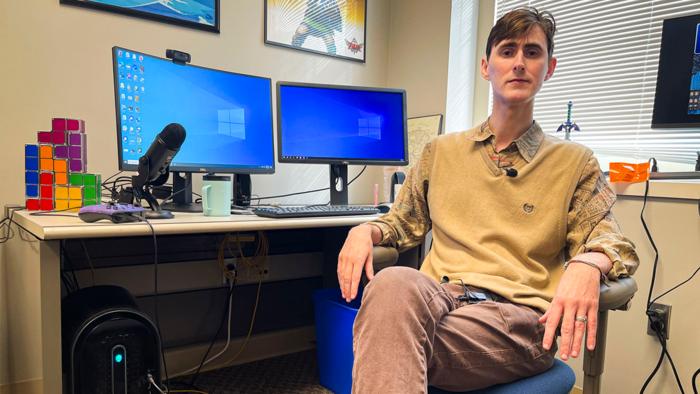
Credit: University of Missouri
COLUMBIA, Mo. — Many people associate virtual reality headsets with interactive video games, but a researcher at the University of Missouri is using them for something far more important — helping autistic people navigate public transportation on college campuses.
MU researcher Noah Glaser — in collaboration with Matthew Schmidt, an associate professor at the University of Georgia, and others — partnered with a program at the University of Cincinnati on a pair of studies geared toward providing autistic people virtual training opportunities to practice using a public bus to get around town.
Using artificial intelligence (AI), the research team found that autistic people often experience their environment differently than their neurotypical peers, and that their attention and gaze patterns are often diverted due to sensory processing challenges in overstimulating environments. These findings pave the way for future research exploring how virtual reality simulations can help autistic individuals increase their self-confidence and community engagement by providing a safe space to practice various tasks.
“There is an abundance of autism-related research in the medical industry, but we want to show how interventions beyond medicine can help autistic people feel more comfortable in society,” said Glaser, an assistant professor in the MU College of Education and Human Development.
Practice makes perfect
One study examined how a group of young autistic adults navigated an on-campus bus system.
To gather data, Glaser and team created a virtual reality simulation that’s an exact replica of a university’s campus and shuttle system. They used an AI technique known as “computer vision” — or the ability for computers to detect objects and make informed decisions — to analyze how participants wearing the virtual reality headset attended to physical objects along their virtual journey across campus to the bus stop. They then compared that data to neurotypical users to see what differences might exist.
“We know that neurodiverse individuals often have sensory processing challenges, and certain environments — like going to a bus stop on a busy college campus — can be overstimulating and anxiety-inducing,” Glaser said. “If we can identify which objects were most distracting to neurodiverse learners along their journey and what objects were being attended to the most, we can manipulate or reduce that extra stimuli in a safe, controlled environment before participants attempt that activity in the real world.”
Part of the virtual simulation involved an instructor modelling the skills the participants would eventually perform in real life on a guided tour to the virtual bus stop.
“This project helps us better understand the nature of human-computer interaction from a group of users who typically are left out of those conversations,” Glaser said. “We need more research with neurodiverse individuals to better understand how they interact with virtual reality learning environments so we can adapt the interventions to become more accessible.”
Applications going forward
Glaser said this research is just the tip of the iceberg into examining how AI and virtual reality simulators can help special education professionals, intervention specialists and instructional designers support neurodiverse individuals.
“Going forward, we can use these tools to help provide training opportunities for neurodiverse learners who are interested in cybersecurity and science, technology, engineering and math (STEM)-related fields,” Glaser said. “These are industries that have historically been severely underrepresented in people with disabilities and neurodiverse individuals.”
Glaser said he hopes his efforts can help translate the skills neurodiverse learners adapt virtually into the real world, which will improve both their own self-confidence and their contributions to society at-large.
“This work can spark more opportunities for promoting inclusive learning environments and better understanding of how neurodiverse individuals use and interact with technology,” Glaser said. “When learning interventions are being developed, it is important we include neurodiverse individuals as part of the design process.”
“Through the lens of artificial intelligence: A novel study of spherical video-based virtual reality usage in autism and neurotypical participants,” and “Programming for generalization: Confronting known challenges in the design of virtual reality interventions for autistic users” were published in Computers & Education: X Reality.
Editor’s note:
Matthew Schmidt was the primary investigator on the research project.
-30-
DOI
10.1016/j.cexr.2023.100041
Method of Research
Experimental study
Subject of Research
People
Article Title
Through the lens of artificial intelligence: A novel study of spherical video-based virtual reality usage in autism and neurotypical participants
Article Publication Date
11-Oct-2023