According to a new study conducted at the University of Helsinki, the area of northern peatlands has grown in recent centuries. Previously, it was thought that the lateral expansion of peatlands in Fennoscandia has halted or significantly slowed, as the flat areas susceptible to peat formation have already turned into peatland.
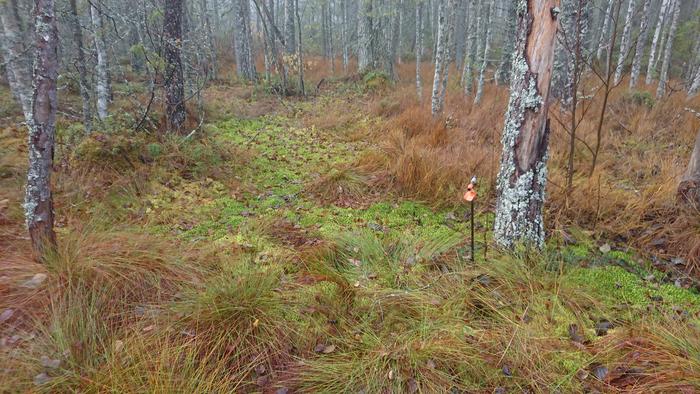
Credit: Teemu Juselius-Rajamäki.
According to a new study conducted at the University of Helsinki, the area of northern peatlands has grown in recent centuries. Previously, it was thought that the lateral expansion of peatlands in Fennoscandia has halted or significantly slowed, as the flat areas susceptible to peat formation have already turned into peatland.
The study conducted was aimed at investigating how peatlands have expanded and what it means for carbon sinks and natural landscape. In addition, the researchers examined the effect of forest fires and local conditions, such as topography and the composition of the subsoil, on the expansion of peatlands.
“Our study challenges the previous assumption that the lateral expansion of peatlands has halted or slowed down in Fennoscandia. On the contrary, lateral expansion has accelerated in the past 1,500 years,” says Doctoral Researcher Teemu Juselius-Rajamäki from the Faculty of Biological and Environmental Sciences.
“While the growth rate in the sandy, gravel and till soils studied is moderate compared to the rates measured in flat clay soils, this translates into the continuous expansion of peatlands by on average approximately one centimetre per year,” Juselius-Rajamäki adds.
Peatlands are significant carbon sequestrating and storing ecosystems, and the growth of peatlands can in fact significantly increase the amount of carbon bound to peat in the future. At the same time, if the new peatlands are very wet peatland types dominated by sedges, their methane emissions can initially be high.
Peatland ecosystems are power-hungry, expansion-oriented natural entities
The study raises questions about the development of peatland and forest margins. In the study, peatland ecosystems were found to be expansive by nature, which is important to consider when setting boundaries to conservation areas and in restoration plans. In addition, the study opens up an opportunity to understand the role of new peatlands as future carbon stocks and methane sources.
Taking into account the increasing interest in the carbon stored in peatlands emphasises the topical nature of the issue. Compared to forests, peatlands have received less attention in the carbon debate, even though they constitute an enormous carbon stock.
“According to estimates, there remains capacity for storing nearly 900 billion tonnes of carbon in the northern peatlands. This study contributes to increasing our understanding of the peatland environment and provides valuable information in support of future decision-making,” says Professor of Environmental Change Atte Korhola, who headed the study.
The study was based on peat samples dated using radiocarbon dating, which makes it possible to determine the age of the peat basal layers. Even though radiocarbon dating is expensive and limits the number of samples, accumulating research data will provide a better understanding of peatland development.
In terms of peatland ecology and the prevention of climate change, knowledge pertaining to the lateral expansion of northern peatlands is important. This study provides valuable information on significant but overlooked peatland margins.
Journal
Global Change Biology
DOI
10.1111/gcb.16988
Article Title
The ongoing lateral expansion of peatlands in Finland
Article Publication Date
19-Oct-2023