• HOME
  • NEWS
  • EXPLORE
    • CAREER
      • Companies
      • Jobs
    • EVENTS
    • iGEM
      • News
      • Team
    • PHOTOS
    • VIDEO
    • WIKI
  • BLOG
  • COMMUNITY
    • FACEBOOK
    • INSTAGRAM
    • TWITTER
Saturday, February 7, 2026
BIOENGINEER.ORG
No Result
View All Result
  • Login
  • HOME
  • NEWS
  • EXPLORE
    • CAREER
      • Companies
      • Jobs
        • Lecturer
        • PhD Studentship
        • Postdoc
        • Research Assistant
    • EVENTS
    • iGEM
      • News
      • Team
    • PHOTOS
    • VIDEO
    • WIKI
  • BLOG
  • COMMUNITY
    • FACEBOOK
    • INSTAGRAM
    • TWITTER
  • HOME
  • NEWS
  • EXPLORE
    • CAREER
      • Companies
      • Jobs
        • Lecturer
        • PhD Studentship
        • Postdoc
        • Research Assistant
    • EVENTS
    • iGEM
      • News
      • Team
    • PHOTOS
    • VIDEO
    • WIKI
  • BLOG
  • COMMUNITY
    • FACEBOOK
    • INSTAGRAM
    • TWITTER
No Result
View All Result
Bioengineer.org
No Result
View All Result
Home NEWS Science News Biology

Organophosphorus flame retardants induce malformations in avian embryos

Bioengineer by Bioengineer
October 20, 2023
in Biology
Reading Time: 2 mins read
0
Chigusa et al Graphic Abstract
Share on FacebookShare on TwitterShare on LinkedinShare on RedditShare on Telegram

Tris(2-chloroisopropyl) phosphate (TCIPP) is one of the organophosphorus flame retardants that has been detected in the environment, and in the eggs, feathers, and liver of birds. Early developmental avian embryos are known to be sensitive to chemical exposure, but  knowledge regarding the effects of TCIPP on avian embryonic development is limited. In this study, a shell-less embryo incubation system was used to investigate the toxicity of TCIPP in early chicken (Gallus gallus domesticus) embryos.
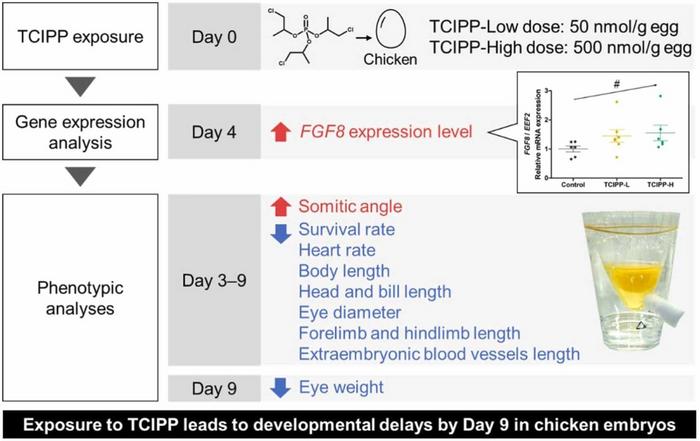
Chigusa et al Graphic Abstract

Credit: Center for Marine Environmental Studies (CMES), Ehime University

Tris(2-chloroisopropyl) phosphate (TCIPP) is one of the organophosphorus flame retardants that has been detected in the environment, and in the eggs, feathers, and liver of birds. Early developmental avian embryos are known to be sensitive to chemical exposure, but  knowledge regarding the effects of TCIPP on avian embryonic development is limited. In this study, a shell-less embryo incubation system was used to investigate the toxicity of TCIPP in early chicken (Gallus gallus domesticus) embryos.

Fertilized chick embryos were exposed to 50 nmol TCIPP/g, 500 nmol TCIPP/g, or vehicle control, dimethyl sulfoxide (DMSO) on day 0 of incubation. Embryos were observed on days 3-9 of incubation, and expression levels of several genes were measured in embryos on day 4.

Survival was significantly reduced in both groups exposed to TCIPP. Imaging analysis showed that body length, head and bill length, eye diameter, and forelimb and hindlimb length were significantly reduced in both groups exposed to TCIPP. In addition, TCIPP exposure significantly inhibited extraembryonic vascular length and red blood cell production. The heart rate decreased in a dose-dependent manner, particularly on days 4-7, and the somitic angle was significantly increased on days 4-6 in the TCIPP-exposed group, inducing asymmetrical somite formation. The significant correlation between somitic angle and FGF8 expression suggested that TCIPP exposure affects somite formation through an altered FGF signaling pathway.

These results indicate that TCIPP exposure exerts toxic effects on development, including vascularization, cardiac function, and somite formation in avian embryos.


Journal

Ecotoxicology and Environmental Safety

DOI

10.1016/j.ecoenv.2023.115445

Share12Tweet8Share2ShareShareShare2

Related Posts

Florida Cane Toad: Complex Spread and Selective Evolution

Florida Cane Toad: Complex Spread and Selective Evolution

February 7, 2026
New Study Uncovers Mechanism Behind Burn Pit Particulate Matter–Induced Lung Inflammation

New Study Uncovers Mechanism Behind Burn Pit Particulate Matter–Induced Lung Inflammation

February 6, 2026

DeepBlastoid: Advancing Automated and Efficient Evaluation of Human Blastoids with Deep Learning

February 6, 2026

Navigating the Gut: The Role of Formic Acid in the Microbiome

February 6, 2026

POPULAR NEWS

  • Robotic Ureteral Reconstruction: A Novel Approach

    Robotic Ureteral Reconstruction: A Novel Approach

    82 shares
    Share 33 Tweet 21
  • Digital Privacy: Health Data Control in Incarceration

    63 shares
    Share 25 Tweet 16
  • Study Reveals Lipid Accumulation in ME/CFS Cells

    57 shares
    Share 23 Tweet 14
  • Breakthrough in RNA Research Accelerates Medical Innovations Timeline

    53 shares
    Share 21 Tweet 13

About

We bring you the latest biotechnology news from best research centers and universities around the world. Check our website.

Follow us

Recent News

Evaluating Pediatric Emergency Care Quality in Ethiopia

TPMT Expression Predictions Linked to Azathioprine Side Effects

Improving Dementia Care with Enhanced Activity Kits

Subscribe to Blog via Email

Enter your email address to subscribe to this blog and receive notifications of new posts by email.

Join 73 other subscribers
  • Contact Us

Bioengineer.org © Copyright 2023 All Rights Reserved.

Welcome Back!

Login to your account below

Forgotten Password?

Retrieve your password

Please enter your username or email address to reset your password.

Log In
No Result
View All Result
  • Homepages
    • Home Page 1
    • Home Page 2
  • News
  • National
  • Business
  • Health
  • Lifestyle
  • Science

Bioengineer.org © Copyright 2023 All Rights Reserved.