Researchers have shown how the principles of rogue waves – huge 30-metre waves that arise unexpectedly in the ocean – can be applied on a nano scale, with dozens of applications from medicine to manufacturing.
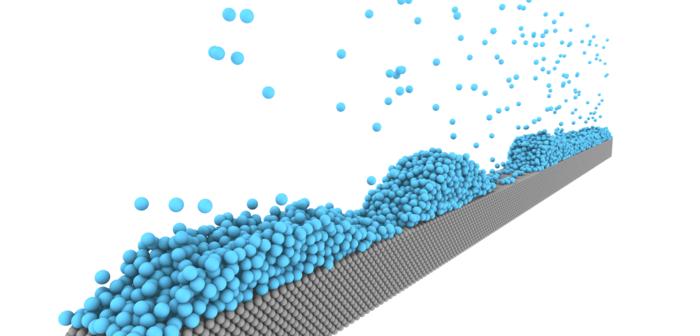
Credit: Credit: Jingbang Liu, University of Warwick.
Researchers have shown how the principles of rogue waves – huge 30-metre waves that arise unexpectedly in the ocean – can be applied on a nano scale, with dozens of applications from medicine to manufacturing.
Long considered to be a myth, rogue waves strike from comparably calm surroundings, smashing oil rigs and ships in their path. Unlike tsunamis, rogue waves form by the chance combination of smaller waves in the ocean, creating an event that is very rare.
There has been a lot of research into rogue waves in recent years but now, for the first time, scientists are showing how this can be applied on a much smaller scale – nanometrically. A nanometre is a million times smaller than the thickness of the page of a book. This is a completely new approach to the behaviour of liquids on a nanometric scale, published as a Letter in Physical Review Fluids.
The holes and bumps caused by rogue waves can be manipulated to spontaneously produce patterns and structures for use in nano-manufacturing (manufacturing on a scale one-billionth of a metre). For example, patterns formed that rupture liquid films can be used to build micro-electronic circuits, which could be used in the production of low-cost components of solar cells. Furthermore, the behaviour of thin liquid layers could help to explain why millions of people worldwide suffer from dry eye. This occurs when the tear film covering the eye ruptures.
Through direct simulations of molecules and new mathematical models, the study led by the University of Warwick’s Mathematics Institute discovered how nanoscopic layers of liquid behave in counterintuitive ways. Whilst a spilt layer of coffee on a table may sit apparently motionless, at the nanoscale the chaotic motion of molecules creates random waves on a liquid’s surface. A rare event occurs when these waves conspire to create a large ‘rogue nanowave’ that bursts through the layer and creates a hole. The new theory explains both how and when this hole is formed, giving new insight into a previously unpredictable effect, by taking their large oceanic cousins as a mathematical blueprint.
The team of researchers is excited about the potential of this research in different industries; the applications are far-reaching.
Professor James Sprittles, Mathematics Institute, University of Warwick, said: “We were excited to discover that mathematical models originally developed for quantum physics and recently applied to predict rogue ocean waves are crucial for predicting the stability of nanoscopic layers of liquid.
“In future, we hope that the theory can be exploited to enable an array of nano-technologies, where manipulating when and how layers rupture is crucial. There might also be applications in related areas, such as the behaviour of emulsions, e.g. in foods or paints, where the stability of thin liquid films dictates their shelf-life.”
Read the open access Letter here https://journals.aps.org/prfluids/abstract/10.1103/PhysRevFluids.8.L092001
Researchers have shown how the principles of rogue waves – huge 30-metre waves that arise unexpectedly in the ocean – can be applied on a nano scale, with dozens of applications from medicine to manufacturing.
Long considered to be a myth, rogue waves strike from comparably calm surroundings, smashing oil rigs and ships in their path. Unlike tsunamis, rogue waves form by the chance combination of smaller waves in the ocean, creating an event that is very rare.
There has been a lot of research into rogue waves in recent years but now, for the first time, scientists are showing how this can be applied on a much smaller scale – nanometrically. A nanometre is a million times smaller than the thickness of the page of a book. This is a completely new approach to the behaviour of liquids on a nanometric scale, published as a Letter in Physical Review Fluids.
The holes and bumps caused by rogue waves can be manipulated to spontaneously produce patterns and structures for use in nano-manufacturing (manufacturing on a scale one-billionth of a metre). For example, patterns formed that rupture liquid films can be used to build micro-electronic circuits, which could be used in the production of low-cost components of solar cells. Furthermore, the behaviour of thin liquid layers could help to explain why millions of people worldwide suffer from dry eye. This occurs when the tear film covering the eye ruptures.
Through direct simulations of molecules and new mathematical models, the study led by the University of Warwick’s Mathematics Institute discovered how nanoscopic layers of liquid behave in counterintuitive ways. Whilst a spilt layer of coffee on a table may sit apparently motionless, at the nanoscale the chaotic motion of molecules creates random waves on a liquid’s surface. A rare event occurs when these waves conspire to create a large ‘rogue nanowave’ that bursts through the layer and creates a hole. The new theory explains both how and when this hole is formed, giving new insight into a previously unpredictable effect, by taking their large oceanic cousins as a mathematical blueprint.
The team of researchers is excited about the potential of this research in different industries; the applications are far-reaching.
Professor James Sprittles, Mathematics Institute, University of Warwick, said: “We were excited to discover that mathematical models originally developed for quantum physics and recently applied to predict rogue ocean waves are crucial for predicting the stability of nanoscopic layers of liquid.
“In future, we hope that the theory can be exploited to enable an array of nano-technologies, where manipulating when and how layers rupture is crucial. There might also be applications in related areas, such as the behaviour of emulsions, e.g. in foods or paints, where the stability of thin liquid films dictates their shelf-life.”
Read the open access Letter here https://journals.aps.org/prfluids/abstract/10.1103/PhysRevFluids.8.L092001
DOI
10.1103/PhysRevFluids.8.L092001