Around one third of people with heart disease suffer from sleep problems. In a paper published in the journal Science, a team at the Technical University of Munich (TUM) shows that heart diseases affect the production of the sleep hormone melatonin in the pineal gland. The link between the two organs is a ganglion in the neck region. The study demonstrates a previously unknown role of ganglia and points to possible treatments.
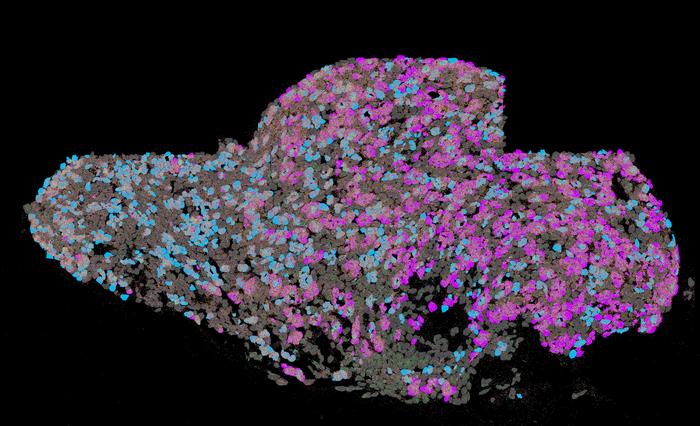
Credit: Karin Ziegler / TUM
Around one third of people with heart disease suffer from sleep problems. In a paper published in the journal Science, a team at the Technical University of Munich (TUM) shows that heart diseases affect the production of the sleep hormone melatonin in the pineal gland. The link between the two organs is a ganglion in the neck region. The study demonstrates a previously unknown role of ganglia and points to possible treatments.
The fact that melatonin levels can decrease in patients with diseases of the heart muscle, for example after a heart attack, has been known for some time. This has generally been seen as a further example of how a heart condition acts systemically on the entire body. A team working with Stefan Engelhardt, Professor of Pharmacology and Toxicology at TUM, and first author Dr. Karin Ziegler, has now shown that there is a direct cause behind sleep disturbances in people suffering from heart conditions.
Ganglia as “electrical switchboxes”
“In our work, we show that the problems with the heart muscle affect an organ that would seem at first glance to have no direct link to it,” says Stefan Engelhardt. Melatonin is produced in the pineal gland, located inside the brain. Like the heart, it is controlled through the autonomic nervous system, which regulates involuntary processes in the body. The related nerves originate in the ganglia, among other places. Particularly important for the heart and pineal gland is the superior cervical ganglion.
“To get a clear sense of our results, imagine the ganglion as an electrical switchbox. In a patient suffering from sleep disturbances following a heart disease, you can think of a problem with one wire causing a fire to break out in the switchbox and then spreading to another wire,” says Stefan Engelhart.
Nerve connection to pineal gland destroyed in mice and humans
The team discovered that macrophages – cells that eat dead cells – accumulate in the cervical ganglion of mice with heart disease. The exact mechanisms behind this are still unknown. The macrophages cause inflammation and scarring in the ganglion and the destruction of nerve cells. In mice, as in humans, long fibers extending from these nerve cells, called axons, lead to the pineal gland. At advanced stages of disease, there was a substantial decrease in the number of axons connecting the gland to the nervous system. There was less melatonin in the bodies of the animals and their day/night rhythm was disrupted.
Comparable organic effects were seen in humans. The team investigated the pineal glands in nine heart patients. Compared to the control group, significantly fewer axons were found. As with the mice, the superior cervical ganglion in the humans with heart disease showed scarring and was noticeably enlarged.
Starting point for new drugs
The researchers assume that the negative effects of the dead axons become permanent at an advanced stage. “In an early stage we were able to return melatonin production in mice to the original level by using drugs to destroy the macrophages in the superior cervical ganglion,” says Karin Ziegler. “First, this demonstrates the role of the ganglion in this phenomenon. And second, it inspires hope that we can develop drugs to prevent irreparable sleep disturbances in heart disease.” That is one of the tasks the team wishes to address in the coming years.
Investigating ganglia for other possible connections
Along with new hope for a large number of heart patients that a treatment will be found for sleep disturbances, Stefan Engelhardt sees the study as a reason to look at the ganglia from a new vantage point. “New methods such as spatial single cell sequencing make it possible to investigate individual nerve cells much more closely. Our study could prompt researchers to start systematically searching for connections between other diseases in organs linked via ganglia acting as switchboxes and to look at ganglia as starting points in the search for new drugs.”
Engelhardt believes that ganglia could also become important from a diagnostic standpoint. Because all of the cervical ganglia in the heart patients they examined were significantly enlarged, the researchers believe that this may be an indicator of heart failure. The size of the ganglion can be checked easily with a conventional ultrasound device. If the results are confirmed in further studies, it may be advisable to order more extensive checks of the heart when the ganglion is found to be enlarged.
Publication:
K.A. Ziegler, A. Ahles, A. Dueck, D. Esfandyari, P. Pichler, K. Weber, S. Kotschi, A. Bartelt, I. Sinicina, M. Graw, H. Leonhardt, L. Weckbach, S. Massberg, M. Schifferer, M. Simons, L. Hoeher, J. Luo, A. Ertürk, G.G. Schiattarella, Y. Sassi, T. Misgeld, S. Engelhardt. “Immune-mediated denervation of the pineal gland underlies sleep disturbance in cardiac disease”. Science (2023). DOI: 10.1126/science.abn6366
Further Information:
- TUM Institute of Pharmacology and Toxicology: https://ipt.med.tum.de/en
- Prof. Dr. Dr. Stefan Engelhardt: https://www.professoren.tum.de/en/engelhardt-stefan
Journal
Science
DOI
10.1126/science.abn6366
Method of Research
Experimental study
Subject of Research
Animals
Article Title
Immune-mediated denervation of the pineal gland underlies sleep disturbance in cardiac disease
Article Publication Date
21-Jul-2023
COI Statement
The TU Munich has filed a patent related to local modulation of macrophages in sympathetic ganglia for which K.A.Z. and S.E. are listed as inventors.