Between 6.4 and 5.8 million years ago, most of the land bridge that connects North and South America had already emerged and the channels connecting both Pacific and Atlantic oceans were shallow. Recent fossil discoveries in the northern Panama Canal area suggest that marine species interchange persisted across these shallow waters during the final stages of formation of the isthmus.
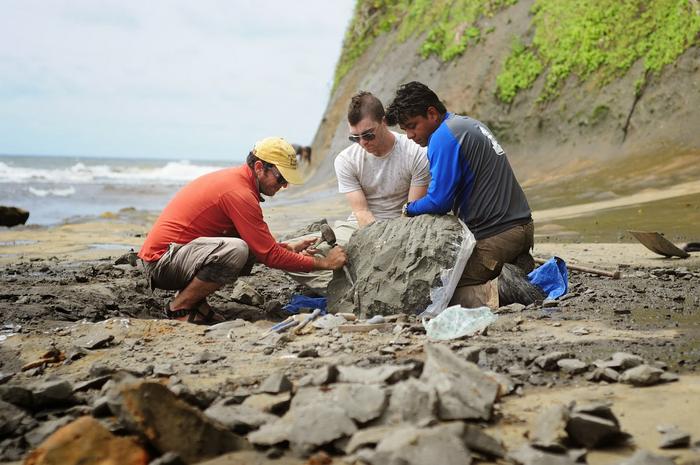
Credit: Aldo B./Jorge V./Carlos de G.
Between 6.4 and 5.8 million years ago, most of the land bridge that connects North and South America had already emerged and the channels connecting both Pacific and Atlantic oceans were shallow. Recent fossil discoveries in the northern Panama Canal area suggest that marine species interchange persisted across these shallow waters during the final stages of formation of the isthmus.
In 2017 and 2019, Aldo Benites-Palomino was studying fossils collected in Caribbean Panama, when he came across some unexpected specimens. He was a biology student in Perú, where his training had been very classical. As an intern and later a fellow at the Smithsonian Tropical Research Institute (STRI), his mindset shifted. His mentor, STRI staff scientist and paleobiologist Carlos Jaramillo, encouraged his students to change their focus when looking at fossils: instead of thinking about specimens or methods, to think about the questions that the fossils could help answer.
“I wanted to go to STRI because it is the most important tropical biology center in the world,” said Benites-Palomino. “There I was able to learn a lot about the way biology and ecology is done in the modern world.”
The fossil remains belonged to small-sized cetaceans, a group of aquatic mammals that includes whales and dolphins, and the specimens were new for the region. Most of them had been collected by Carlos de Gracia from STRI and Jorge Velez Juarbe from the Los Angeles Museum of Natural History, both co-authors in a new paper published in Biology Letters. In the article, Benites-Palomino and his colleagues go beyond describing the specimens, they also unearth the story they reveal about the isthmus’ deep past.
The fossils belonged to the Late Miocene, around 6.4 to 5.8 million years ago, when the final stages of formation of the isthmus had already started. This event affected oceanic waters and marine currents across the globe and triggered speciation events, where species separated by the land bridge developed their own unique characteristics on either ocean.
However, these cetaceans found in Caribbean Panama shared similarities with other Late Miocene species from the North and South Pacific Ocean, particularly the Pisco Formation in Peru, suggesting that some organisms were still able to disperse via the shallowing seaway at a time when deep water interchange between both oceans was no longer occurring.
The lack of fossil marine mammals from the western Caribbean has thus far hampered understanding of the region’s deep past, so these new findings help strengthen current knowledge regarding the connectivity between the Pacific and Caribbean marine faunas during the final phases of formation of the isthmus.
“The marine vertebrate fossil record of Panama has been barely explored,” said Carlos Jaramillo, STRI staff scientist and co-author of the study. “There are still many specimens that need to be studied and many more still in the rocks waiting to be found.”
Journal
Biology Letters
DOI
10.1098/rsbl.2023.0124
Article Title
Bridging two oceans: small toothed cetaceans (Odontoceti) from the Late Miocene Chagres Formation, eastern Caribbean (Colon, Panama)
Article Publication Date
21-Jun-2023