• HOME
  • NEWS
  • EXPLORE
    • CAREER
      • Companies
      • Jobs
    • EVENTS
    • iGEM
      • News
      • Team
    • PHOTOS
    • VIDEO
    • WIKI
  • BLOG
  • COMMUNITY
    • FACEBOOK
    • INSTAGRAM
    • TWITTER
Tuesday, September 1, 2026
BIOENGINEER.ORG
No Result
View All Result
  • Login
  • HOME
  • NEWS
  • EXPLORE
    • CAREER
      • Companies
      • Jobs
        • Lecturer
        • PhD Studentship
        • Postdoc
        • Research Assistant
    • EVENTS
    • iGEM
      • News
      • Team
    • PHOTOS
    • VIDEO
    • WIKI
  • BLOG
  • COMMUNITY
    • FACEBOOK
    • INSTAGRAM
    • TWITTER
  • HOME
  • NEWS
  • EXPLORE
    • CAREER
      • Companies
      • Jobs
        • Lecturer
        • PhD Studentship
        • Postdoc
        • Research Assistant
    • EVENTS
    • iGEM
      • News
      • Team
    • PHOTOS
    • VIDEO
    • WIKI
  • BLOG
  • COMMUNITY
    • FACEBOOK
    • INSTAGRAM
    • TWITTER
No Result
View All Result
Bioengineer.org
No Result
View All Result
Home NEWS Science News Biology

Marine fossils unearth story about Panama’s deep past

Bioengineer by Bioengineer
July 13, 2023
in Biology
Reading Time: 3 mins read
0
Field work Colon
Share on FacebookShare on TwitterShare on LinkedinShare on RedditShare on Telegram

Between 6.4 and 5.8 million years ago, most of the land bridge that connects North and South America had already emerged and the channels connecting both Pacific and Atlantic oceans were shallow. Recent fossil discoveries in the northern Panama Canal area suggest that marine species interchange persisted across these shallow waters during the final stages of formation of the isthmus.
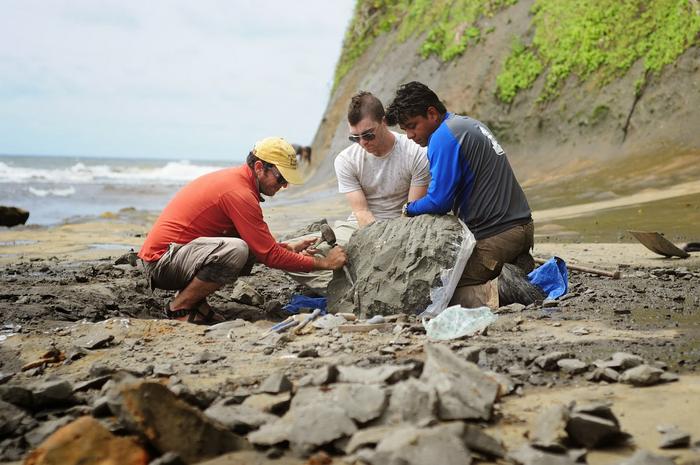
Field work Colon

Credit: Aldo B./Jorge V./Carlos de G.

Between 6.4 and 5.8 million years ago, most of the land bridge that connects North and South America had already emerged and the channels connecting both Pacific and Atlantic oceans were shallow. Recent fossil discoveries in the northern Panama Canal area suggest that marine species interchange persisted across these shallow waters during the final stages of formation of the isthmus.

In 2017 and 2019, Aldo Benites-Palomino was studying fossils collected in Caribbean Panama, when he came across some unexpected specimens. He was a biology student in Perú, where his training had been very classical. As an intern and later a fellow at the Smithsonian Tropical Research Institute (STRI), his mindset shifted. His mentor, STRI staff scientist and paleobiologist Carlos Jaramillo, encouraged his students to change their focus when looking at fossils: instead of thinking about specimens or methods, to think about the questions that the fossils could help answer.

“I wanted to go to STRI because it is the most important tropical biology center in the world,” said Benites-Palomino. “There I was able to learn a lot about the way biology and ecology is done in the modern world.”

The fossil remains belonged to small-sized cetaceans, a group of aquatic mammals that includes whales and dolphins, and the specimens were new for the region. Most of them had been collected by Carlos de Gracia from STRI and Jorge Velez Juarbe from the Los Angeles Museum of Natural History, both co-authors in a new paper published in Biology Letters. In the article, Benites-Palomino and his colleagues go beyond describing the specimens, they also unearth the story they reveal about the isthmus’ deep past.

The fossils belonged to the Late Miocene, around 6.4 to 5.8 million years ago, when the final stages of formation of the isthmus had already started. This event affected oceanic waters and marine currents across the globe and triggered speciation events, where species separated by the land bridge developed their own unique characteristics on either ocean.

However, these cetaceans found in Caribbean Panama shared similarities with other Late Miocene species from the North and South Pacific Ocean, particularly the Pisco Formation in Peru, suggesting that some organisms were still able to disperse via the shallowing seaway at a time when deep water interchange between both oceans was no longer occurring.

The lack of fossil marine mammals from the western Caribbean has thus far hampered understanding of the region’s deep past, so these new findings help strengthen current knowledge regarding the connectivity between the Pacific and Caribbean marine faunas during the final phases of formation of the isthmus.

“The marine vertebrate fossil record of Panama has been barely explored,” said Carlos Jaramillo, STRI staff scientist and co-author of the study. “There are still many specimens that need to be studied and many more still in the rocks waiting to be found.”


Journal

Biology Letters

DOI

10.1098/rsbl.2023.0124

Article Title

Bridging two oceans: small toothed cetaceans (Odontoceti) from the Late Miocene Chagres Formation, eastern Caribbean (Colon, Panama)

Article Publication Date

21-Jun-2023
Share12Tweet8Share2ShareShareShare2

Related Posts

Methylation puts parasites in motion

Methylation puts parasites in motion

August 31, 2026
Desiccation promotes DNA damage and rifampin resistance in Mycobacterium tuberculosis

Desiccation promotes DNA damage and rifampin resistance in Mycobacterium tuberculosis

August 31, 2026

Gastrointestinal Parasitism in Cattle and Water Buffaloes in Pakistan: Prevalence and Associated Risk Factors

August 31, 2026

Development of HPLC–PDA method for steviol glycosides analysis in food matrices

August 31, 2026

POPULAR NEWS

  • β-Sitosterol from Ipomoea carnea Jacq. As a promising anti-inflammatory agent: Evidence from in silico modeling and in vitro validation

    29 shares
    Share 12 Tweet 7
  • Design, fabrication and characterization of a wearable Fiber Bragg grating sensor for cardiorespiratory monitoring using finger plethysmography

    29 shares
    Share 12 Tweet 7
  • KAIST opens the era of industrial-scale microbial foods, proposing growth strategies for the next-generation protein market

    29 shares
    Share 12 Tweet 7
  • Virologist awarded $2 million NIH grant to investigate how virus-infected cells live and die

    29 shares
    Share 12 Tweet 7

About

We bring you the latest biotechnology news from best research centers and universities around the world. Check our website.

Follow us

Recent News

β-Sitosterol from Ipomoea carnea Jacq. As a promising anti-inflammatory agent: Evidence from in silico modeling and in vitro validation

Design, fabrication and characterization of a wearable Fiber Bragg grating sensor for cardiorespiratory monitoring using finger plethysmography

KAIST opens the era of industrial-scale microbial foods, proposing growth strategies for the next-generation protein market

Subscribe to Blog via Email

Enter your email address to subscribe to this blog and receive notifications of new posts by email.

Join 85 other subscribers
  • Contact Us

Bioengineer.org © Copyright 2023 All Rights Reserved.

Welcome Back!

Login to your account below

Forgotten Password?

Retrieve your password

Please enter your username or email address to reset your password.

Log In
No Result
View All Result
  • Homepages
    • Home Page 1
    • Home Page 2
  • News
  • National
  • Business
  • Health
  • Lifestyle
  • Science

Bioengineer.org © Copyright 2023 All Rights Reserved.